Is 3D Printing Strong Enough for Functional and End-Use Parts?
Page sections
Details
Yes — for most functional and end-use parts, when the material, the print orientation and the wall strategy are right. FDM parts are strong along the layers and weaker across them, so an engineer orients the part to the load, adds walls where the stress runs, and picks a grade that survives the job. Get those right and the layer-line weakness stops mattering.
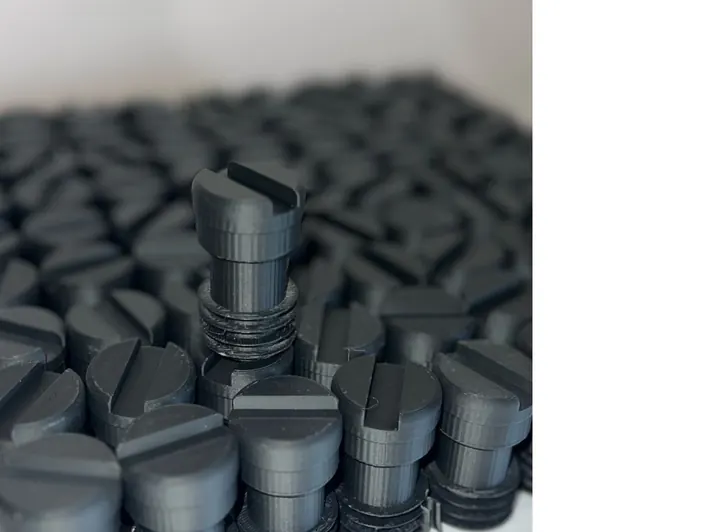
Are 3D printed parts strong? Yes — strength isn't a property of the process, it's an engineering choice you make on every part.
The honest answer to "is FDM strong enough" is almost always yes, once you understand why a printed part can be strong one way and weak another. This page is an engineer's walk through what actually sets strength — layer adhesion and anisotropy, walls versus infill, the material ladder and print orientation — plus an honest list of where FDM is the wrong tool. Not sure FDM is even the right process for your part? See which 3D printing process to use — FDM vs SLA vs SLS. Then an engineer reviews your file against its real load before it prints.

The honest answer to "are 3D printed parts strong enough?"
The reason this question feels uncertain is that the honest answer is "it depends" — and most people are told that without ever being told what it depends on. So here it is plainly: an FDM part is not a solid block of plastic. It's outer walls wrapped around an internal lattice, built up one layer at a time. Within each layer the plastic is close to full strength. Between the layers, the bond is weaker. That single fact is the whole story.
On our own calibration testing, tensile strength along the layers (the XY plane) is typically four to five times higher than across them (the Z direction), and the interlayer bond is roughly 10–25% weaker than the plastic within a layer. That's the biggest single strength variable in the part — and it costs nothing to control. You orient the part so the load runs the strong way, add walls where the stress concentrates, and choose a grade to suit. A part that snaps and a part that holds are usually the same geometry, printed by someone who did or didn't account for this.
Layer adhesion and anisotropy — why direction is everything
FDM builds a part by drawing one molten layer on top of the last. The result is strong in some directions and weaker in others. Here's what that means in practice.
- 1
Along the layers — close to full strength
Within a single layer, the molten plastic is laid down as a continuous bead and stays near its bulk strength. A load that runs along the layers — in the XY plane — is carried by solid, continuous material. This is the strong direction, and it's where you want your main load to act. On our testing it's typically four to five times stronger than the across-layer direction.
We orient for it · the part is turned so the working load runs along the layers, not across them - 2
Across the layers — the weld is the weak plane
Each new layer fuses to the one below while the plastic is still hot. That interlayer weld is real and strong, but never quite as strong as continuous plastic — roughly 10–25% weaker on our calibration testing. A load pulling the layers apart finds that plane, which is why a badly-oriented part shears cleanly along a layer line. The weakness is predictable, so it's designable-around.
We design around it · perimeters and orientation keep the across-layer load low where it matters - 3
Process control — making the weld as strong as it can be
The interlayer bond isn't fixed — it depends on how the part is printed. The right nozzle temperature, properly dried filament, tuned flow and the correct cooling all push the weld towards the top of its range. A part snapping cleanly along layers usually means a cold or under-dried print, not a limit of the material. This is exactly the discipline our calibration work exists to control.
We control it · dried filament, per-material temperature and flow tuning for the strongest weld
Walls and infill — where the strength actually lives
The single most common misconception is that strength comes from infill. It mostly doesn't. The walls — the solid perimeters — carry most real-world loads. Infill stops the walls buckling inward and adds some stiffness, but cranking it towards solid is the slow, heavy, expensive lever.
More walls plus moderate infill almost always beats thin walls plus high infill — stronger, lighter and cheaper. It's the most common saving our engineering reviews find.
Walls do the work
Adding perimeters puts solid material exactly where the stress runs — at the surface, where bending and tensile loads are highest. Extra perimeters usually add more strength than extra infill, at a fraction of the weight and time.
Infill has diminishing returns
Going from 20% to 100% infill adds a lot of grams and machine-hours for a shrinking strength gain. Past a moderate density, you're mostly buying weight. For most functional parts, 30–50% with strong walls is the sweet spot.
The pattern matters too
Gyroid and cubic infills carry load evenly in all directions; honeycomb is efficient in-plane. Matching the pattern to how the part is loaded gets more strength from the same grams. We pick it against your part's job, not a default.
Print orientation — the free strength lever
Because a printed part is four-to-five-times stronger along its layers, the single most powerful thing you can do for strength costs nothing: turn the part the right way up before it prints.
The same hook, two ways
Take a simple L-shaped bracket loaded at the tip. Print it flat, layers running along the arm, and the bending load runs along the layers — the strong direction. Print it standing up, layers stacked across the arm, and the very same load now pulls the layers apart at the corner — the weak plane — and it snaps at a fraction of the force. Identical file, identical material, identical infill. The only difference is which way it was oriented on the bed.
Why we don't leave it to a slicer default
A slicer will happily print a load-bearing part in its weakest orientation if that's how the file landed on the plate — it optimises for support and time, not for your load. An engineer reads what the part has to do, finds the working load, and orients the layers to run with it. On parts with loads in more than one direction, that's a judgement call about which load to favour — exactly the call a calculator can't make.
The material ladder — what each rung survives
Strength isn't one number — stiffest, toughest, most heat-resistant and most fatigue-resistant can be different grades. The ladder below runs from the cheapest, stiff-but-brittle rung up to the metal-replacing composites. The right choice is the lowest rung that genuinely survives your load. We print Polymaker and Fiberon filament exclusively, FDM only — chopped-fibre and thermoplastic grades, not continuous-fibre, metal, SLS or MJF.
| Material | Typical functional use | Relative strength character |
|---|---|---|
| PLA / PLA+ | Shape and fit checks, jigs, light-duty indoor parts, display pieces. | Stiff and dimensionally stable, but brittle and low-heat — snaps rather than bends; not for sustained load or warmth. |
| PETG / PETG+ | Functional all-rounder — enclosures, brackets, fittings, outdoor-ish parts. | Generally tougher and less brittle than PLA, decent layer adhesion and chemical resistance — the forgiving default for working parts. |
| ABS / ASA | Impact-prone parts, housings, automotive trim, outdoor (ASA, UV-stable). | Generally tougher and more impact- and heat-resistant than PETG; ASA adds UV stability for outdoor end-use. Needs an enclosed print. |
| PA12-CF / PA12 nylon | Load-bearing brackets, fixtures, structural housings, metal-replacement parts. | High stiffness and strength-to-weight; chopped-carbon-fibre PA12-CF can replace machined metal in suitable brackets and jigs. |
| PPS-CF | High-temperature, chemical-exposure and demanding structural end-use parts. | One of the highest service temperatures we offer — carbon-fibre PPS adds chemical resistance and high service temperature on top of composite stiffness. |
The honest summary: PLA proves the shape, PETG is the working default, ABS/ASA add toughness and weather resistance, and the carbon-fibre nylons (PA12-CF) and high-spec composites (PPS-CF) replace metal. Browse the full range on the materials hub — an engineer picks the rung against your actual load, never an upsell.
When FDM is not the answer — the honest limits
"Strong enough" has real edges, and we'd rather tell you before you commit than after a part fails. Here's where we'll point you elsewhere.
- 1
High-cycle fatigue loading
A part flexed many thousands or millions of times can find the layer interfaces and fail there over time. For safety-critical fatigue parts — live hinges under constant cycling, structural members in fatigue — FDM is usually the wrong job, and we'll say so.
- 2
Fully watertight or pressure-tight parts
Layer lines can wick liquid, so a genuinely watertight or pressurised part is hard to guarantee in raw FDM. Wall strategy, thicker perimeters and post-sealing help, but if leak-tightness is critical we'll be honest about the risk first.
- 3
Food-safe and very high volume
We do not offer food-safe printing — full stop. And once a design is frozen and you need many thousands of near-isotropic parts, injection moulding is the better buy. See 3D printing vs injection moulding for where that crossover sits — we'll flag it rather than print past it.
Every part is reviewed for its load before it prints.
That's the difference between sending a file to a print farm and sending it to us. An engineer reads what the part has to do, then sets the four levers — orientation, walls, material and process — against that load. The review is free and comes back inside 2 hours.
What the engineer review sets for strength
- Orientation to the load. The layers are turned to run along the main working load — the four-to-five-times-stronger direction — so the weak plane never sees the critical force.
- Walls where the stress runs. Perimeters are added at the stress concentrations rather than blanket high infill, putting solid material exactly where the part is loaded.
- The right rung of the ladder. The lowest material grade that genuinely survives your load — PETG for a working all-rounder, PA12-CF where it replaces metal — never an over-spec upsell.
- Process control for the weld. Dried filament, per-material temperature and tuned flow so the interlayer bond is as strong as the material allows. Used across product development and small-batch production alike.
The lesson in one line: a printed part is exactly as strong as the engineering decisions behind it. Tell us what the part has to do, and the engineer reviewing your file will make it survive that for the least sensible spend.
Send the part and the load. We'll tell you if FDM is strong enough.
An engineer reviews your file against its real-world load and returns a fixed UK quote within 2 hours — and tells you honestly if a different material, orientation or process is the answer, or if FDM isn't the right tool at all. Rated 4.9★ across 48 Google reviews.