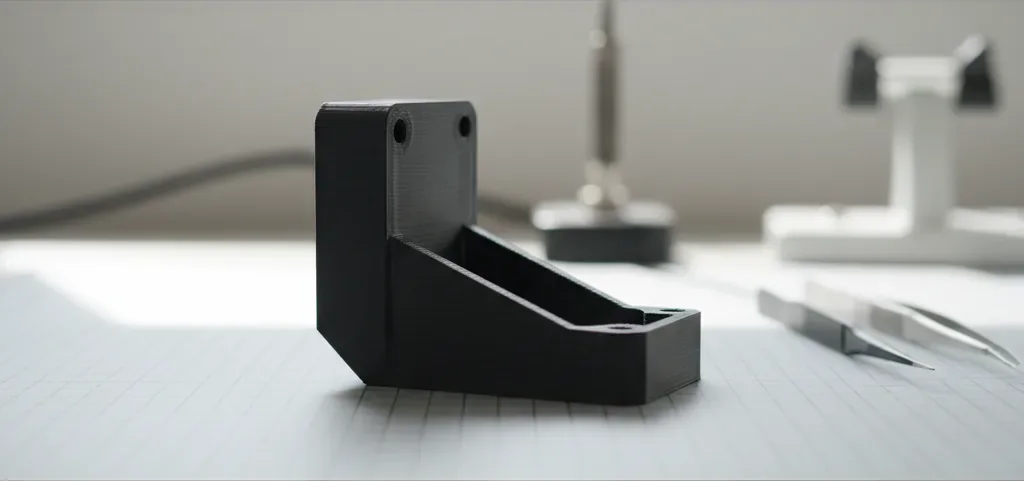
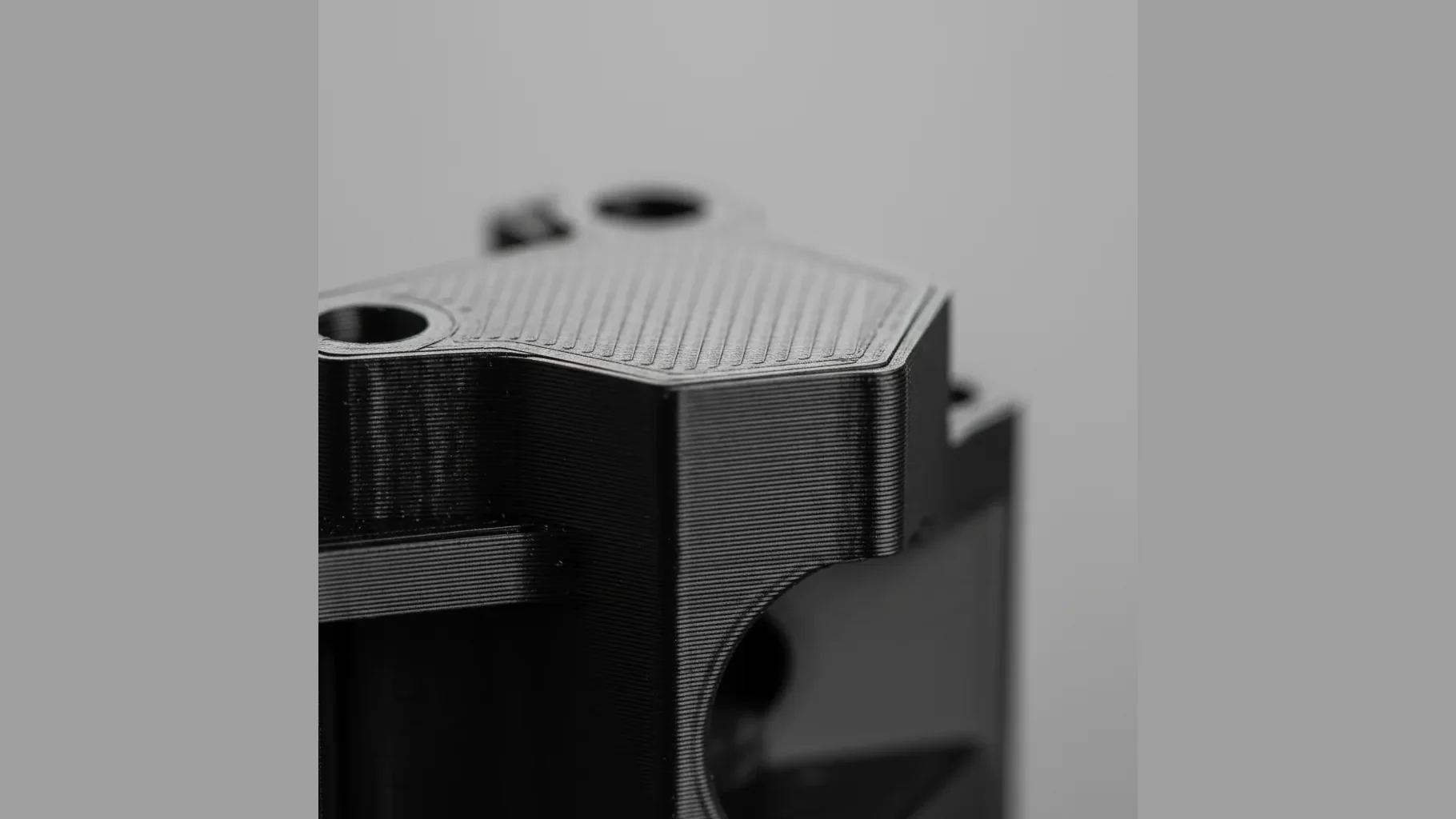
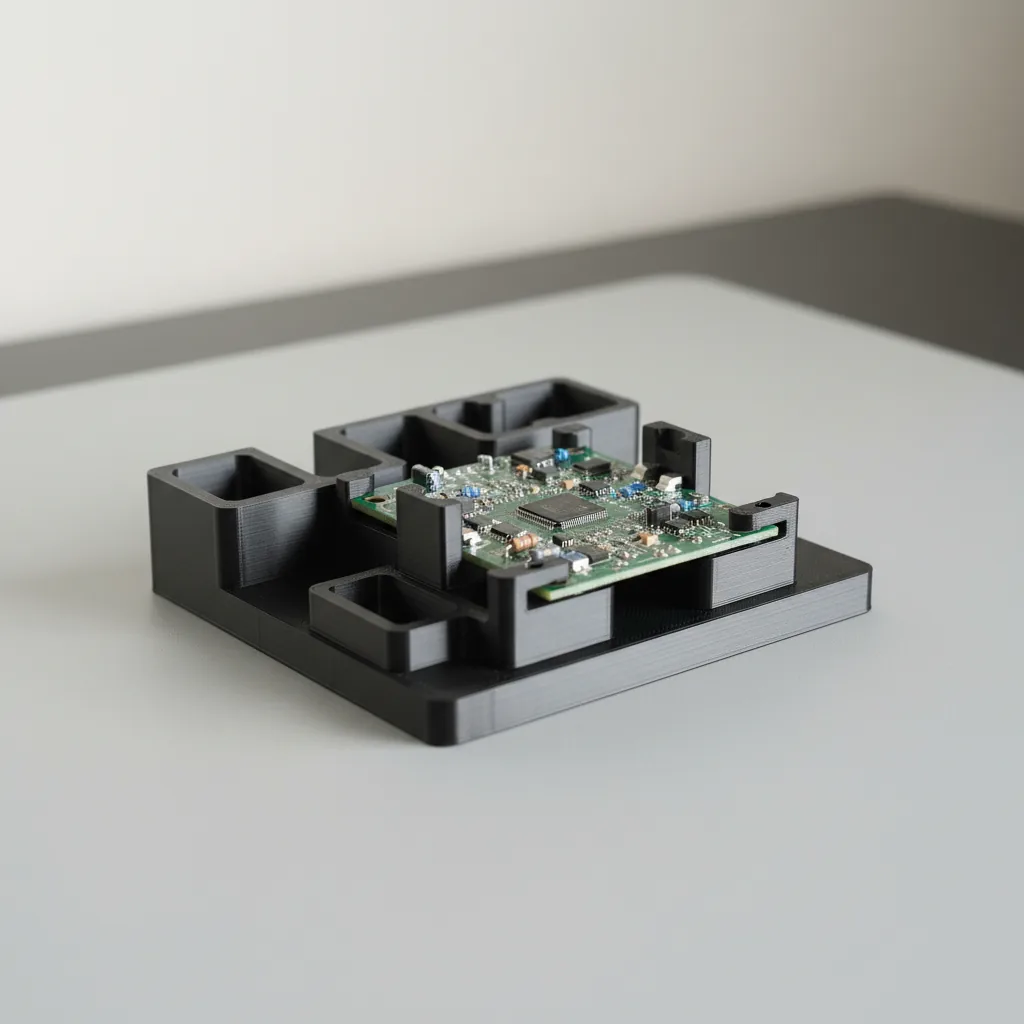
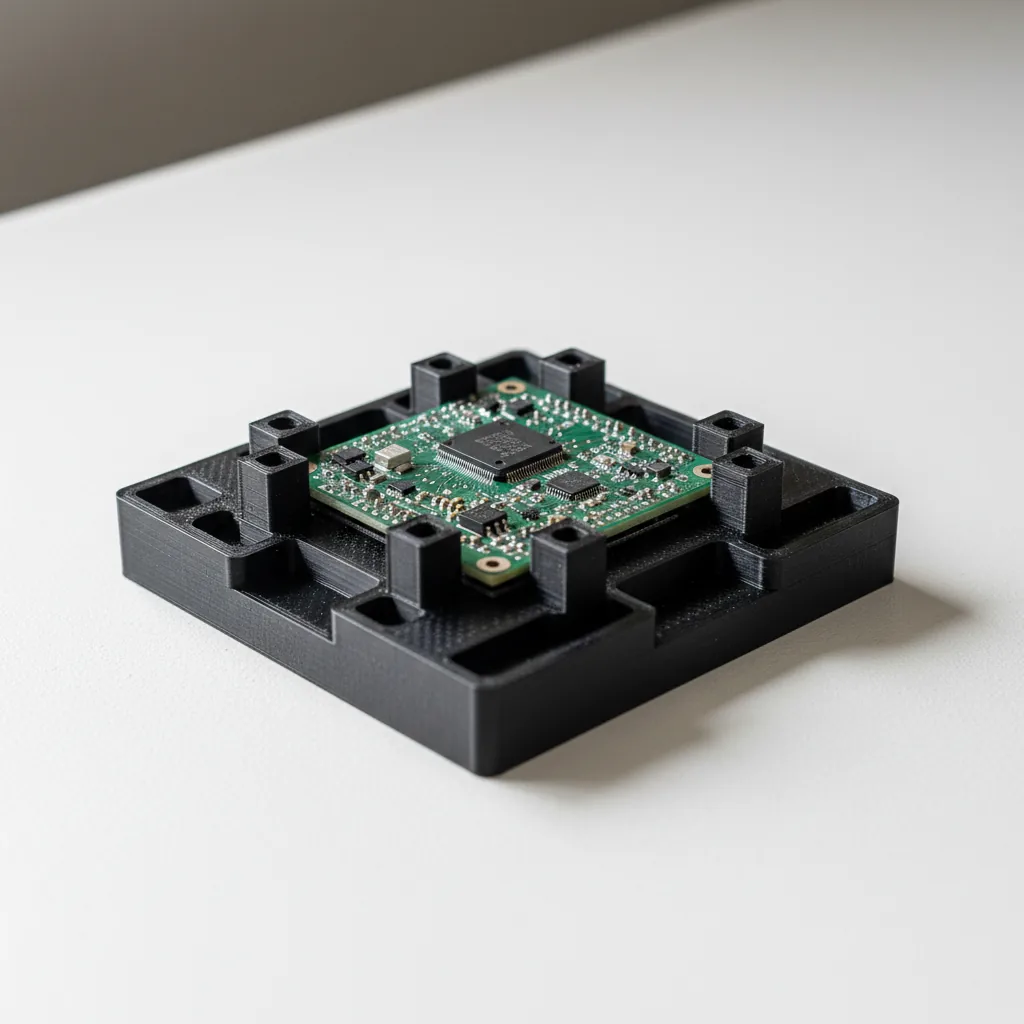
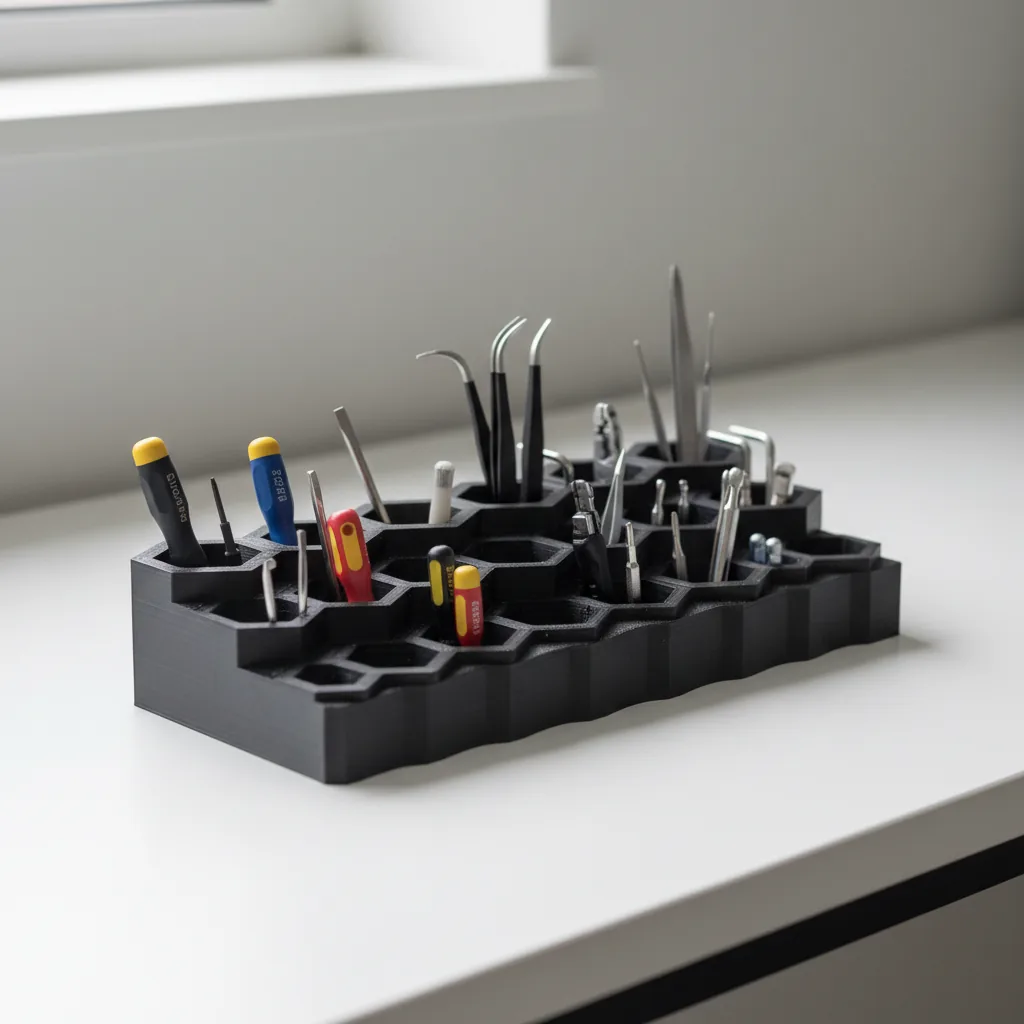
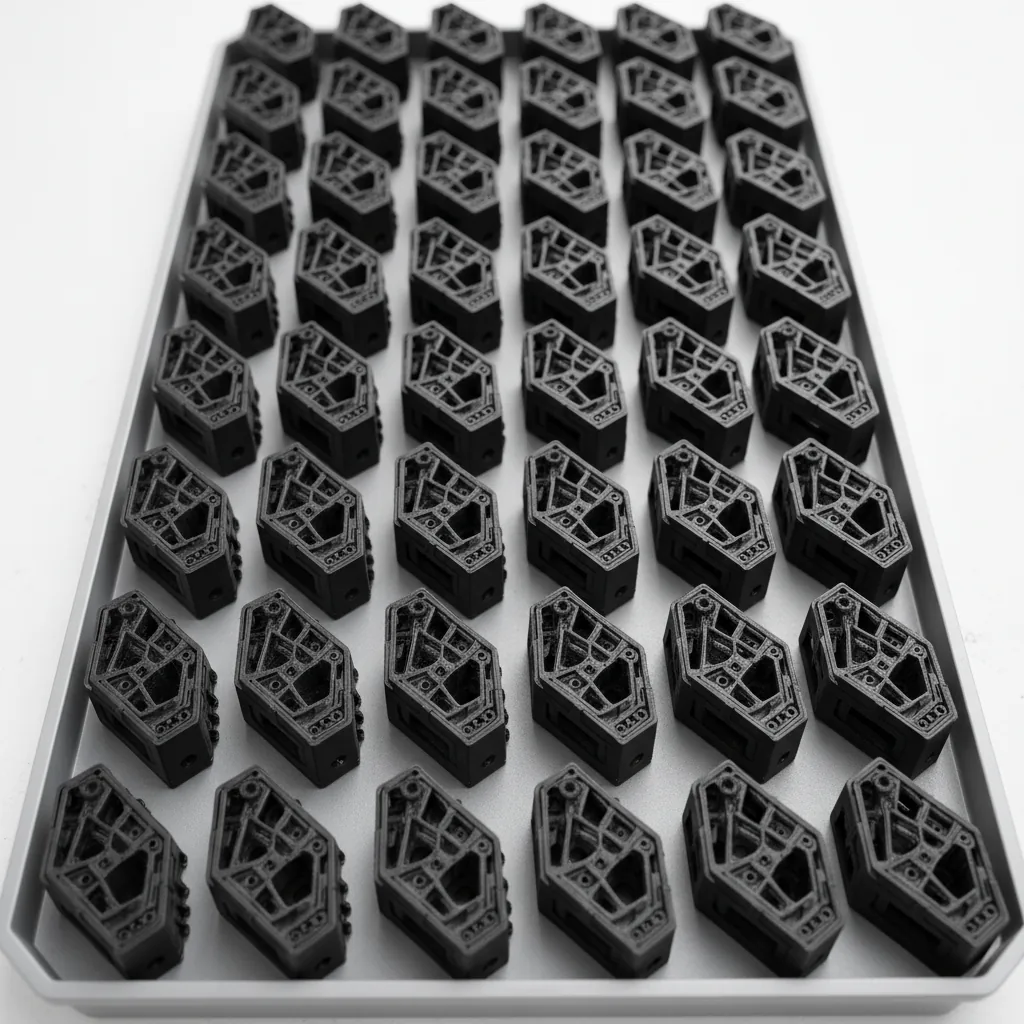
Do you recycle PETG-ESD print waste?
Yes. We run a closed loop in our own workshop. Failed prints, purge, and support waste are collected, reground, and reprocessed here instead of going to landfill. That is standard on every PETG-ESD job, no surcharge.
What does ESD-safe actually mean for a 3D-printed part?
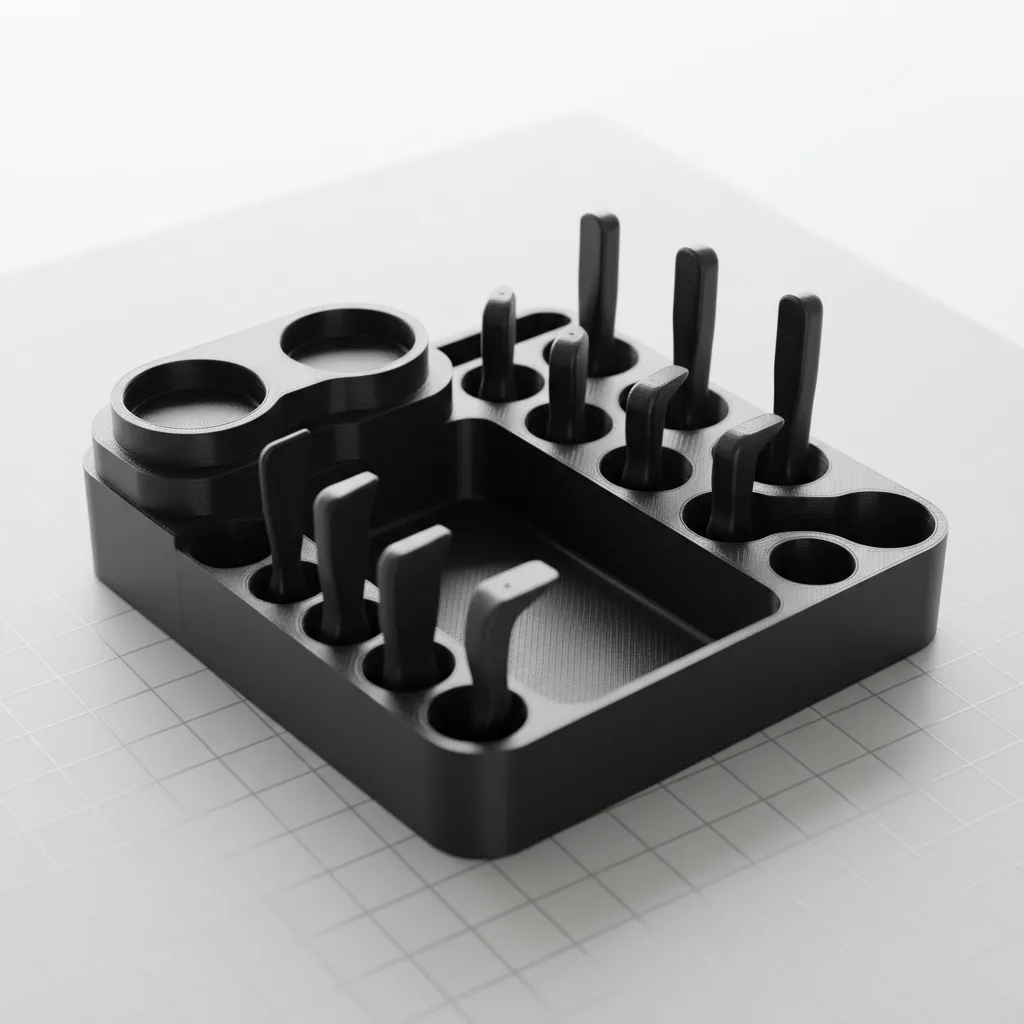
ESD-safe is a controlled-resistance band, not a binary. ANSI/ESD S20.20-2021 defines three classes by surface resistivity: conductive (<10⁴ Ω/sq), dissipative (10⁴ to <10¹¹ Ω/sq), and insulative (≥10¹¹ Ω/sq). PETG-ESD sits in the dissipative band at ~10⁵ Ω/sq when printed at our calibrated 270°C nozzle · the right band for electronics-bench tooling, jigs, fixtures, and trays. Plain PETG measures ~10¹⁴ Ω/sq · firmly insulative · and will hold and discharge static through whatever ESD-sensitive component you place on it.
Does PETG conduct electricity?
Standard PETG does not: it is an electrical insulator, at around 10¹⁴ Ω/sq surface resistivity. PETG-ESD is dissipative: printed at our calibrated 270°C nozzle it sits at around 10⁵ Ω/sq, inside the ANSI/ESD S20.20-2021 dissipative band, so it bleeds static to ground. It is not conductive class (below 10⁴ Ω/sq), so it is not a current path.
Why does the nozzle temperature affect ESD performance so much?
PETG-ESD relies on a percolation network · carbon nanotubes that physically touch through the polymer matrix to carry charge. At 250°C the polymer is too viscous · CNTs cluster and the network is patchy (resistivity drifts insulative). At 290°C polymer flow is too fluid · CNTs over-disperse and the network ends up over-percolated (conductive class, not dissipative). 270°C is the sweet spot · this is why we run every PETG-ESD job at our calibrated 270°C profile. Print a PETG-ESD spool at the manufacturer's generic 240°C and you may get a part that doesn't behave ESD-safe even though it's labelled ESD.
PETG-ESD vs PA612-ESD · which one for my part?
Service temperature is the decider. PETG-ESD: 65°C ambient max (Tg 77°C), printable on any 250°C+ FDM, ~£40-55/kg filament. PA612-ESD: 110°C continuous service, requires 280°C+ hotend and ideally a heated chamber, ~£90-130/kg filament. For room-temperature electronics-bench fixtures, jigs, IC trays, soldering stations · PETG-ESD wins on cost and ease. For under-bonnet or near-equipment fixtures that sit warm during use, specify PA612-ESD.
Is PETG-ESD as strong as plain PETG?
Slightly lower · tensile 36.1 MPa PETG-ESD vs 50.8 MPa plain PETG XY (~29% lower) and modulus 1983 vs 2117 MPa (~6% less stiff) · the CNT loading trades a little strength for the dissipative network. Notched Charpy actually improves ~2× over plain PETG (5.7 vs 2.6 kJ/m²) · the CNT toughens the matrix. The other trade-off is colour: PETG-ESD is matt black only. If you need ESD-safe AND a colour, spray with an ESD-compatible topcoat after print.
Is PETG-ESD food-contact safe? · what the CNT additive means
No. The CNT loading disqualifies PETG-ESD from food-contact applications. The base PETG resin is food-contact certifiable in plain form, but once carbon nanotubes are dispersed in the matrix, EU 10/2011 and FDA food-contact compliance no longer apply. For food-contact prototypes specify plain PETG. The chemical-resistance picture is inherited from plain PETG:
| Chemical / family | Resistance | Notes |
|---|
| Weak acids (acetic, citric, dilute organic) | Good | Manufacturer TDS rating · short-term storage |
| Strong acids (sulphuric, HCl, nitric) | Poor | Manufacturer TDS rating · polymer chain breakdown |
| Weak alkalis (dilute soap, mild bleach) | Fair | Manufacturer TDS rating · short-term only |
| Strong alkalis (caustic soda, ammonia) | Poor | Manufacturer TDS rating · ester bond hydrolysis |
| Oils and grease | Good | Manufacturer TDS rating · sustained contact OK |
| Cold water, sea water (cold) | Excellent | PET-backbone hydrolytic stability · proven in bottles |
| Hot water (sustained > 60°C) | Limited | Approaches HDT · hydrolysis accelerates over months |
| Steam autoclave (121°C) | Fails | Above HDT · parts deform · choose PEEK / PPSU |
| Detergents, soap (mild) | Good | Dishwasher-style detergents · short-cycle only (heat above 60°C is the limit) |
| Alcohols (IPA, ethanol, methanol) wipe | Good | Surface cleaning, no soak |
| Acetone, MEK (ketones) | Poor | Partial dissolution · industrial degreaser, nail polish remover |
| Toluene, xylene (aromatic hydrocarbons) | Poor | Degrades over time |
| Petrol, diesel (brief contact) | Limited | Brief OK · sustained attacks the polymer |
| Chlorinated solvents (DCM, chloroform) | Poor | Strong solvents · industrial use only, workshop hazards |
| Swimming pool chemistry (chlorine, bromine) | Limited | Short-term OK · sustained immersion attacks the polymer |
| UV exposure (UK outdoor) | Limited | 6-12 months uncoated · multi-year requires overcoat or ASA |
| Outdoor weathering (sheltered) | Good | Rain-tight under cover, hydroponic outdoor, garden irrigation |
| Food contact (base PET chemistry) | Excellent | NOT food-contact certified (CNT additive) base · printed grade needs certification + sealing for true food-contact |
First five rows are direct manufacturer TDS ratings. Remaining rows reflect industry-typical PETG behaviour and our workshop experience · brief contact is always more forgiving than sustained exposure. For sustained chemical service beyond water and oils, switch material to ABS, PA12, or PP depending on the exposure.
Does PETG-ESD warp when printing?
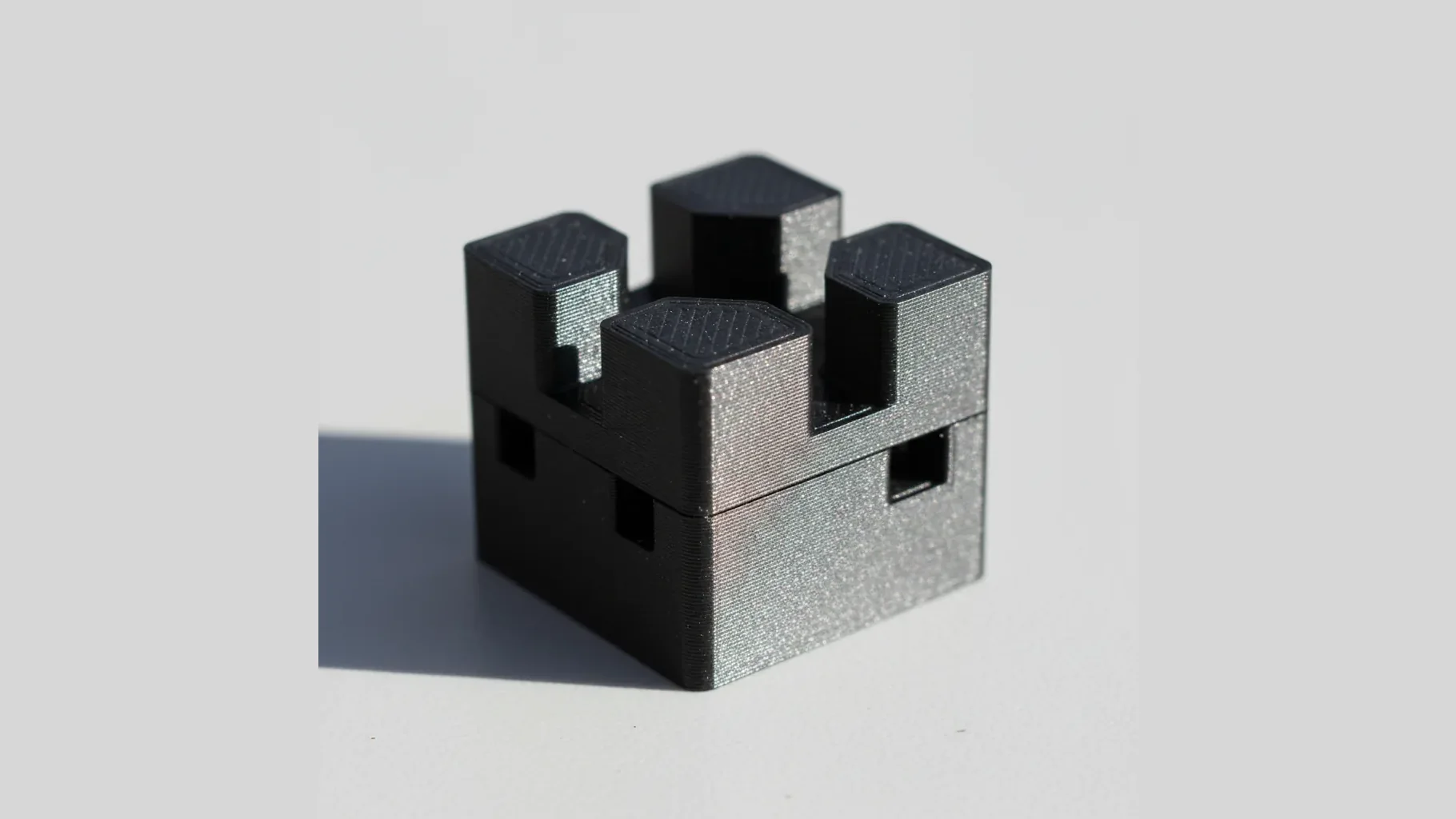
Less than ABS, slightly more than plain PETG. The CNT network increases stiffness modestly, which raises internal cooling stress slightly compared to plain PETG. Bed adhesion on PEI or textured glass is good. Large flat parts stay flat. The main print issue is wet filament producing stringing and brittle layer adhesion · this is why we dry every PETG-ESD spool at 65°C for 3 hours before printing (manufacturer setting).
Does PETG-ESD need a hardened-steel nozzle?
Yes. Carbon nanotubes are abrasive · running PETG-ESD through a standard brass nozzle scores the bore within a few hundred grams of throughput and degrades flow consistency. We use hardened-steel or tungsten-carbide nozzles for every PETG-ESD job. DIY makers using brass nozzles produce parts whose ESD performance drifts as the nozzle wears.
Can I bond PETG-ESD parts together?
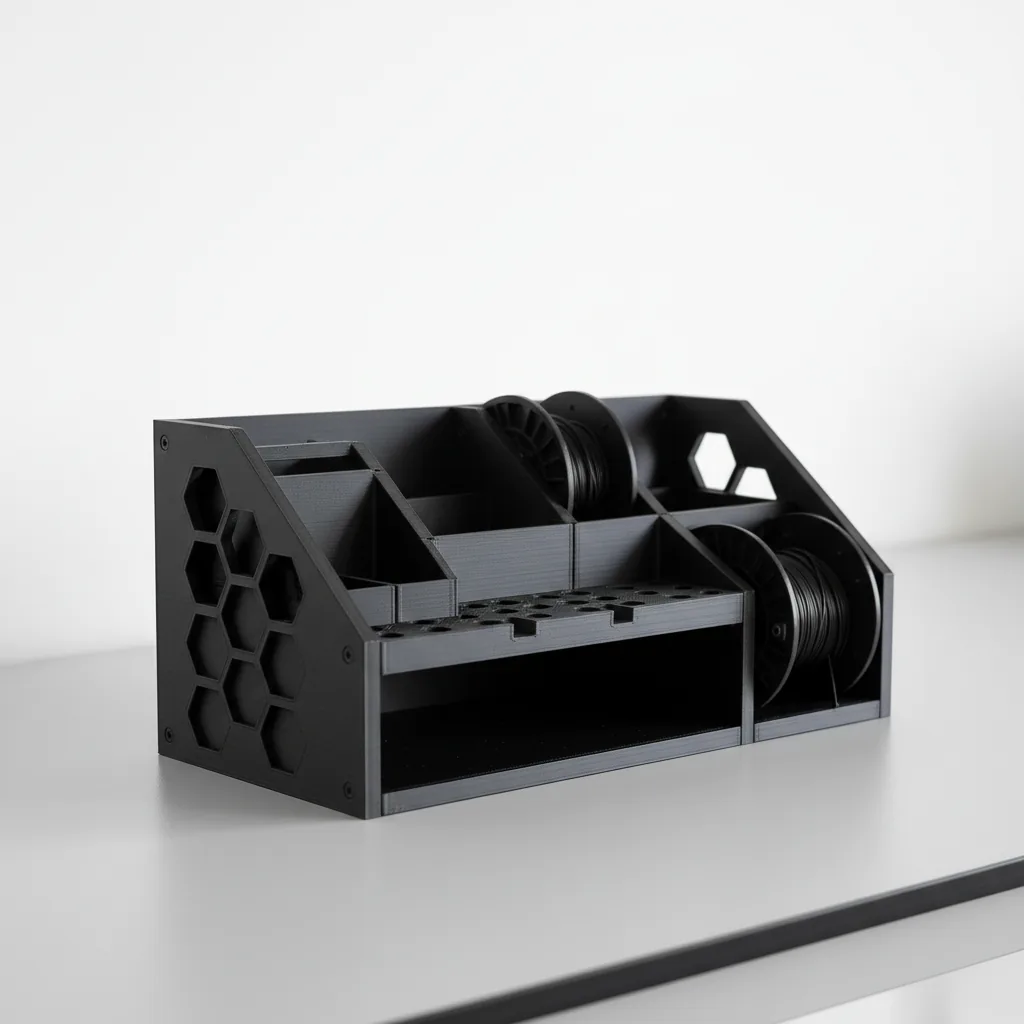
Mechanically yes, ESD-continuous-ly no. Two-part epoxy holds well · cyanoacrylate works but is weaker than on PLA or ABS. The catch: bonded joints break ESD continuity unless the adhesive is itself ESD-compatible. For multi-part ESD fixtures, design them as single-piece prints with snap-fits or heat-set inserts, or use mechanical fasteners with metal washers to maintain the ground path.
What temperature does PETG-ESD actually fail at?
Tg sits at 77°C · above this PETG-ESD softens. HDT is 76°C at 0.45 MPa and 72°C at 1.8 MPa. Vicat softening at 86°C. A PETG-ESD part in sustained service above 70°C will creep and lose dimensional accuracy. PETG-ESD won't survive a hot UK summer in direct sun, and is the wrong choice anywhere near a soldering iron tip rest. For warm-service ESD fixtures choose PA612-ESD (110°C continuous).
Why is PETG-ESD only available in black?
Carbon nanotubes are intrinsically black · the loading required to hit the dissipative percolation network (~3-5% by weight) makes any other colour impractical. The matt-black finish is actually a useful signal on a workbench: black tooling means ESD-safe, coloured tooling means not. If you need a coloured ESD-safe part, the workflow is print in PETG-ESD, then spray with an ESD-compatible topcoat (Hi-Tech 7100 or similar) that preserves the dissipative path.
How do I verify the ESD performance of a delivered part?
Surface resistivity is measured with a two-point probe (e.g. ACL Staticide 800 series) at 10V on a clean, room-temperature, 50% RH part. Reading should fall between 10⁴ and 10¹¹ Ω/sq for the dissipative class. For audited supply chains we can include a measured certificate of resistivity per part run · request this in the brief and we'll budget the QC step in the quote.
How much does PETG-ESD cost vs plain PETG?
Filament cost is roughly £40-55/kg for PETG-ESD · about 1.5 to 2× plain PETG (£25-35/kg). For typical electronics-bench fixtures that's a unit-cost adder of £3-8 per part. For a fraction of the cost of PA612-ESD (£90-130/kg) you get most of the ESD benefit, provided service temperature stays below 65°C. Send the brief with use-case and we'll quote the actual job.