PPS-CF · PEEK-grade heat and V-0 flame resistance · at a fraction of the cost.

The spec, the chemistry, the V-0 flame story, and where PPS-CF actually wins · cross-checked against the manufacturer's TDS V1.1, written by the team that prints it.

Reviewed by the 3D Printing Express engineering team.

PPS-CF high temperature 3D printing service · UK · quoted in 6 hours.

Holds its shape past 250°C and resists fuels, acids and solvents · self-certifiable V-0.

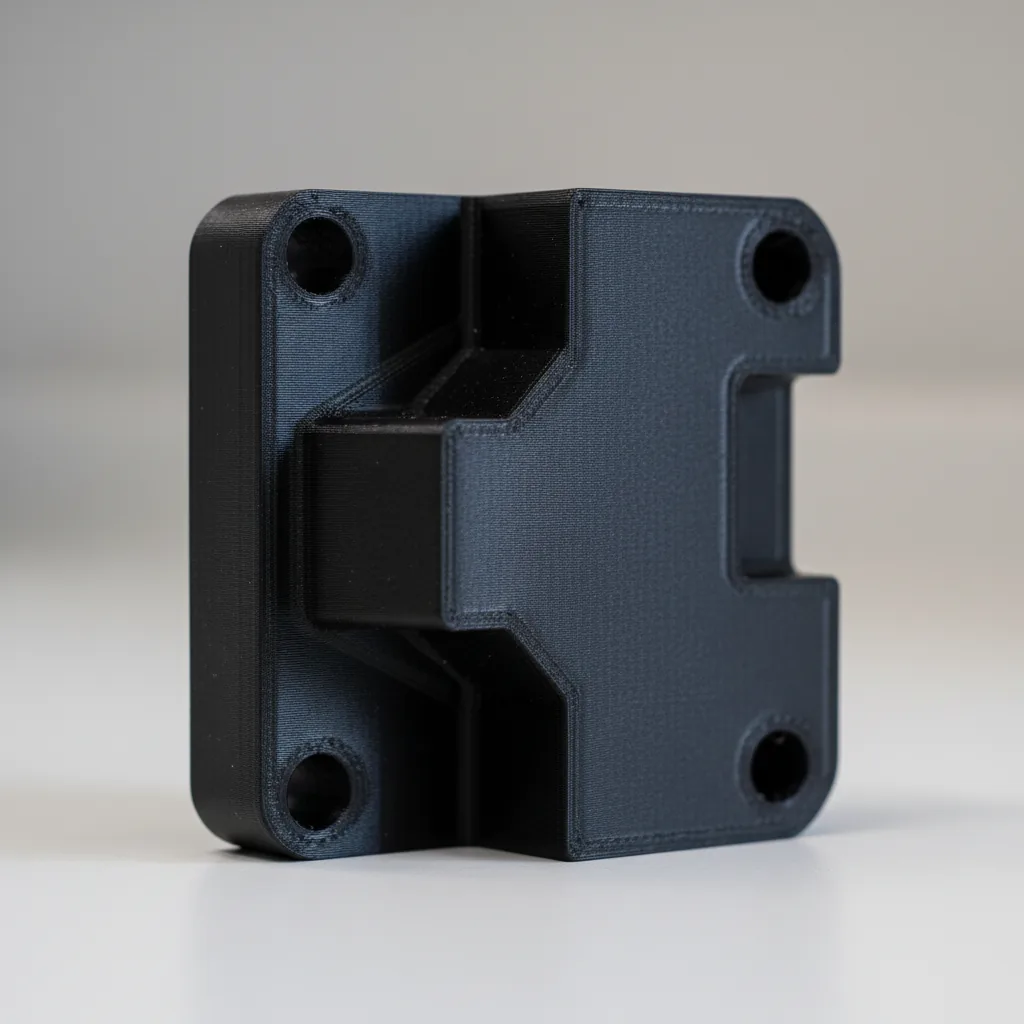
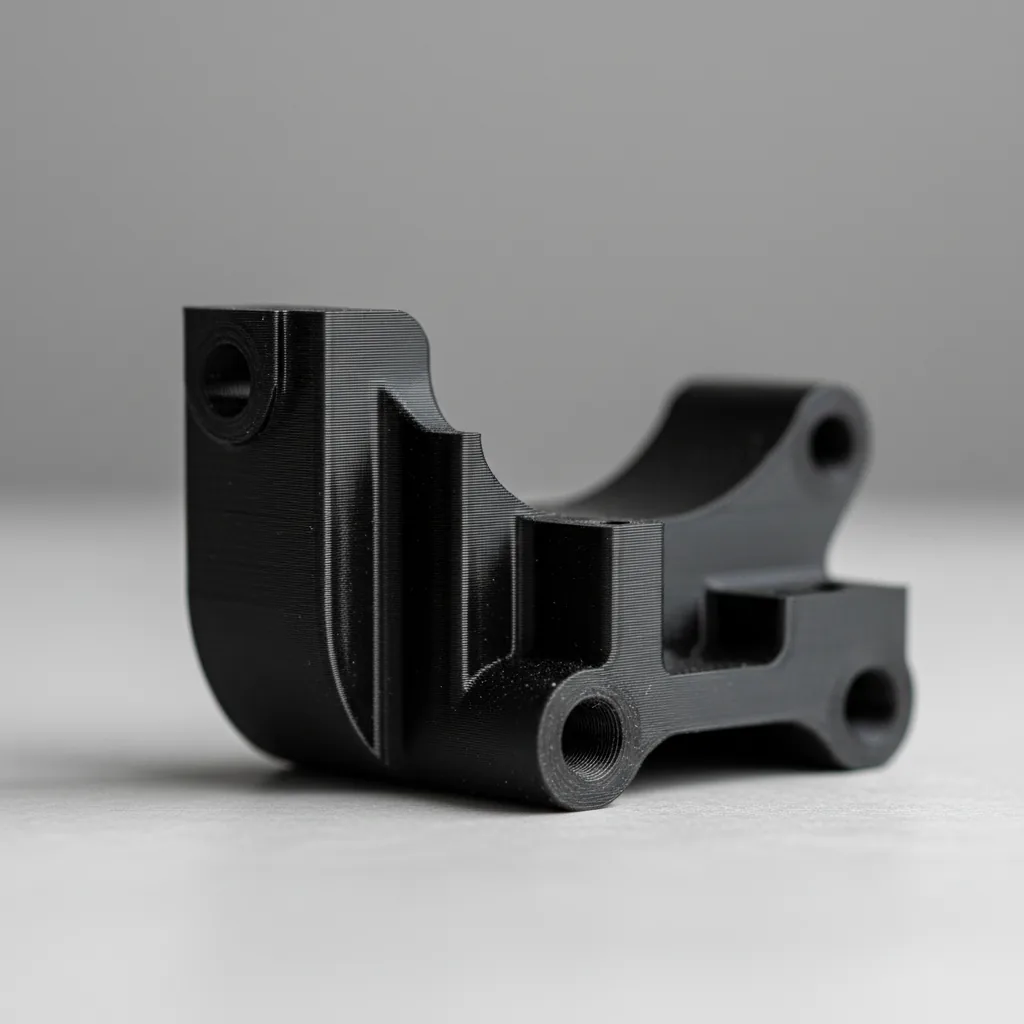
Macro photo of a 3D-printed PPS-CF carbon-fibre PPS composite engineering bracket
Process · FDM
This page covers FDM PPS-CF10 · 10% carbon-fibre PPS composite filament printed on industrial FDM machines (room-temperature chamber, 80-90°C bed, hardened-steel nozzle at 310-350°C, post-print 125°C / 16h anneal recommended). If you need peak stiffness in PET family (PET-CF), impact toughness (PA12-CF), UV outdoor tolerance (PA612-CF or ASA), or sustained service above 200°C (PEEK · third-party), send your brief and we'll advise on the right process.
The short version

PPS-CF · the short version

Got 1 minute

The quick version.

Great for
  • The highest heat we print.Holds its shape past 250°C, for under-bonnet, aerospace fluid-handling and high-temperature fixtures.
  • Flame-rated and chemical-proof.UL94 V-0 rated and resistant to fuels, acids, bases and solvents.
  • Stable in the worst conditions.The driest grade we ship, holding tolerance where others swell.
! Worth knowing
  • Premium price.Several times the cost of CF nylons, so it's for when the heat or flame rating is essential. Don't need 250°C? See PA6-CF.
  • Lower impact, matt black only.The trade for thermal performance is reduced impact toughness.
Not sure PPS-CF is right for your part? Send your brief → and we'll match the right material.
Got 5 minutes

How PPS-CF behaves, visually.

Four quick visuals. Start with which material to pick and where PPS-CF works; the engineering detail is at the end if you want it.

Which to pick

When PPS-CF, and when to switch.

Pick PPS-CF

Stiffness-critical fixtures in humid service · dimensional jigs that hold tolerance through humidity cycles · electrical insulators · hydrocarbon-resistant brackets

Pick another

Impact toughness = PA12-CF · UV outdoor = PA612-CF / ASA · flame V-0 = PPS-CF · ESD = PETG-ESD / PA612-ESD · 200°C+ = PPS / PEEK

Where it works

Holds shape past 250°C.

  • Humid workshops / outdoor
  • Petrol, diesel, oils, alcohols
  • Dimensional fixtures, jigs
  • Steam autoclave (repeated)
  • Strong acids · hot caustic
  • Impact-loaded thin walls
What it is

PPS plus chopped carbon fibre.

PPS's repeating aromatic ring plus sulfide linkage is the same backbone behind industrial chemical-plant piping. Far fewer water-attackable sites than nylon amide chains · 0.225% equilibrium water absorption. CF aligns with extrusion · drives 1.86× XY/Z anisotropy.

For engineers
Mechanical character

Heat and flame first, along the layers.

1.86× tensile XY/Z (59.4 / 32.0 MPa) · moderate by composite standards (higher than PA12-CF 1.48× and PET-GF 1.24×, lower than PET-CF 2.36×). Plan orientation in CAD before slicing · the rigid PPS matrix carries less Z-axis load than the more compliant nylon matrices.

What clients say about our UK 3D printing service on Google

4.9 based on 36 Google reviews
Read all 36 on Google →
Jonny Higgs
· 2 months ago · via Google

"James handled the 3D printing for a functional heat resistant component we needed in batch production. He helped dial in the prototype first with their design service, then produced the final batch with really consistent results. Super fast 3D print turnaround and great quality across all the 3D printed parts. Will 100% be coming back."

Matt Shutler
· 8 months ago · via Google

"We needed a sit-in F1-car for an exhibition to showcase our new racing game. 3D Printing Express took our CAD, optimised it for strength and weight as we had no idea how it all worked! Turned out beautifully. They colour matched the finish and was looking like the real deal. On show day the cockpit ran non-stop, adults and kids jumped in. Multiple visitors asked who built it."

Kayleigh Adams
· 7 months ago · via Google

"We ordered a batch of 100 PA-12 parts from 3D Printing Express and could not be happier. Every part arrived consistent, dimensionally accurate, and ready for use straight from the box. The PA-12 gave us the strength and stability we needed for functional testing, with minimal post-processing required. Delivery was on time, communication was excellent, and their QC clearly made a difference."

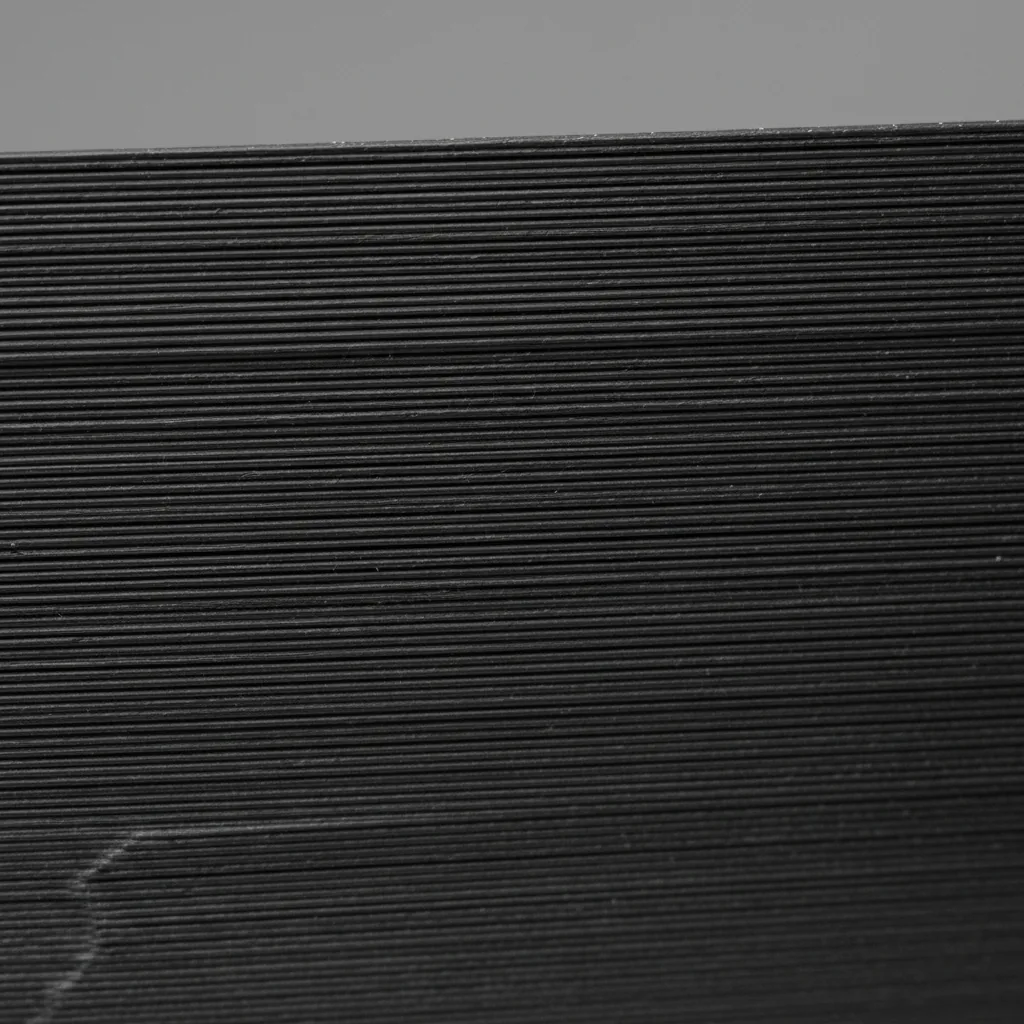
Extreme macro of the surface of a deep matte black 3D-printed PPS-CF part: uniform fine matte carbon texture with clearly visible horizontal layer lines and a subtle satin sheen
The four numbers engineers scan first

The short answer before the spec sheet.

UL94 flame rating
V-0

Our highest-temperature V-0 grade (PETG-V0 covers V-0 at lower temperatures) · for electrical, transportation, and aerospace self-certification work. PA-CF nylons and PET-CF are all HB-rated.

UL 94 · V-0 at 1.5mm
HDT · 0.45 MPa (annealed)
252.5°C

Highest HDT in our composite range · 60°C above PA6-GF, 121°C above PA12-CF, 105°C above PET-CF. Sustains 133°C under 1.8 MPa structural load. PEEK-adjacent territory.

ISO 75 · 252.5°C @ 0.45 MPa, 133°C @ 1.8 MPa
Water absorption · equilibrium
0.225%

Lowest in our entire range · below PET-GF (0.32%), PET-CF (0.53%), PA12-CF (1.5%). Holds dimensions indefinitely through any humidity.

TDS V1.1 absorption curve · 70% RH, 23°C
Young's modulus · XY
5447MPa

Engineering-grade stiffness comparable to PET-CF (5447 vs 5481 MPa) · 65% stiffer than PA12-CF. Combined with V-0 flame and 252°C HDT, no other commodity composite covers this performance envelope.

ISO 527 · 5447 ± 149 MPa post-anneal 125°C / 16h
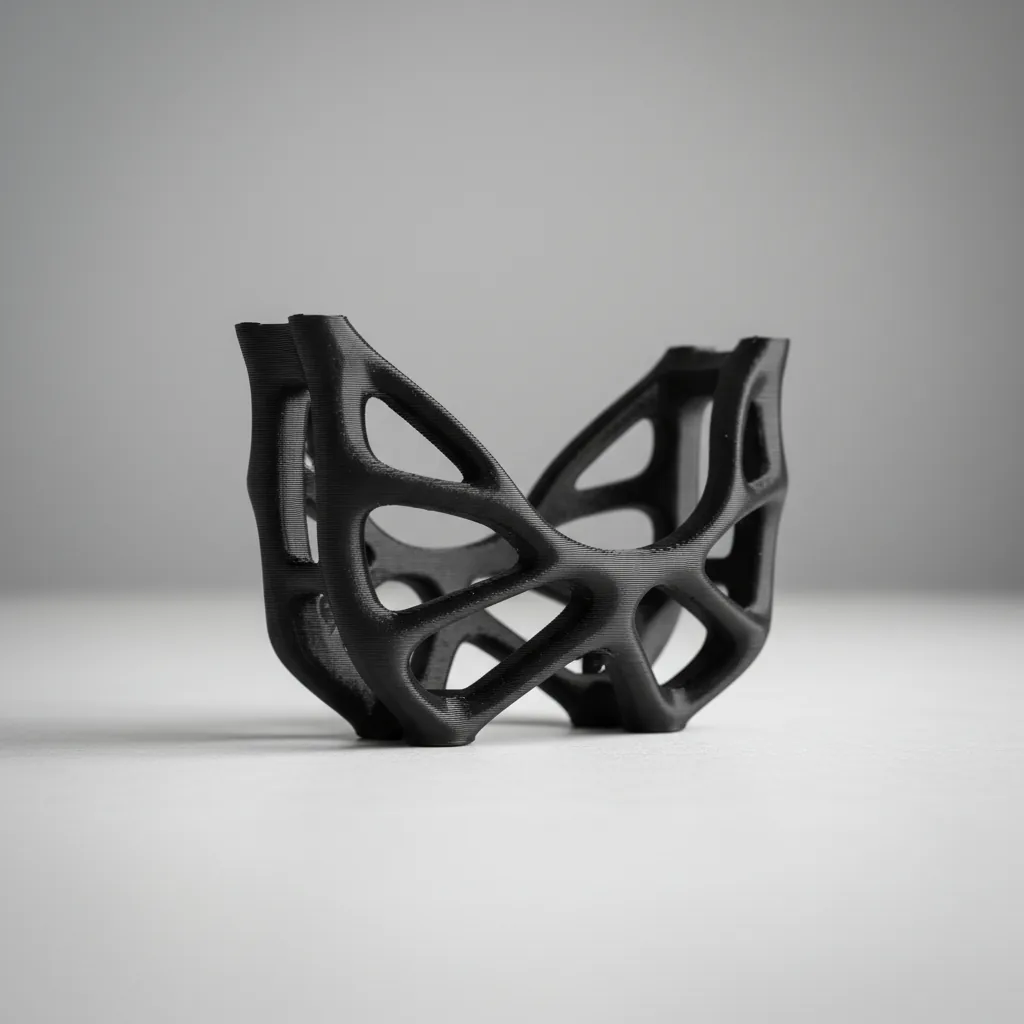
A 3D-printed PPS-CF topology-optimised lightweight bracket with stress-led ribbing
Perfect for

Where PPS-CF is the right call.

The use cases where PPS-CF earns its place · UL94 V-0 self-certification, 200°C+ continuous service envelope, broad chemical resistance, and a printable lead time when PEEK-class hardware or cost can't be justified.

Honest limits

Where PPS-CF is the wrong call.

Engineering materials are bought on what they can do · sold on what they can't. Pick a different filament if any of these apply to your part.

What people actually print in this

Four industries that order PPS-CF by name.

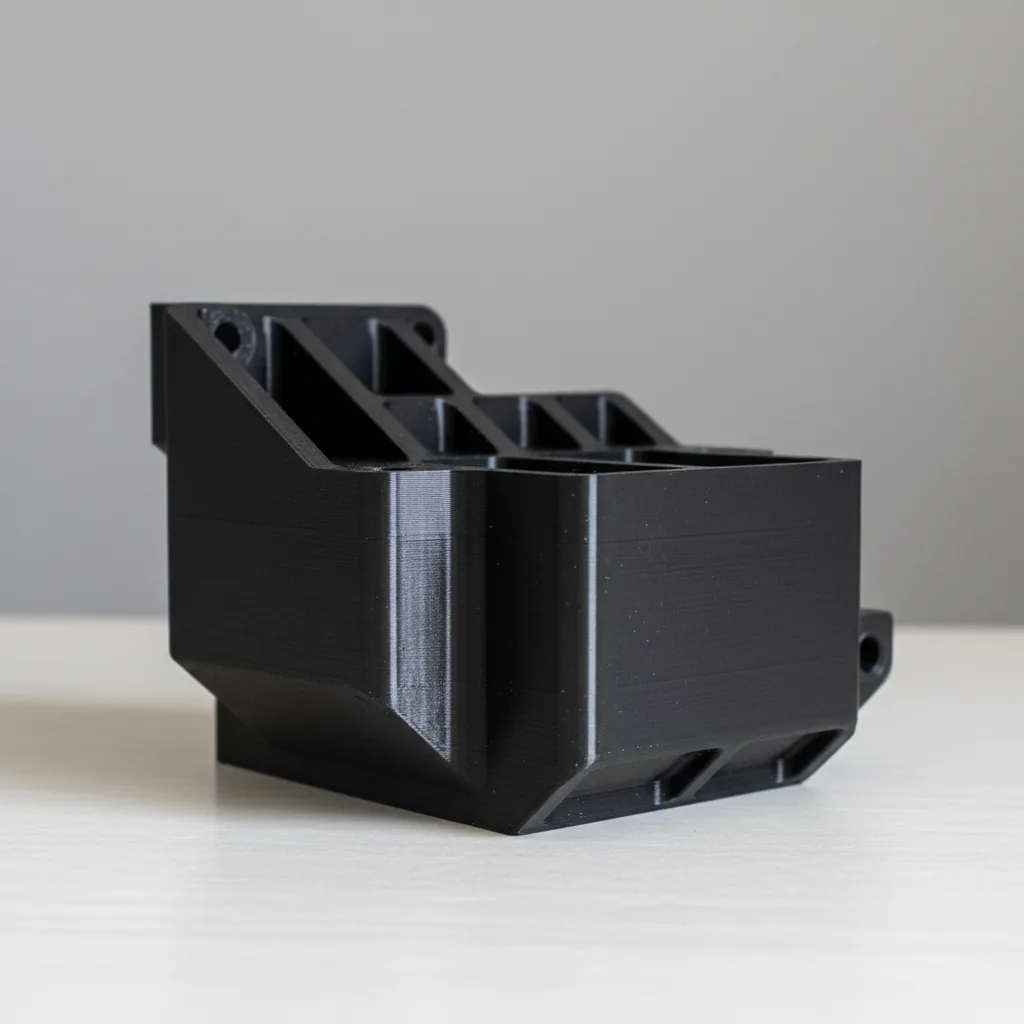
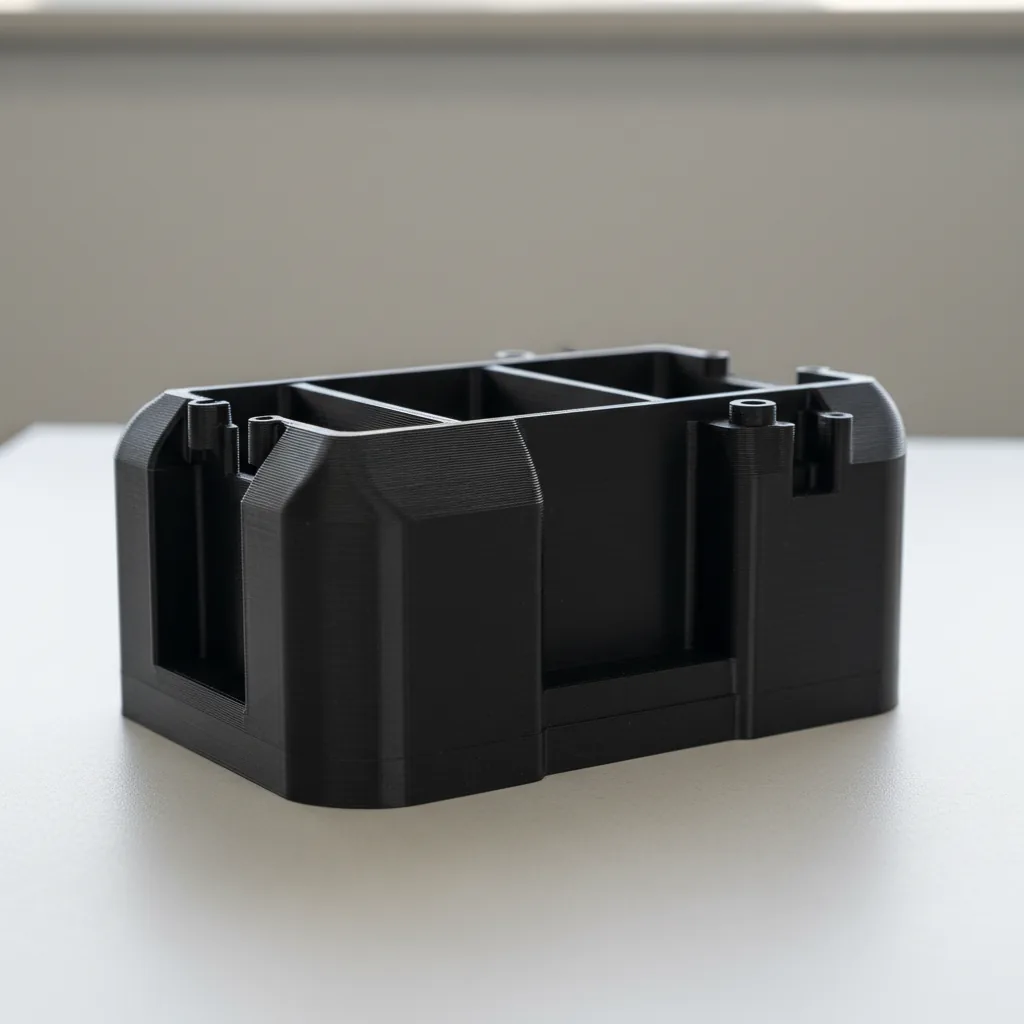
A 3D-printed PPS-CF EV battery-pack structural bracket
EV · battery

Battery module brackets, cell-holder fixtures, busbar mounts

V-0 flame rating + 252°C HDT + low moisture + dimensional stability is exactly the property profile EV battery packs need. The Warp-Free additive package allows large-format printing without PEEK-class chamber heating · cost-effective vs PEEK alternatives.

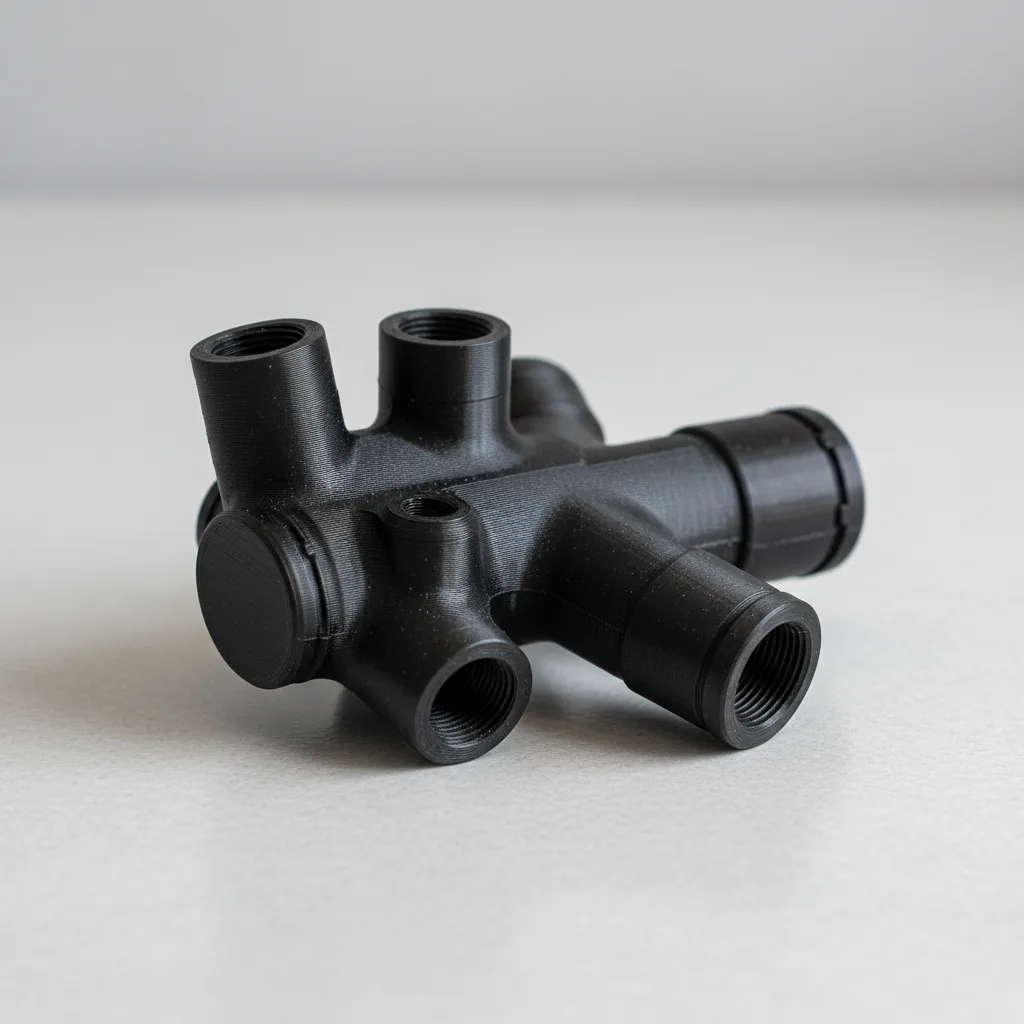
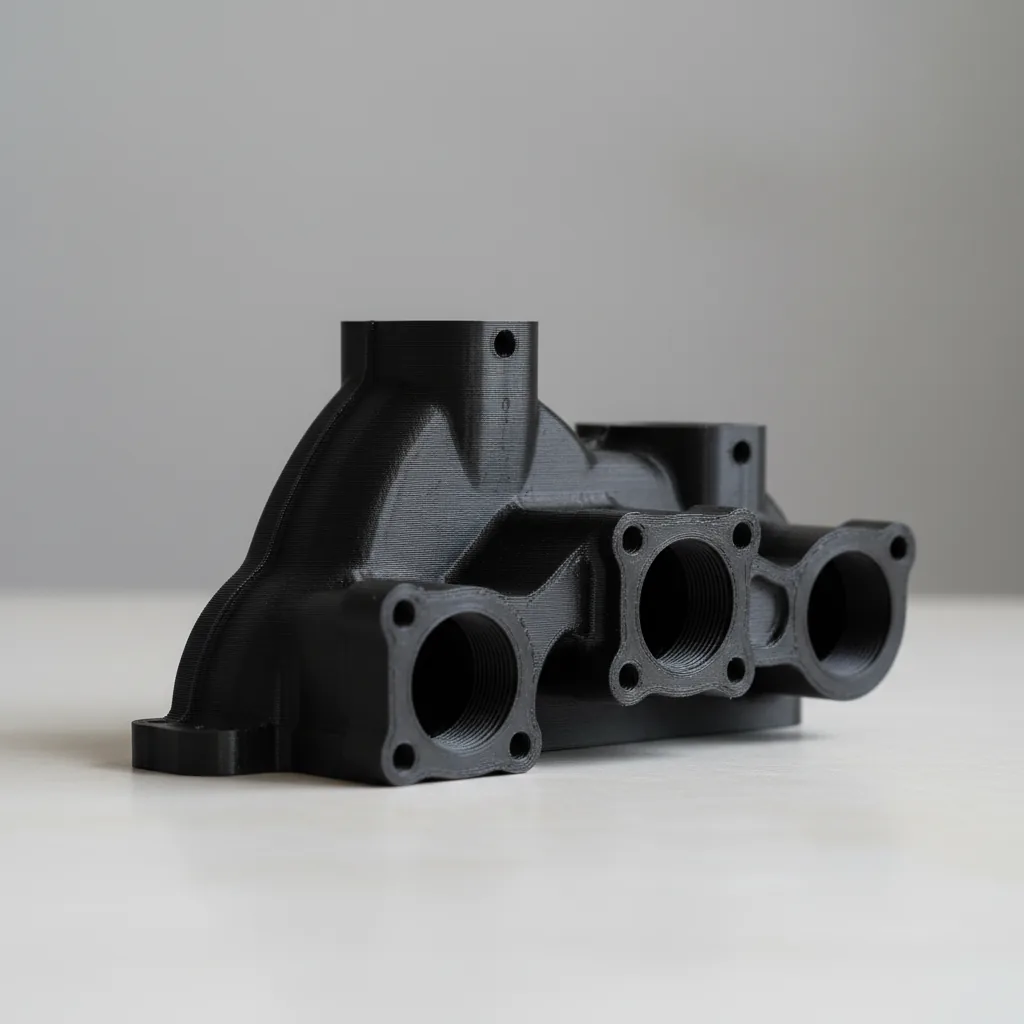
A 3D-printed PPS-CF aerospace fluid-handling manifold fitting
Aerospace · fluid handling

Non-flight-critical brackets, fluid-handling fixtures, cabin interior parts

PPS is the engineering polymer used commercially for aerospace fluid-handling. V-0 flame rating covers cabin interior self-certification (FAR 25.853 categories). CF reinforcement adds the structural stiffness needed for non-flight-critical brackets and mounts.

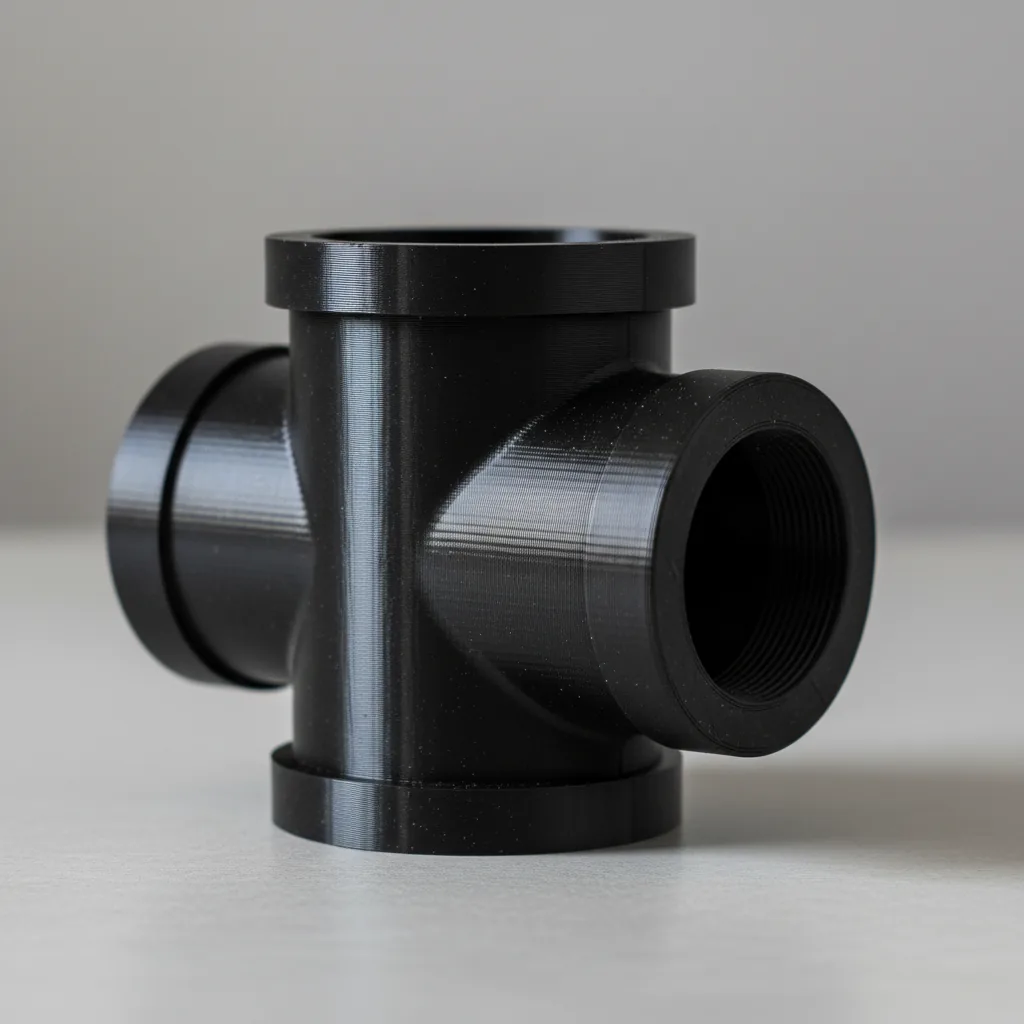
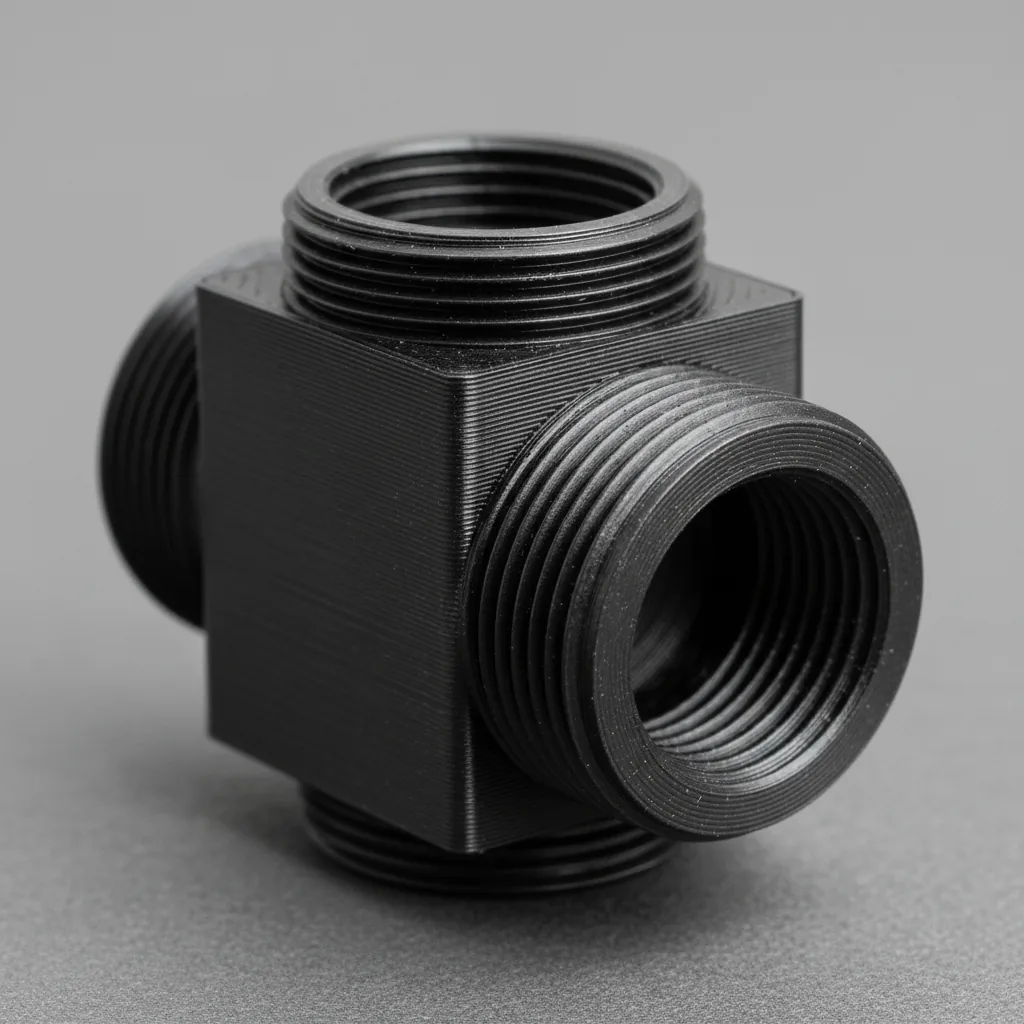
A 3D-printed PPS-CF chemical-plant valve and pipe fitting component
Oil-and-gas · chemical-plant

Downhole tooling, chemical-line fixtures, valve internals, process tooling

PPS resists petrol, diesel, alcohols, aqueous acids, aqueous bases, most organic solvents, and oils up to 200°C. Used industrially for chemical-plant piping and downhole tooling. For applications where chemical resistance is the defining brief, PPS-CF is the FDM analogue.

A 3D-printed PPS-CF semiconductor cleanroom tooling fixture
Semiconductor · cleanroom

Wafer handling jigs, vacuum-furnace fixtures, cleanroom hardware

Low outgassing, chemical-resistant, 252°C HDT, and V-0 flame make PPS-CF the cleanroom-friendly engineering composite. Used for non-conductive wafer carriers, semiconductor process-tool fixtures, and adjacent tooling that needs to survive elevated-temperature etch and clean cycles.

A stack of black carbon-fibre PPS composite filament spools on a shelf
Decision helper

PPS-CF vs PA12-CF vs PEEK · the high-performance composite triangle.

A side-by-side of PPS-CF against the impact-toughness workhorse (PA12-CF) and the gold-standard high-performance reference (PEEK · not 3DPE-stocked, literature values shown). PPS-CF wins on cost vs PEEK and on thermal/flame vs PA12-CF; PEEK wins on continuous-service ceiling; PA12-CF wins on impact + price.

PPS-CF vs PA12-CF vs PA6-CF · headline metric comparisonPPS-CF vs PA12-CF vs PA6-CF · stiffness, water absorption, HDT, anisotropy and cost per kg PPS-CF (here) PA12-CF PEEK (3rd-party) ★ winner STIFFNESS · YOUNG'S MODULUS XY · MPa 0 5000 10000PPS-CF 5447 PA12-CF 3311 PEEK-CF ~12000 ★WATER ABSORPTION · % EQUILIBRIUM · lower = humidity-stable 0% 1% 2%PPS-CF 0.225% PA12-CF 1.5% PEEK-CF ~0.12% ★HEAT DEFLECTION · HDT @ 0.45 MPa · °C 0 150 300°CPPS-CF 252.5 ★ PA12-CF 131 PEEK-CF ~280IMPACT TOUGHNESS · CHARPY NOTCHED XY · kJ/m² · the stiffness trade 0 15 30 kJ/m²PPS-CF 5.3 PA12-CF 9.9 ★ PEEK-CF ~7COST PER KG OF FILAMENT · £ · lower = lower-cost 0 300 600 £/kgPPS-CF £110-180 PA12-CF £90-130 ★ PEEK-CF £400-600

PPS-CF values from the manufacturer's PPS-CF10 TDS V1.1 (ISO 527, ISO 75, ISO 178, ISO 1183 · post-anneal 125°C / 16h). PA12-CF values from PA12-CF10 TDS. PEEK-CF values are illustrative literature averages for 10-15 wt% CF PEEK grades · 3DPE does not stock PEEK · listed for reference only.

PropertyPPS-CF (here)PA12-CFPEEK-CF (3rd-party)
Base polymerSemi-crystalline PPS (polysulfide)PA12 (long-chain nylon)PEEK (polyether-ether-ketone)
Tensile strength XY59.4 MPa77 MPa~100 MPa
Stiffness (Young's modulus XY)5447 MPa3311 MPa~12000 MPa
Heat deflection (HDT 0.45)252.5°C131°C~280°C
Heat deflection (HDT 1.8)133°C~80°C~250°C
Continuous service ceiling~200°C~90°C~250°C
UL94 flame ratingV-0 at 1.5mmHB at 1.5mmV-0 at 1.5mm
Equilibrium water absorption0.225%1.5%~0.12%
Heated chamber required?No · room temp, 80-90°C bedPreferredRequired · 120-150°C chamber + 200°C bed
Hotend temperature310-350°C260-290°C410-450°C · specialised hotend required
Cost per kg (filament)£110-180£90-130£400-600+
Best forV-0 self-cert, 200°C+ service, EV battery, aerospace cabin, chemical-plant toolingImpact-loaded brackets, balanced strength + ductility, general engineeringSustained service above 220°C, aerospace flight-rated parts, medical implants
If your row has a star, that's the right column · otherwise PPS-CF is the right pick when you need V-0 flame and 200°C+ HDT on standard FDM hardware, at a fraction of PEEK cost. Send your brief and we'll confirm.

FDM PPS-CF (this page) vs SLS PA12 · which process?

The other common engineering-composite process decision. SLS is a different machine entirely · different base polymer, near-isotropic strength, different cost structure. Pick the row that matches your job.

PropertyFDM PPS-CF (here)SLS PA12 (powder-bed)
ProcessFilament extrusion, layer-by-layer · post-print anneal requiredPowder-bed, laser-sintered
Stiffness (Young's modulus XY)5447 MPa1700 MPa
Tensile strength XY59.4 MPa48 MPa
Anisotropy XY/Z1.86×~1.1× (near-isotropic)
Elongation at break1.4%~20% (ductile)
HDT @ 0.45 MPa252.5°C (annealed)163°C
Water absorption0.225%~1.5%
Surface finish · as printedLayer lines visible · sand or paint for smoothMatt powder-grain finish, uniform
Min wall thickness2.0 mm structural (anisotropy)0.7 mm achievable
Internal channels / latticesLimited (support material)Excellent (powder is the support)
Per-part cost · 1-offLowerHigher (machine + powder cost)
Per-part cost · batch of 100ComparableLower (efficient bed packing)
Best forStiffness-critical humidity-stable fixtures, dimensional jigs, electrical insulatorsComplex geometry, lattices, near-isotropic strength, batch-of-50+, food-contact certified grades
FDM PPS-CF wins when stiffness, humidity stability, or small-batch cost is the driver. SLS PA12 wins when geometry is complex (internal channels, lattices), when isotropic strength matters, or for batches above ~50 units. Send the brief with peak load + service temp + part geometry · we'll spec the right process.
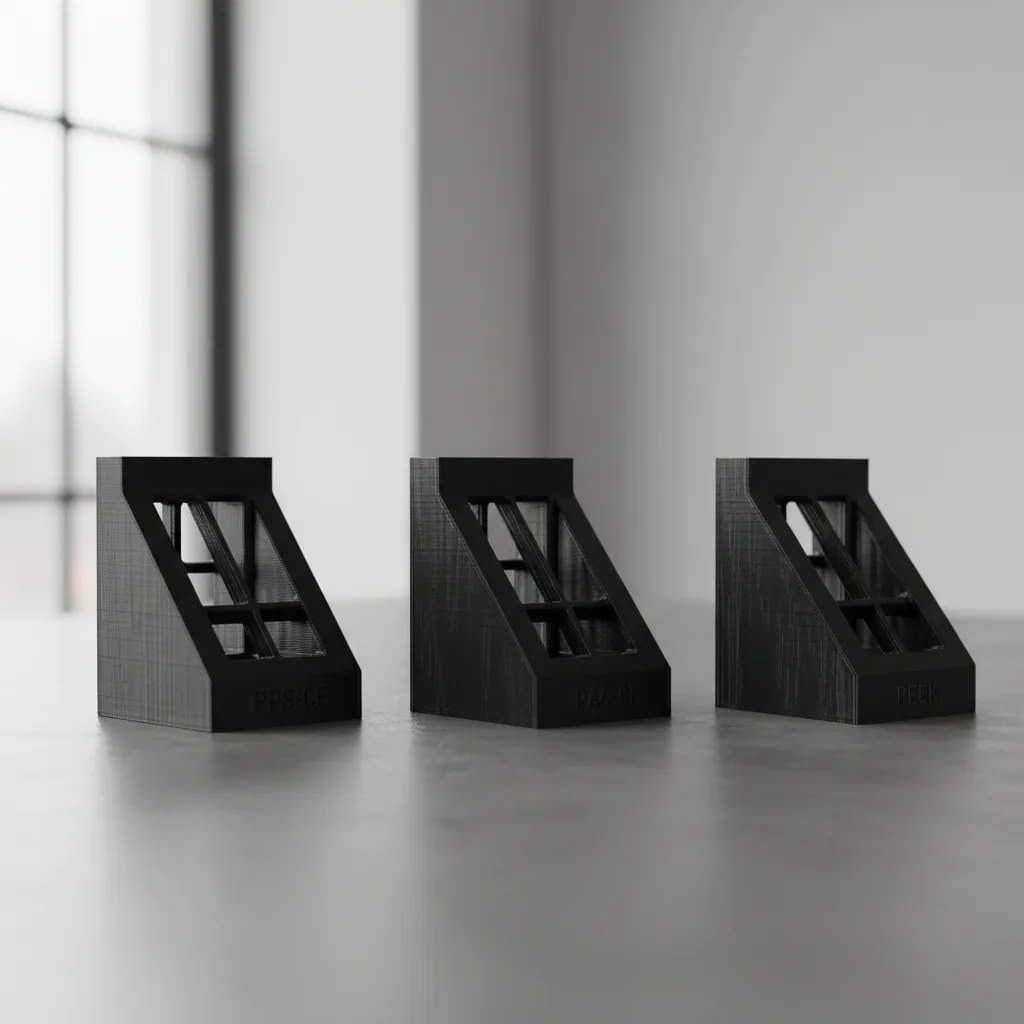
Three identical 3D-printed brackets to compare PPS-CF
How we print it

Recommended print environment for PPS-CF.

A single 3D-printed PPS-CF chemical-resistant fluid fitting with threaded ports
From brief to dispatch

Our process · How a PPS-CF order moves through our workshop.

01

Brief

File or sketch in. We confirm material, orientation, finish, target HDT.

02

Quote

Engineer reviewed. Lead time + per-unit cost back inside 24 hours.

03

DFM check

Wall thickness, XY-load-path orientation, anneal-shrinkage compensation flagged before print.

04

Print

Filament dried 100°C / 10h pre-print. 80-90°C bed. Hardened steel nozzle. ISO-spec adherence.

05

Anneal & finish

125°C / 16h anneal recommended for stress relief and full HDT lock-in. Sand or 2K paint to spec.

06

Dispatch

Tracked UK courier, tracking number sent the moment it leaves.

Typical lead times · PPS-CF
1-off prototype
3 to 5 working days
Quote inside 24h · printing starts the day we agree
Batch of 10
5 to 7 working days
Sequential or parallel printing depending on bed footprint
Batch of 100
10 to 14 working days
Splits across multiple printers · QC sampled per print run
Rush turnaround
Same-week, on request
Possible for small parts · ask in your brief, we'll confirm before quoting

Drying adds 10 hours and annealing adds 18 hours (10h dwell + slow cooldown) to any of the above. Lead times start when CAD is signed off · CAD round-trips on rev requests can extend the clock.

Case study
ManufacturingHumidity-stable fixture
EV · battery module bracket

V-0 flame-rated battery module bracket batch.

EV-startup client needed UL94 V-0 self-certifiable brackets for a battery module enclosure · the design had to survive thermal runaway service ceiling (~180°C) while passing flame test for safety sign-off. PPS-CF gave V-0 at 1.5mm wall plus 252.5°C HDT headroom over the worst-case heat load · PA-CF nylons would have failed both flame test and heat. Room-temperature chamber printing meant we delivered the batch on standard industrial FDM rather than chasing PEEK printer capacity · cost was ~3× PA-CF but ~25% of PEEK equivalent.

Material: PPS-CF10 (10% CF · V-0 flame-rated) Anneal: 125°C / 16h post-print (recommended · stress relief) Read the full case study →
A 3D-printed PPS-CF EV battery component
Material science · why it behaves the way it does

What PPS-CF actually is · and why that matters for your part.

Definition

PPS-CF is 10% carbon-fibre-reinforced polyphenylene sulfide · a semi-crystalline aromatic polysulfide filament reinforced with chopped carbon fibre. PPS is the same chemistry behind industrial chemical-plant piping, aerospace fluid-handling, and oil-and-gas downhole tools · the rigid aromatic ring and sulfide linkage backbone give PPS dimensional stability, broad chemical resistance, and inherent V-0 flame rating with very low moisture absorption (0.225% equilibrium, the among the lowest of any composite (PPS-GF 0.11% is lower)). Carbon-fibre at 10 wt% delivers 59.4 MPa tensile XY (annealed), 5447 MPa Young's modulus, and 252.5°C HDT at 0.45 MPa · the highest HDT of any composite in our range. PPS-CF is our highest-temperature V-0 flame-rated grade (PETG-V0 is the lower-temperature V-0 option). The defining trade-off is anisotropy · 1.86× XY/Z tensile ratio means design loads must run along XY. PPS is mostly crystalline as-printed; the recommended 125°C / 16h anneal is stress relief (not a phase change) that locks the published HDT and trims residual print stress with negligible shrinkage (~0.1% XY, 0% Z).

"PPS-CF is the CF composite I reach for when stiffness in a humid workshop matters more than impact toughness. PA6-CF is stronger on the bench but loses half its tensile in any humid environment · PA12-CF holds dimensions better than PA-CF but is only half the stiffness. PPS-CF gives the highest Young's modulus we ship at 0.225% water absorption · numbers that hold across UK humidity cycles where nylon would have drifted. The trades are real though · 1.86× anisotropy and only 5 kJ/m² Charpy notched mean you cannot skip the load-path-orientation step in CAD, and the anneal is recommended not optional. Get those right and PPS-CF earns its place in the fixture cabinet."

· 3D Printing Express engineering team · UK workshop

Three questions every engineer Googles when picking PPS-CF · the PPS polymer chemistry, why annealing is recommended (stress relief, not phase change), and what the 1.86× anisotropy means in design.

Stress-relief anneal

Anneal locks dimensional stability · 252.5°C HDT in service

PPS-CF is mostly crystalline directly off the bed · unlike PET (which prints amorphous and requires a phase-change anneal). The 125°C / 16h anneal is stress relief that sharpens dimensional consistency and locks the full 252.5°C HDT. Negligible shrinkage · ~0.1% XY and 0% Z (the cleanest anneal cycle of any composite we ship).

CF orientation

Carbon fibres line up with the print head

10% chopped carbon fibre (~80-200 micron length) aligns along extrusion direction during deposition · drives the 1.86× XY/Z anisotropy ratio. Moderate-to-high by composite standards (higher than PA12-CF 1.48× and PET-GF 1.24×, lower than PET-CF 2.36×). The driver is the rigid PPS matrix · it transfers Z-axis load less effectively than the compliant nylon matrices because the inter-layer matrix-controlled regions are stiff and brittle. Design load paths along XY · not optional.

Water absorption · the wedge

0.225% equilibrium · the driest engineering composite

PPS's aromatic sulfide linkages absorb far less water than nylon amide groups. PPS-CF holds 3× drier than PA12-CF (1.5%), 4× drier than PA612-CF (2.2%), 6× drier than PA6-GF (3.33%). No wet-state design margin needed · dimensional stability holds through UK humidity cycles where nylon-CF fixtures drift and bind.

What is polyphenylene sulfide (PPS) and why use it as the base polymer?

Polyphenylene sulfide (PPS) is a semi-crystalline aromatic polysulfide produced by polycondensation of para-dichlorobenzene with sodium sulfide. The repeating unit contains a rigid aromatic (phenyl) ring connected through sulfur (sulfide) linkages · this combination gives PPS its extraordinary thermal stability, broad chemical resistance, and inherent flame retardancy. PPS sits in a different polymer family from the engineering nylons (which are polyamides) and from the polyester composites like PET-CF · the aromatic sulfide linkage absorbs almost no water and resists most solvents up to 200°C.

The commercial pedigree is industrial-grade. PPS is the polymer behind chemical-plant piping and valve bodies, oil-and-gas downhole tools, aerospace fluid-handling components (fuel pumps, hydraulic manifolds), under-bonnet automotive parts (engine sensor housings, ignition coil bobbins), and electronics components where V-0 flame rating and high HDT matter together. The same chemical resistance, thermal stability, and dimensional integrity carries through to the FDM-printed grade · engineering parts that need to survive heat, chemistry, and flame in one envelope inherit the polymer's pedigree.

Why is annealing recommended for PPS-CF (and what does it actually do)?

PPS prints in a mostly-crystalline state directly off the bed · unlike PET (which prints amorphous and requires anneal-driven phase change to reach published HDT), PPS already has most of its crystallinity locked in by the time the part cools. The 125°C / 16h anneal is a stress-relief cycle, not a phase change. As-printed PPS-CF holds dimensional shape immediately · the anneal trims residual print stress, sharpens dimensional consistency over weeks of thermal service, and locks the full published 252.5°C HDT @ 0.45 MPa.

Critically, PPS-CF's anneal causes negligible shrinkage · ~0.1% XY and 0% Z (per TDS shrinkage block, 40mm specimen). This is the cleanest anneal cycle of any composite we ship · PET-CF loses up to 1.5% XY and 1% Z, PA612-CF loses 0.6%. For load-bearing thermal-service parts where dimensional creep over weeks matters, annealing is the recommended default. For one-off chemistry-resistant brackets that don't see thermal load, the anneal can be skipped without sacrificing the chemistry envelope · only HDT and dimensional creep margin shift slightly.

How does chopped carbon fibre change the print, and why is anisotropy so high?

Our stocked grade is 10% carbon fibre by weight, chopped to short segments (80-200 microns long). The fibres orient along the print-head direction as the molten filament extrudes. That orientation drives the 1.86× XY/Z anisotropy ratio · moderate by composite standards (higher than PA12-CF at 1.48× and PET-GF at 1.24×, but lower than PET-CF at 2.36×). The driver is the rigid PPS matrix: it transfers Z-axis load less effectively than the compliant nylon matrices because the inter-layer matrix-controlled regions are stiff and brittle rather than ductile · they bear Z load with minimal yielding before failure.

Practically, design every PPS-CF part with the load path running along the XY print plane. Z-loaded thin walls under 2mm are the failure mode. Where PA12-CF can absorb some Z-direction misalignment through matrix ductility, PPS-CF will not · plan orientation in CAD before slicing, and keep structural walls at 2mm or thicker.

A 3D-printed PPS-CF high-temperature manifold part rated to 252C
Full material spec · ISO-referenced

Every number an engineer needs, in one table.

Values measured to the ISO standards cited in the right-hand column, on the manufacturer's own injection-moulded test specimens · directly comparable to other engineering thermoplastics.

PropertyXY · print planeZ · build axisWet · XY / Z · post-immersionUnitStandard
Mechanical · post-anneal status (125°C / 16h)
Tensile strength59.432.0·MPaISO 527
Young's modulus54472790·MPaISO 527
Elongation at break1.41.6·%ISO 527
Flexural strength94.330.0·MPaISO 178
Flexural modulus46472619·MPaISO 178
Charpy impact (notched, XY)5.3··kJ/m²ISO 179
Charpy impact (unnotched, XY)11.4··kJ/m²ISO 179
Charpy impact (unnotched, Z)·4.1·kJ/m²ISO 179
Thermal
Heat deflection (HDT @ 0.45 MPa)252.5 (annealed)°CISO 75
Heat deflection (HDT @ 1.8 MPa)133 (annealed)°CISO 75
Glass transition temperature (Tg)97.7°CDSC, 10°C/min
Melting temperature (Tm)279.7°CDSC lab figure · not the print temperature or the in-service softening limit (see HDT/Tg)
Crystallisation temperature (Tc)218.8°CDSC, 10°C/min
Vicat softening temperature267.5°CISO 306
Decomposition temperature502.7°CTGA, 20°C/min
Physical
Density1.29g/cm³ @ 23°CISO 1183
Carbon-fibre content10% by weightmanufacturer spec
Equilibrium water absorption0.225%manufacturer absorption curve
Melt flow index26.2g/10min (270°C, 2.16kg)ISO 1133
UL94 flame ratingV-0 at 1.5mm·UL 94
Surface resistivity>10¹²Ω/sq (insulator)ANSI ESD S11.11
Processing
Recommended print temperature310-350°Cmanufacturer spec
Recommended bed temperature80-90°Cmanufacturer spec
Chamber requirementRoom temperature (no heated chamber required)·manufacturer spec
Drying conditions100°C / 10h before printing·manufacturer spec
Annealing125°C / 16h post-print · recommended (stress relief) for full spec·manufacturer spec
Nozzle materialHardened steel or ruby (brass 1-3 jobs life)·manufacturer spec
All mechanical and HDT values measured on post-anneal specimens (125°C / 16h). Without the anneal, HDT is slightly lower due to residual print stress (PPS is mostly crystalline as-printed · no phase change involved). PPS-CF's 0.225% water absorption means no separate wet-state column is needed. Request full TDS by email →
Design for additive manufacturing

How to design a part that prints right in PPS-CF.

Orientation

Design load paths along XY · not optional for PPS-CF

Tensile load > 20 MPa: orient with load in the XY plane. Z bonds are 46% weaker · 32.0 vs 59.4 MPa, anisotropy 1.86×. The rigid PPS matrix transfers Z-axis load less effectively than the compliant nylon matrices · this is one of the more orientation-sensitive composites we ship.

Wall thickness

2.0 mm structural minimum

PPS-CF's 1.86× anisotropy makes thin walls particularly brittle in Z-loaded geometry · 2mm minimum structural (vs 1.5mm for PA-CF nylons). 0.8 mm is cosmetic only. For load-bearing service add ribs rather than thinning walls.

Overhang rule

≤45° prints unsupported

Above 45° from vertical needs support material · plan part orientation to keep critical surfaces support-free.

Tolerance

±0.2 mm XY, ±0.3 mm Z typical

Tight-tolerance ±0.1 mm achievable on small parts with calibration · ask before finalising CAD.

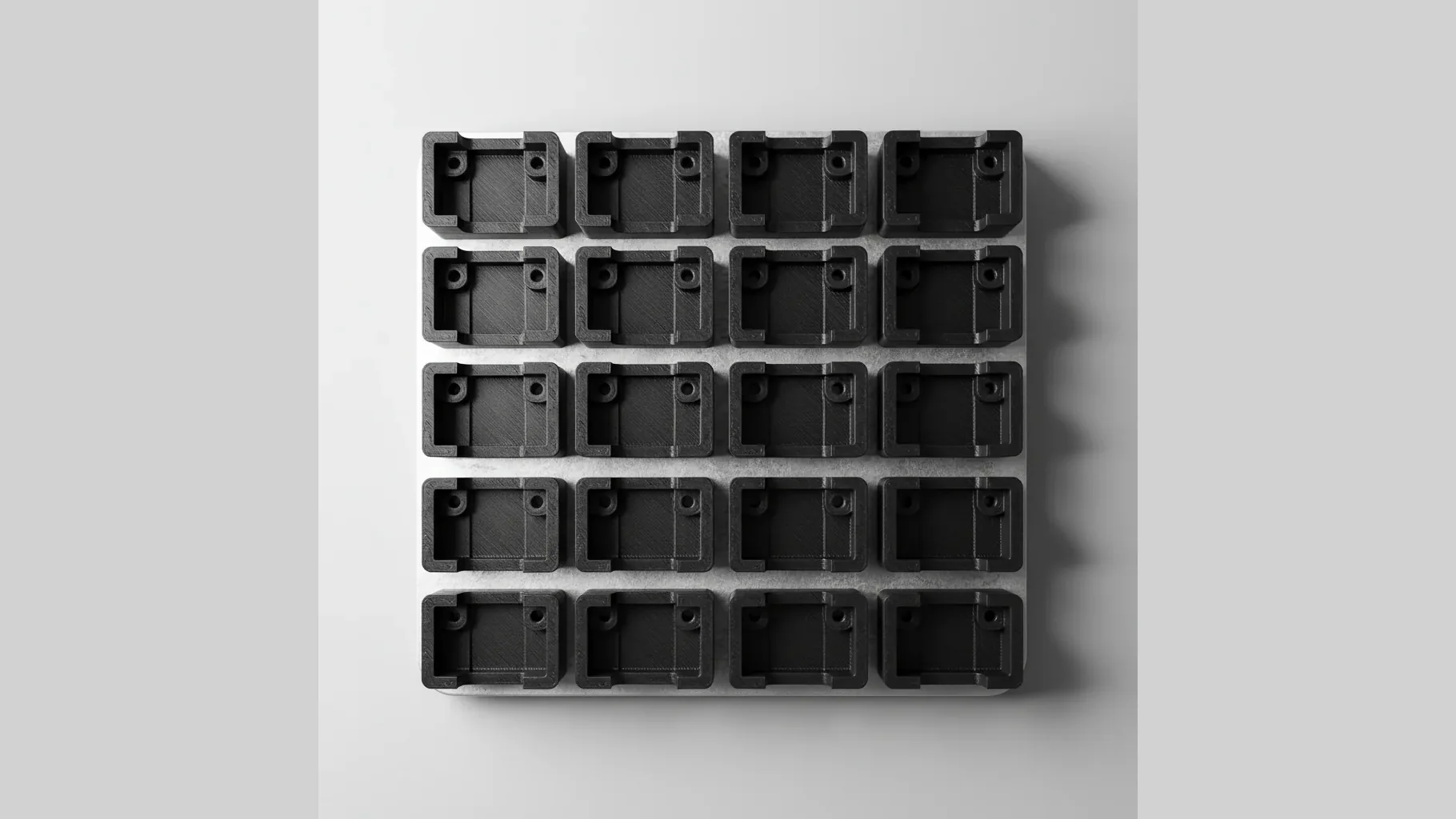
A neat tray of identical 3D-printed PPS-CF brackets
Post-processing

Four routes to a finished surface.

Sanding · 240 → 400 → 800

Removes layer lines · matte finish

Removes 0.1-0.3 mm per surface · pre-paint prep or stand-alone hand-feel polish.

Annealing · 125°C / 16h (RECOMMENDED)

Anneal locks dimensional stability · stress relief, not phase change

Manufacturer states annealing is recommended for PPS-CF · provides stress relief and locks the published 252.5°C HDT. PPS is mostly crystalline as-printed (unlike PET) so the anneal sharpens dimensional consistency rather than transforming the polymer. Negligible shrinkage · ~0.1% XY and 0% Z (the cleanest anneal cycle of any composite we ship).

2K spray paint · RAL match

Glass-smooth, any colour

Adds 0.05-0.15 mm per surface · sand 800 grit first, primer + topcoat · for colour-matched exterior parts.

Skip vapour-smoothing

Doesn't smooth CF fibres

Vapour fuses the matrix without flattening exposed carbon · glossy but textured · sand + paint instead.

Why 3DPE for PPS-CF

Four reasons engineers send us this material specifically.

ISO

ISO-referenced spec on every part

Every value on this page traces to an ISO test method. We don't quote derived numbers without naming the standard. The annealed-state caveat is clear on every spec figure.

UK

Printed in the UK

No offshore subcontracting. Files, prints, and couriers all stay in the UK.

FIT

Material-fit check on every brief

Send three things: peak load (N or MPa), peak service temperature (°C), and service environment (humid / outdoor / chemical). our team come back inside 24 hours with material, orientation, and post-process recommendation · if PA12-CF, PA6-CF, PA612-CF, or PPS-CF fits better, we say so.

JC
FB

Two engineers, named

our team review every brief before quote. No ticket queue, no account managers.

According to the Fiberon PPS-CF10 TDS, PPS-CF10 reaches HDT 252.5 °C @ 0.45 MPa per ISO 75 · the highest HDT in the Polymaker range · with UL 94 V-0 flame rating at 1.5 mm and Young's modulus 5447 ± 149 MPa (XY).

FAQ

FAQ · Twelve questions engineers ask before specifying PPS-CF.

Why does PPS-CF need annealing?

PPS prints in a mostly-crystalline state directly off the bed · unlike PET, PPS does not undergo a dramatic amorphous-to-semi-crystalline phase change during anneal. The 125°C / 16h anneal is stress-relief and dimensional-stability lock-in. Annealed parts hold the full published HDT (252.5°C @ 0.45 MPa, 133°C @ 1.8 MPa) and have lower residual print stress. For load-bearing thermal-service parts (where dimensional creep over weeks of service matters), annealing is the recommended default · for one-off chemistry-resistant brackets that don't see thermal load, the anneal can be skipped.

Why is PPS-CF so much more anisotropic than other CF composites?

PPS-CF10 has moderate-to-high anisotropy · 1.86× tensile XY/Z (59.4 / 32.0 MPa). PA12-CF is 1.48×, PA612-CF is 1.90×, PA6-GF is 1.32×, PET-CF 2.36×. The driver is the rigid PPS matrix · it transfers Z-axis load less effectively than the more compliant nylon matrices because the inter-layer matrix-controlled regions are stiff and brittle rather than ductile. Design every PPS-CF part with the load path running along XY. Z-loaded thin walls under 2mm are the failure mode.

Is PPS-CF really moisture-insensitive?

Yes · 0.225% equilibrium water absorption per the TDS V1.0 absorption curve. That's the among the lowest of any composite (PPS-GF 0.11% is lower) we ship · 3× drier than PA12-CF (1.5%), 4× drier than PA612-CF (2.2%), 6× drier than PA6-GF (3.33%). PPS's aromatic sulfide linkages absorb far less water than nylon amide groups. The practical result: PPS-CF parts hold dimensions and properties across UK ambient humidity cycles (30-80% RH) where nylon-CF parts swell and lose stiffness. For outdoor fixtures, marine brackets, humid workshops, and parts stored for months · PPS-CF is the right CF composite.

How does PPS-CF compare to PA12-CF?

PPS-CF wins on HDT (252.5 vs 131°C at 0.45 MPa · 92% higher), thermal envelope (Tm 280°C vs 178°C), moisture stability (0.225% vs 1.5% water absorption · 6.7× drier), and flame rating (V-0 vs HB · highest-temperature V-0 grade we offer). PA12-CF wins on tensile strength (77 vs 59.4 MPa XY), impact toughness (Charpy notched 9.9 vs 5.3 kJ/m² · 87% tougher), anisotropy (1.48× vs 1.86×), and cost (~3-5× lower-cost). For thermal-service brackets and V-0 flame-rated parts, PPS-CF. For impact-loaded brackets that need to absorb shock at room temperature, PA12-CF.

What is the glass transition temperature of PPS-CF?

Tg is 97.7°C per the manufacturer TDS V1.1 (DSC, 10°C/min). Bulk PPS literature reports Tg around 85-90°C · the CF-filled grade sits slightly higher because the fibre matrix constrains chain mobility. Above Tg, amorphous regions soften · but PPS is mostly crystalline as-printed, and the crystalline regions continue to carry load up to the HDT (252.5°C at 0.45 MPa, 133°C at 1.8 MPa). For unannealed prints, the working envelope is slightly tighter due to residual print stress. For annealed prints, the HDT figures govern service.

Does PPS-CF need a heated chamber?

No heated chamber required · the TDS specifies room-temperature chamber. PPS-CF prints with a hotter bed (80-90°C) than the PA-CF nylons (40-50°C) to manage first-layer adhesion at the 310-350°C hotend temperature, and the Warp-Free additive package keeps geometric stability without active chamber heating. Standard industrial FDM hardware with a 300°C+ capable hotend and hardened nozzle handles the material · no PEEK-class equipment needed. This is the wedge that brings 252.5°C HDT and V-0 flame onto a standard production-FDM workflow.

What nozzle is needed for PPS-CF?

Hardened steel or ruby. Carbon-fibre at 10 wt% destroys a brass nozzle in 1-3 print jobs. Ruby-tipped nozzles extend life to hundreds of jobs. We run hardened-steel on every CF print as standard, included in the quote · no surcharge.

Is PPS-CF chemical-resistant? · 18-row compatibility table

PPS is one of the most chemically resistant engineering polymers commercially available. The aromatic sulfide backbone gives broad resistance across petrol, diesel, alcohols, aqueous acids, aqueous bases (including hot NaOH where PET fails), most organic solvents, ketones, aromatics, chlorinated solvents at room temperature, hot water, and steam · all up to 200°C. The polymer is used industrially for chemical-plant piping, oil-and-gas downhole tools, and aerospace fluid-handling. Fails only against strong oxidising acids (concentrated nitric, fuming sulphuric, chromic acid) and sustained chlorinated solvent vapour above 200°C.

Chemical / familyResistanceNotes
Petrol / gasolineExcellentPPS is OEM-specified for fuel-system components
DieselExcellentIncluding biodiesel and E85 ethanol-blends
Engine oil, gear oil, hydraulic oilExcellentAll service grades up to 200°C
Brake fluid (DOT 3 / 4 / 5.1 glycol)ExcellentDOT 5 silicone also fine
Coolant / antifreeze (ethylene glycol)ExcellentIncluding hot diluted service coolant
Methanol, ethanol, IPAExcellentIndefinite immersion OK
Aqueous acids (dilute H₂SO₄, HCl, H₃PO₄)ExcellentPPS resists aqueous mineral acids up to ~93°C
Aqueous bases (NaOH, KOH up to 50%)ExcellentPPS resists hot caustic · where PET hydrolyses
Sea water / saline solutionExcellentLong-term immersion OK · marine + downhole grade
Hydrogen peroxide ≤ 30%ExcellentStronger conc. attacks at sustained high temp
Acetone, MEK (ketones)ExcellentPPS resists ketones at room temp · indefinite
Toluene, xylene (aromatics)ExcellentRoom-temp immersion OK · > 150°C limited
Chlorinated solvents (TCE, DCM, chloroform)GoodRoom temp OK · > 180°C sustained degrades
Hot water and steam (sustained > 80°C)ExcellentPPS holds in steam to 200°C · where PET hydrolyses
Weak organic acids (acetic, citric)ExcellentIndefinite OK at all useful concentrations
Concentrated nitric acid (oxidising)FailsStrong oxidiser attacks sulfur linkage
Fuming sulphuric / oleum, chromic acidFailsStrong oxidising acids degrade backbone
Chlorinated solvent vapour > 200°C sustainedFailsCombined heat + chlorine attacks · only failure mode at temperature

Ratings reflect long-term immersion / sustained exposure. Brief contact (cleaning wipes, splashes) is more forgiving. For mission-critical chemical service, request a 7-day immersion sample before committing the design.

Is PPS-CF flame-retardant?

Yes · PPS-CF10 is rated UL94 V-0 at 1.5mm per the manufacturer TDS V1.1. This is the highest-temperature V-0 grade in our range (PETG-V0 covers lower-temperature V-0 needs) · PPS is inherently flame-retardant due to its aromatic sulfide backbone (no halogenated additives required). Suitable for self-certifiable V-0 applications: electrical enclosures, transportation interiors, EV battery hardware, aerospace cabin parts. For full third-party UL certification, the part must be tested in its as-built geometry by a UL-recognised lab.

Is PPS-CF ESD-safe?

No · standard PPS-CF10 is insulative. Surface resistivity is >10¹² Ω/sq per the TDS (rated OL · overload, beyond ESD-safe range). The 10% CF loading sits well below the percolation threshold (typically 25-35 wt% for engineering matrices). For ESD-sensitive electronics handling jigs and PCB fixtures, use PETG-ESD or PA612-ESD (dedicated anti-static grades).

Can PPS-CF be steam-autoclaved?

Yes · PPS holds dimensions and chemistry indefinitely in steam to 200°C, well above standard 121°C autoclave service. Annealed PPS-CF is one of the few commodity FDM composites suitable for repeat steam autoclave (clinical, lab, food-contact-adjacent fixtures · note PPS is not separately food-contact certified). Dry-heat sterilisation, EtO, UV-C, gamma, and IPA wipe-down are also all compatible with PPS-CF. The CF reinforcement adds nothing to chemistry exposure (the matrix is the controlling phase).

What's the typical service envelope for PPS-CF?

Continuous service (annealed): -40 to 200°C · the broadest thermal envelope of any commodity composite we ship. Structural loads up to 133°C @ 1.8 MPa; lower-load service up to 252.5°C @ 0.45 MPa. Decomposition only at 502.7°C. Outdoor: broadly UV-tolerant due to aromatic backbone; 2K paint extends multi-year exterior life. Humid environments: 0.225% water absorption means dimensional stability holds across humidity cycles indefinitely. V-0 flame-rated. Chemical service: petrol, diesel, oils, alcohols, aqueous acids and bases, ketones, aromatics, steam to 200°C. Steam autoclave: yes, repeatedly. Not suitable for ESD service or sub-2mm thin-walled bending parts.

Glossary

Engineering terms used on this page.

Crystalline PPS
PPS is a high-crystallinity engineering polymer · it prints in a mostly-crystalline state directly off the bed (unlike PET which is amorphous as-printed). The 125°C anneal sharpens dimensional consistency through stress relief rather than driving a phase change.
Anisotropy
The dependence of a material's properties on direction. In FDM-printed CF composites, fibres orient along the print head's path, making the part stronger in XY than Z. PPS-CF anisotropy is 1.86× tensile XY/Z · highest in our composite range.
Annealing
Controlled heat treatment after printing (125°C for 16 hours for PPS-CF). Unlike PET composites (where annealing drives a phase change), PPS is mostly crystalline as-printed · the anneal is stress relief that sharpens dimensional consistency and locks the full published HDT. Costs negligible shrinkage (~0.1% XY, 0% Z).
Aromatic backbone
The PPS polymer chain contains a rigid aromatic (phenyl) ring connected through sulfide linkages. The rigidity of the aromatic ring combined with the strong, thermally-stable sulfur bond is the source of PPS's exceptional HDT, chemical resistance, and inherent V-0 flame rating. Very different from the flexible aliphatic chains of nylon (which have no rings) and from the polar ester linkages of PET.
Carbon-fibre content
The percentage of chopped carbon fibre by weight in the filament. PPS-CF10 is 10% · the same loading as PA12-CF (10%), below PA612-CF (15%) and PET-CF (17%). More fibre adds stiffness but also anisotropy and brittleness · the 10% loading is a balance between mechanical performance and processability.
Equilibrium water absorption
The percentage moisture pickup at indefinite immersion / saturated humidity. PPS-CF: 0.225% (lowest in our engineering composite range). PA12-CF: 1.5%. PA612-CF: 2.2%. PA6-GF: 3.33%.
Sulfide linkage
The -S- chemical bond (sulfur bridging two carbon atoms) that joins repeat phenyl units in PPS. Thermally stable, broadly inert, and almost completely non-polar · the source of PPS's 0.225% equilibrium water absorption (lower than the polar ester linkage of PET or the hydrogen-bonded amide linkage of nylon).
FDM (Fused Deposition Modelling)
Filament-extrusion 3D printing. Distinct from SLS/MJF (powder-bed) and SLA (resin). PPS-CF prints on FDM machines with a hardened nozzle at 310-350°C, hot bed (80-90°C), room-temperature chamber.
Heat deflection temperature (HDT)
The temperature at which a loaded specimen deflects a standard amount under a defined load (ISO 75). HDT @ 0.45 MPa is the lower-load value (cosmetic service ceiling); HDT @ 1.8 MPa is the structural ceiling. PPS-CF: 252.5°C / 133°C (annealed) · the highest HDT of any composite in our range.
Polyphenylene sulfide (PPS)
A semi-crystalline aromatic polysulfide · the same chemistry as industrial chemical-plant piping, aerospace fluid-handling, and oil-and-gas downhole tools. Different polymer family from the engineering nylons (polyamides) and the polyester composites (PET-CF/PET-GF). Aromatic sulfide linkages absorb almost no water and provide broad chemical resistance up to 200°C.
Semi-crystalline PPS
The natural state of PPS · the polymer holds high crystallinity (typically 40-65%) directly off the print bed. Opaque, high stiffness, HDT 252.5°C @ 0.45 MPa, full chemical resistance · the as-printed and post-anneal state of PPS-CF in service.
Tensile strength
Stress at which a specimen yields or breaks in pure tension (ISO 527). Reported in MPa. PPS-CF annealed: 59.4 MPa XY, 32.0 MPa Z. Anisotropy 1.86×.
UL94
An Underwriters Laboratories standard for plastic flame retardancy. HB (horizontal burn) is the lowest rating; V-0, V-1, V-2 are vertical-burn ratings (more stringent · V-0 is the most demanding common rating). PPS-CF10 stocked grade: V-0 at 1.5mm · the highest-temperature V-0 grade we offer.
PPS-CF · UK PRINTED · ISO-REFERENCED

Got a brief that calls for PPS-CF? Send the file or a description.

You'll hear back from our team within 24 hours · with material-fit check, ISO-referenced spec, and lead time on every quote.

Send your brief Browse other materials Email for full spec