PETG 3D printing · the tough, forgiving all-rounder · the everyday workhorse for functional parts.

The spec, the moisture story, the honest limits, and where PETG actually wins · cross-checked against the manufacturer's TDS V5.4, written by the team that prints it.

Reviewed by the 3D Printing Express engineering team.

Custom PETG 3D printing service · UK · quoted in 6 hours.

Stronger than PLA, easier to print than ABS, and happy around water · no chamber needed.

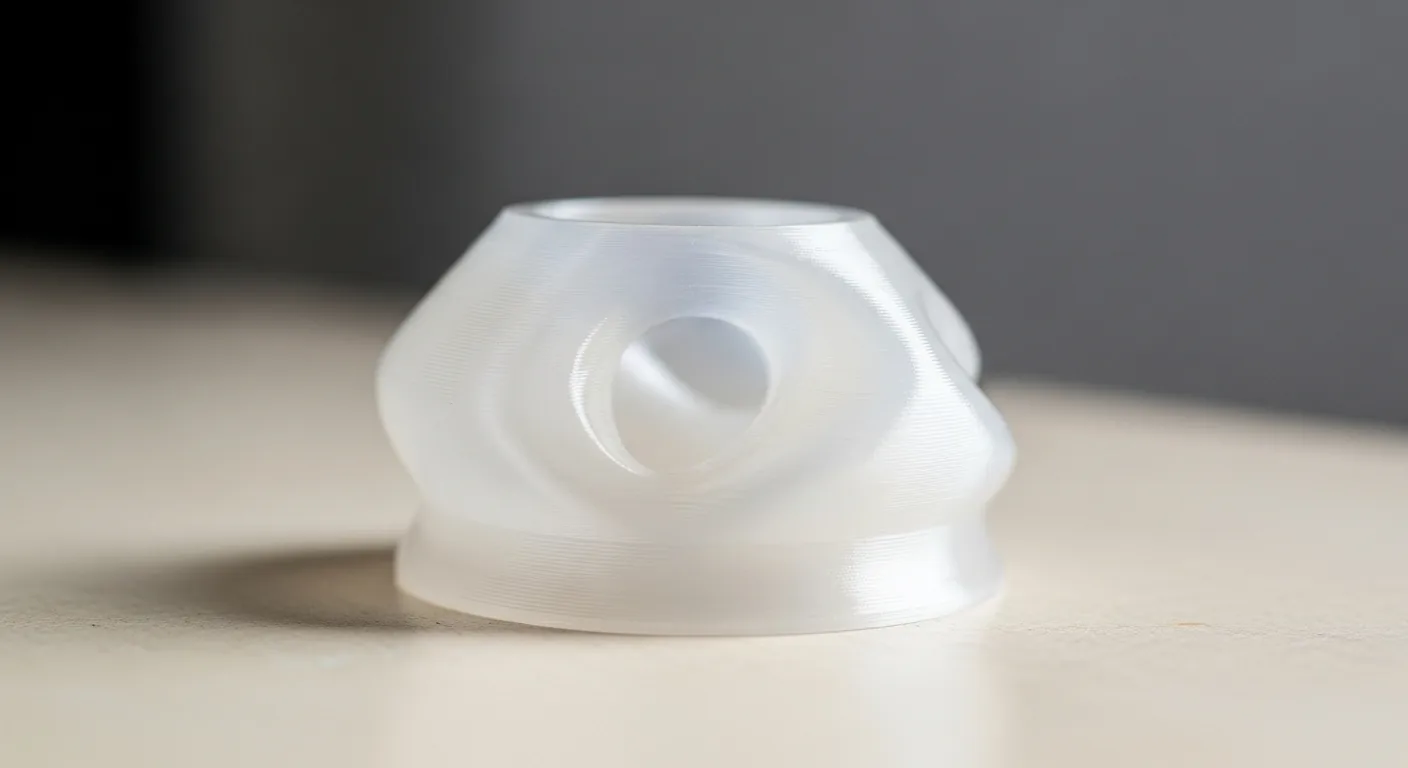
Macro photo of a glossy translucent 3D-printed PETG part on a clean light bench showing its smooth layer finish and slight translucency
Process · FDM
This page covers FDM PETG · the commodity workhorse for water-contact, food-adjacent, and moderate-outdoor parts. If you need lower-cost / cosmetic-only (PLA), tougher / heat-resistant (ABS / ASA), or engineering-grade (PA12-CF / PET-CF), send your brief and we'll match the right material.
The short version

PETG · the short version

Got 1 minute

The quick version.

Great for
  • Tough, forgiving everyday parts.Brackets, housings, fixtures and functional prototypes that have to survive real use. Stronger than PLA and far easier to print than ABS, no enclosure needed.
  • Happy around water and damp.Same PET backbone as drinks bottles, so it's the go-to for hydroponics, splash enclosures, tank fittings and anything that lives around moisture.
  • Bends instead of shattering.Drop a PETG part and it dents or flexes rather than cracking clean like PLA, so it forgives the odd knock.
! Worth knowing
  • Softens in real heat.Comfortable up to about 70°C, so a hot car, an engine bay or a sunny sealed enclosure is too much. Need heat? See ABS or ASA.
  • Not for high-impact loads.It takes everyday knocks fine, but for genuinely impact-critical parts ABS is tougher.
Not sure PETG is right for your part? Send your brief → and we'll match the right material.
Got 5 minutes

How PETG behaves, visually.

Four quick visuals. Start with which material to pick and where PETG works; the engineering detail is at the end if you want it.

Which to pick

When PETG, and when to switch.

Pick PETG

Water-contact · food-adjacent prototype · moderate outdoor (6-12 months) · ductile enclosures · signage

Pick another

Cosmetic-only = PLA · impact / heat = ABS · multi-year outdoor = ASA · engineering = PA12-CF

Where it works

Fine to about 70°C, soft above it.

  • Indoor room temp
  • Engine bay / radiator
  • Hot-water contact < 60°C
  • Steam autoclave 121°C
  • UK summer outdoor (months)
  • Sustained > 70°C service
The chemistry

Bottle-grade plastic, made to print clean.

A fraction of the ethylene glycol monomer is replaced with cyclohexanedimethanol (CHDM), which breaks the crystal symmetry. The result: same PET chemistry, no warping, food-bottle heritage.

For engineers
Mechanical character

Bends and yields, doesn't snap.

PETG yields at 8.4% strain (33% more give than PLA's 6.3%). Notched Charpy is similar to PLA (2.6 vs 3.3 kJ/m²) · the real win is yield behaviour on impact. For raw toughness: ABS at 18.0 kJ/m² (7× higher) or PA12-CF for engineering-grade.

What clients say about our UK 3D printing service on Google

4.9 based on 36 Google reviews
Read all 36 on Google →
Jonny Higgs
· 2 months ago · via Google

"James handled the 3D printing for a functional heat resistant component we needed in batch production. He helped dial in the prototype first with their design service, then produced the final batch with really consistent results. Super fast 3D print turnaround and great quality across all the 3D printed parts. Will 100% be coming back."

Matt Shutler
· 8 months ago · via Google

"We needed a sit-in F1-car for an exhibition to showcase our new racing game. 3D Printing Express took our CAD, optimised it for strength and weight as we had no idea how it all worked! Turned out beautifully. They colour matched the finish and was looking like the real deal. On show day the cockpit ran non-stop, adults and kids jumped in. Multiple visitors asked who built it."

Kayleigh Adams
· 7 months ago · via Google

"We ordered a batch of 100 PA-12 parts from 3D Printing Express and could not be happier. Every part arrived consistent, dimensionally accurate, and ready for use straight from the box. The PA-12 gave us the strength and stability we needed for functional testing, with minimal post-processing required. Delivery was on time, communication was excellent, and their QC clearly made a difference."

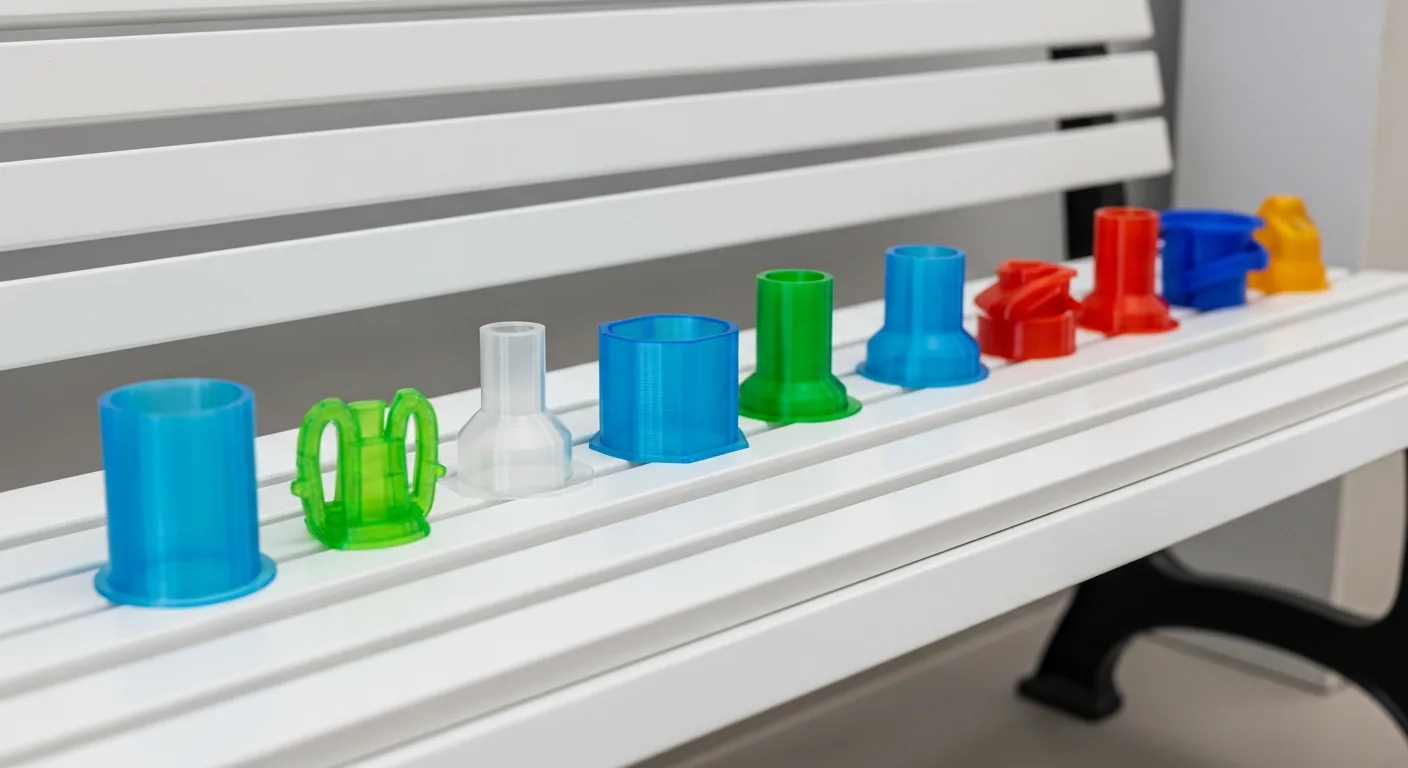
The same small PETG part 3D-printed in a row of translucent colours (clear
The four numbers worth knowing

The short answer before the spec sheet.

Tensile strength · XY
50.8MPa

Effectively tied with PLA (52.3 MPa) on raw tensile · the real PETG advantage is ductility (8.4% elongation vs PLA's 6.3%) and better Z-axis strength.

ISO 527 · 50.8 ± 0.9 MPa XY
HDT · 0.45 MPa
78°C

18°C higher than PLA's 60°C cliff. Survives cold-to-warm water service and UK summer outdoor (months). Engine bay / autoclave is still wrong material.

ISO 75 · 78°C @ 0.45 MPa, 75°C @ 1.8 MPa
Water absorption
0.54%

Hygroscopic at equilibrium · we dry every spool at 65°C for 6 hours before printing per the manufacturer's setting. Wet PETG prints stringy, milky, brittle.

manufacturer TDS V5.4 · equilibrium absorption
Charpy impact · notched
2.6kJ/m²

Similar to PLA (3.3 kJ/m²) on raw notched · PETG yields at 8.4% strain before breaking where PLA snaps at 6.3%. For real toughness: ABS (18 kJ/m² · 7× higher).

ISO 179 · notched, room temperature · 2.6 ± 0.2 kJ/m²
Perfect for

Where PETG is the right call.

PETG earns its place when ductility, moisture tolerance, and moderate-temperature service matter · the commodity workhorse for water-contact, food-adjacent, and outdoor-moderate parts.

Honest limits

Where PETG is the wrong call.

PETG's strengths are ductility, water resistance, and moderate-service breadth · its weaknesses are sustained heat above 70°C, ketone / strong-alkali exposure, multi-year outdoor UV, and impact-critical service. Pick a different filament if any of these apply.

What people actually print in this

Four worlds that order PETG by name.

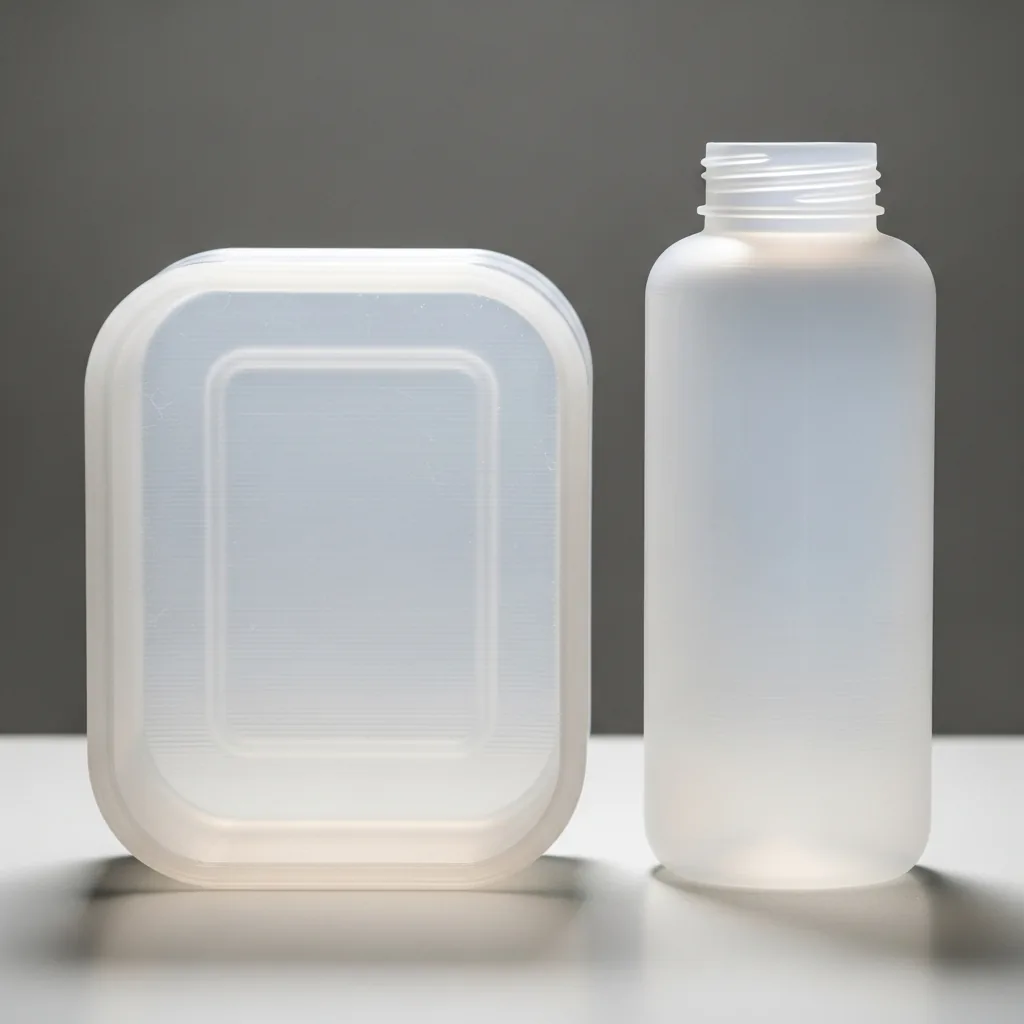
A 3D-printed translucent PETG prototype of a food-packaging container and bottle on a clean white bench
Consumer packaging · food brands

Bottle, container, lid, tray prototypes

Prototype the shape in PETG (same chemistry family as the production part), certify the final grade for production. Base PET is FDA 21 CFR 177.1630 compliant for food contact in moulded form · prototyping in PETG keeps the chemistry consistent.

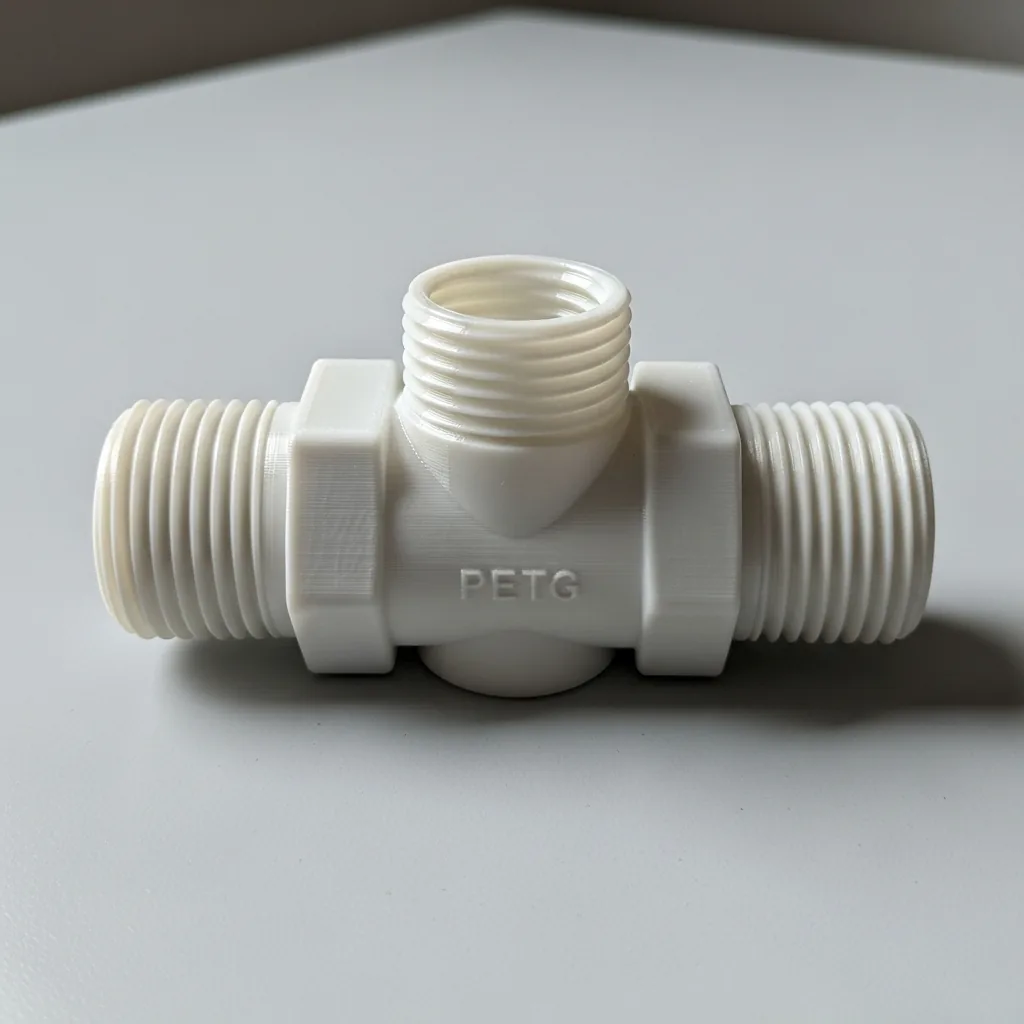
A 3D-printed PETG irrigation/hydroponics water fitting (a threaded pipe junction) on a clean bench
Horticulture · industrial · water-contact

Hydroponic fittings, irrigation parts, splash enclosures, tank brackets

PETG's hydrolytic stability and PET-backbone heritage make it the right material for cold-to-warm water service. Used in irrigation, fountain components, humidity-sensor housings, pump brackets, vases.

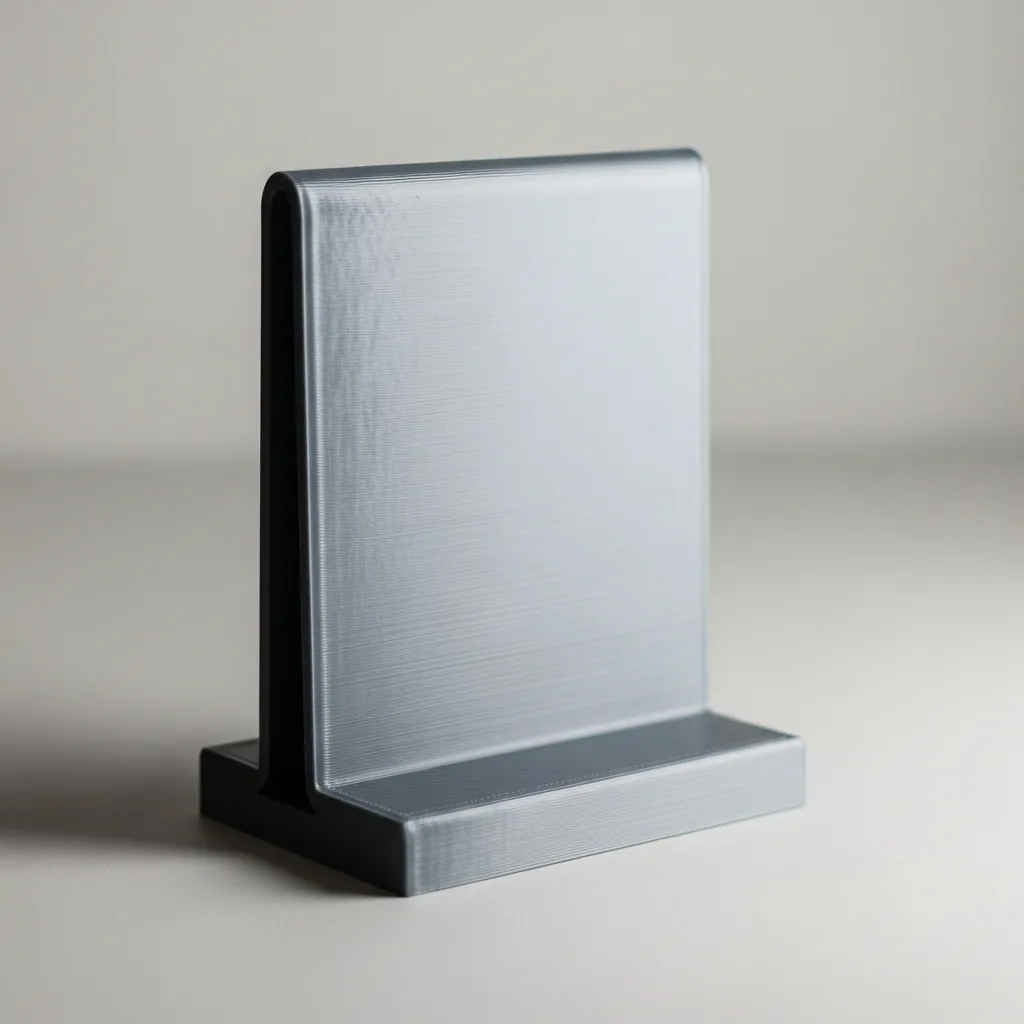
A 3D-printed PETG retail point-of-sale signage display holder on a clean surface
Retail · exhibition · brand activation

Window displays, POS holders, exhibition signage, light-transmission pieces

Moderate UV resistance and translucent grades make PETG the standard for FDM signage. 6-12 month outdoor service uncoated, multi-year with UV overcoat. translucent PETG variants specifically marketed for light-transmission display work.

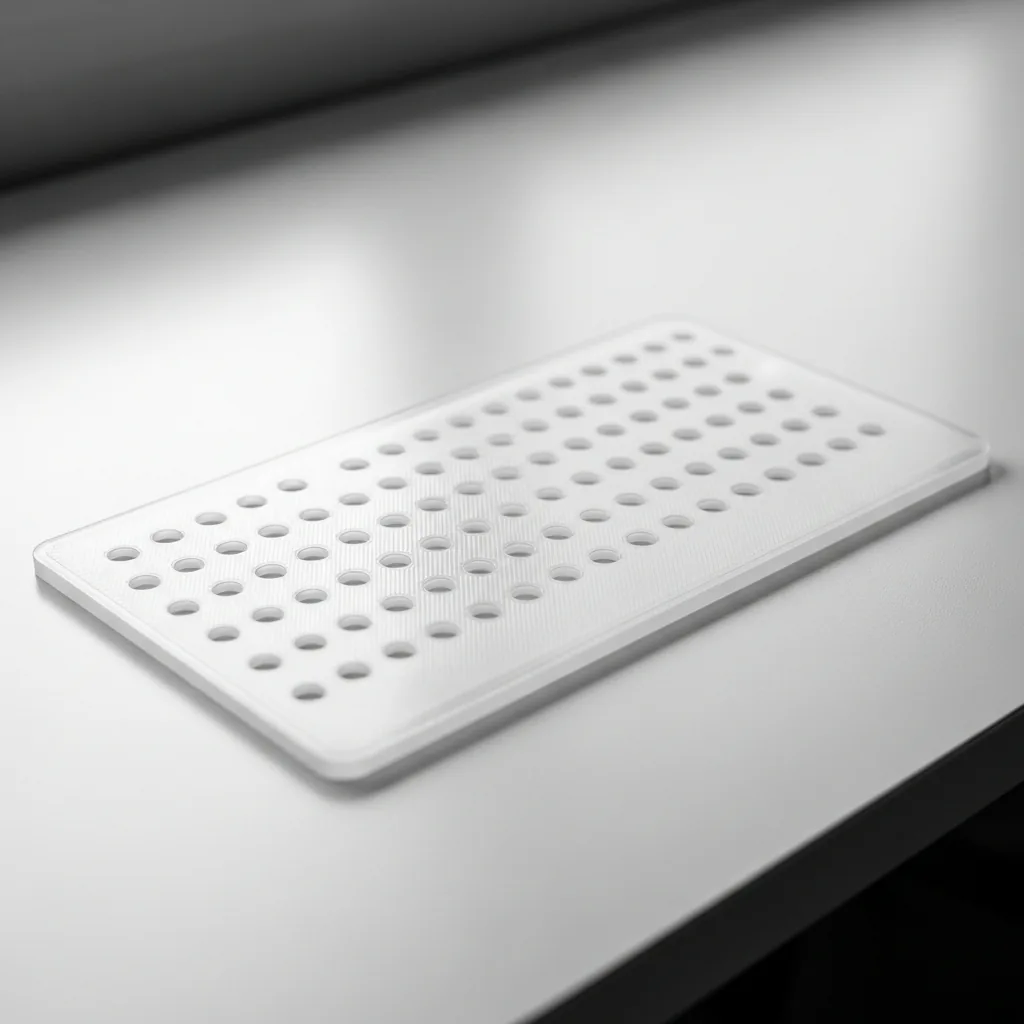
A 3D-printed translucent PETG machine guard / splash shield panel on a workshop bench
Industrial · workshop · safety

Machine guards, protective enclosures, splash shields, electronic housings

PETG's ductility means impact loads bend or yield rather than snap clean. Machine guards around moving equipment, workshop splash guards, electronic enclosures where a dropped tool would crack PLA or fracture ABS.

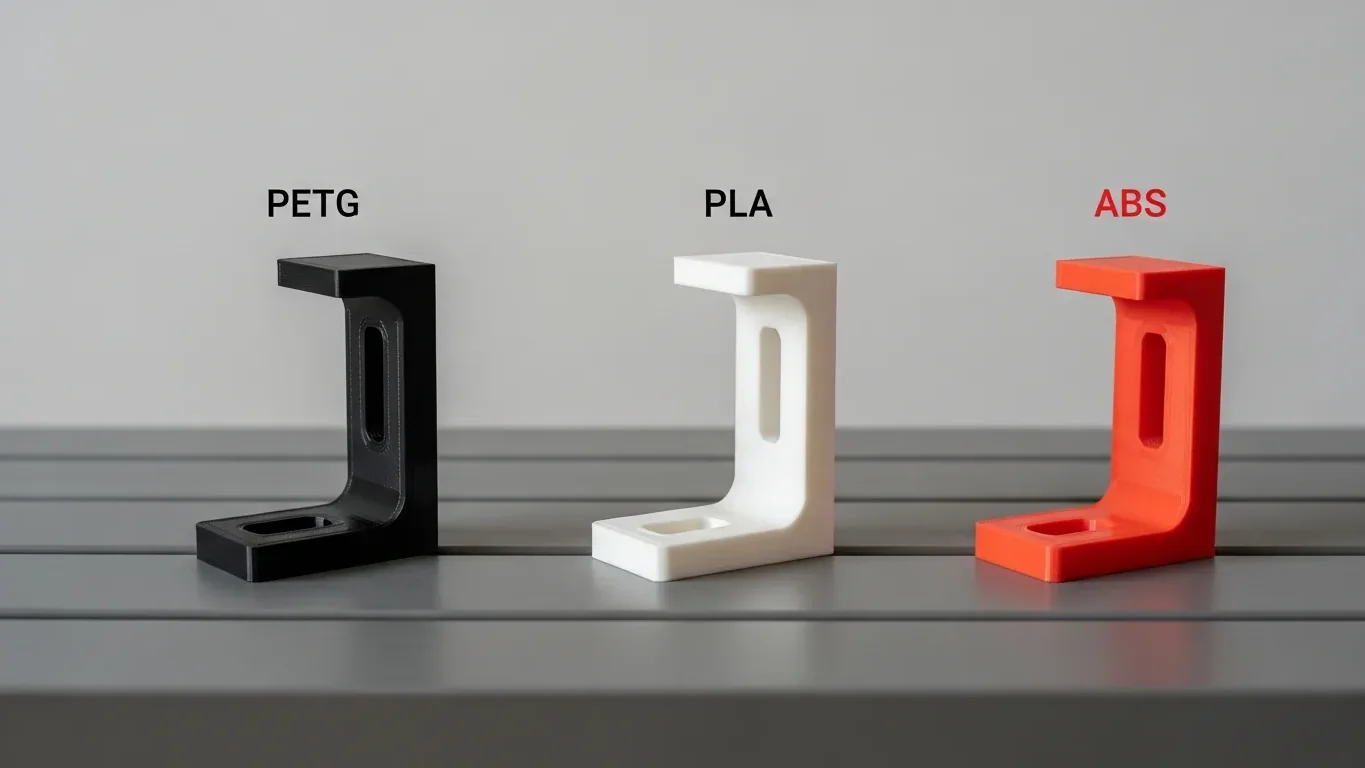
Three identical 3D-printed brackets shown to compare PETG
Decision helper

PETG vs PLA vs ABS · which to pick.

A side-by-side of the three commodity thermoplastics most engineers compare when picking PETG. Each material wins on one axis · PLA on stiffness and cost, ABS on impact and heat, PETG on ductility and water-contact service. Pick PETG when you need the all-rounder.

PETG vs PLA vs ABS · headline metric comparison PETG (here) PLA ABS ★ winner TENSILE STRENGTH XY · MPa 0 30 60PETG 50.8 PLA 52.3 ★ ABS 33.4DUCTILITY · ELONGATION AT BREAK XY · % 0 10 20PETG 8.4 PLA 6.3 ABS 17.9 ★HEAT DEFLECTION · HDT @ 0.45 MPa · °C 0 55 110PETG 78 PLA 60 ABS 100 ★CHARPY IMPACT · NOTCHED XY · kJ/m² 0 10 20PETG 2.6 PLA 3.3 ABS 18.0 ★COST PER KG OF FILAMENT · £ · lower = lower-cost 0 30 60 £/kgPETG £25-40 PLA £20-35 ★ ABS/ASA £30-45

All values from manufacturer Technical Data Sheets V5.4 EN · injection-moulded ISO test specimens (ISO 527 tensile + elongation, ISO 75 HDT, ISO 179 Charpy notched). The chart shows where each material wins · PETG's wedge is ductility plus water/food-contact heritage, not raw strength or heat.

PropertyPETG (here)PLAABS / ASA
Tensile strength XY50.8 MPa52.3 MPa33.4 MPa
Stiffness (Young's modulus XY)2117 MPa3427 MPa2247 MPa
Charpy notched impact2.6 kJ/m²3.3 kJ/m²18.0 kJ/m²
Elongation at break XY8.4%6.3%17.9%
Heat deflection (HDT 0.45)78°C60°C100°C
Glass transition (Tg)81°C61°C101°C
Density1.25 g/cm³1.17 g/cm³1.04 g/cm³
Water-contact serviceYes · PET-backbone hydrolytic stabilityLimited · slow hydrolysisYes · low water absorption
Food-contact base chemistryFDA 21 CFR 177.1630 compliant (base polymer)Not certifiedNot certified
Outdoor / UV (years)6-12 months uncoatedMonths onlyASA grade: 5+ years
Print difficultyModerate · drying requiredEasiestHardest · chamber needed
Cost per kg (filament)£25-40£20-35£30-45
Best forWater-contact, food-adjacent prototypes, signage, ductile enclosuresVisual prototypes, props, indoor cosmeticHeat / outdoor (ASA) / impact-loaded parts
If your row has a star, that's the right column · otherwise PETG is the default for water-contact, food-adjacent, and moderate-temperature commodity service. Send your brief and we'll confirm the right grade.
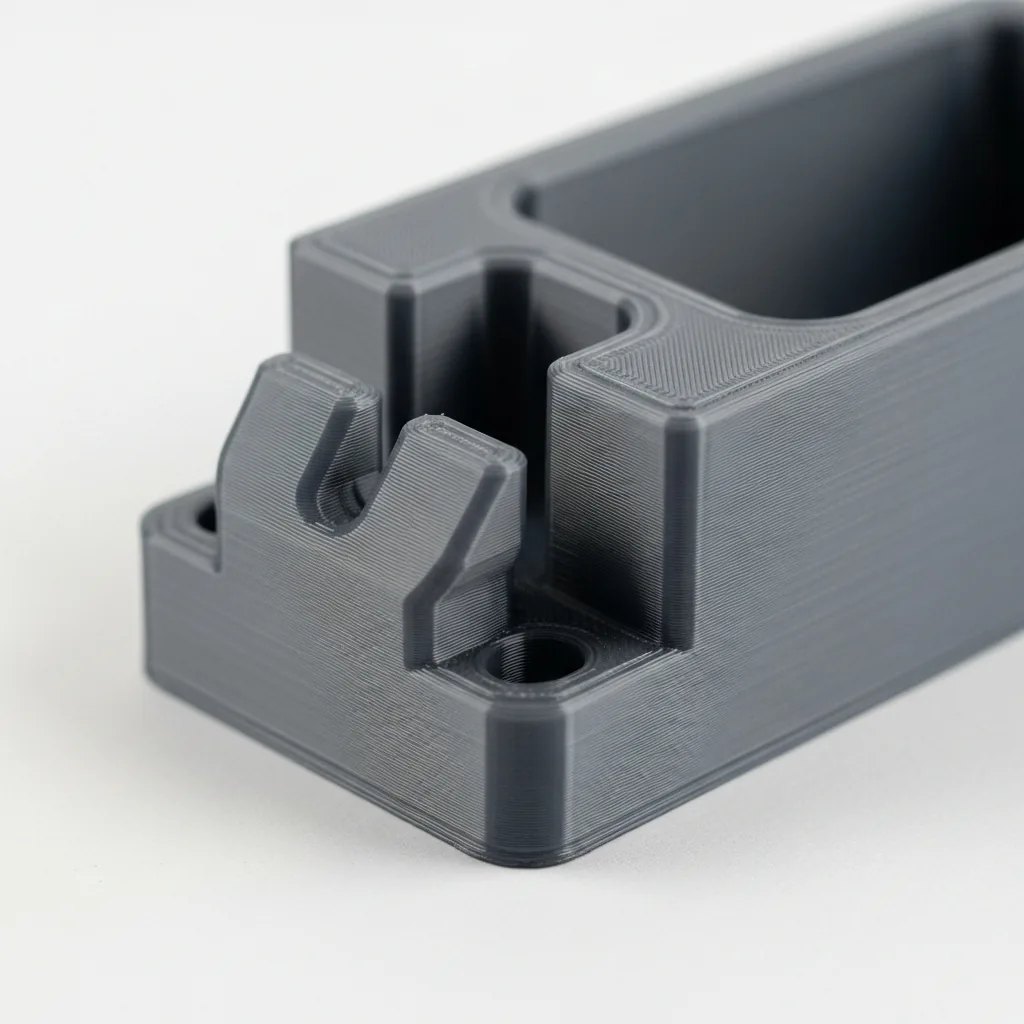
A single 3D-printed glossy PETG functional part with a snap-fit feature
How we print it

Recommended print environment for PETG.

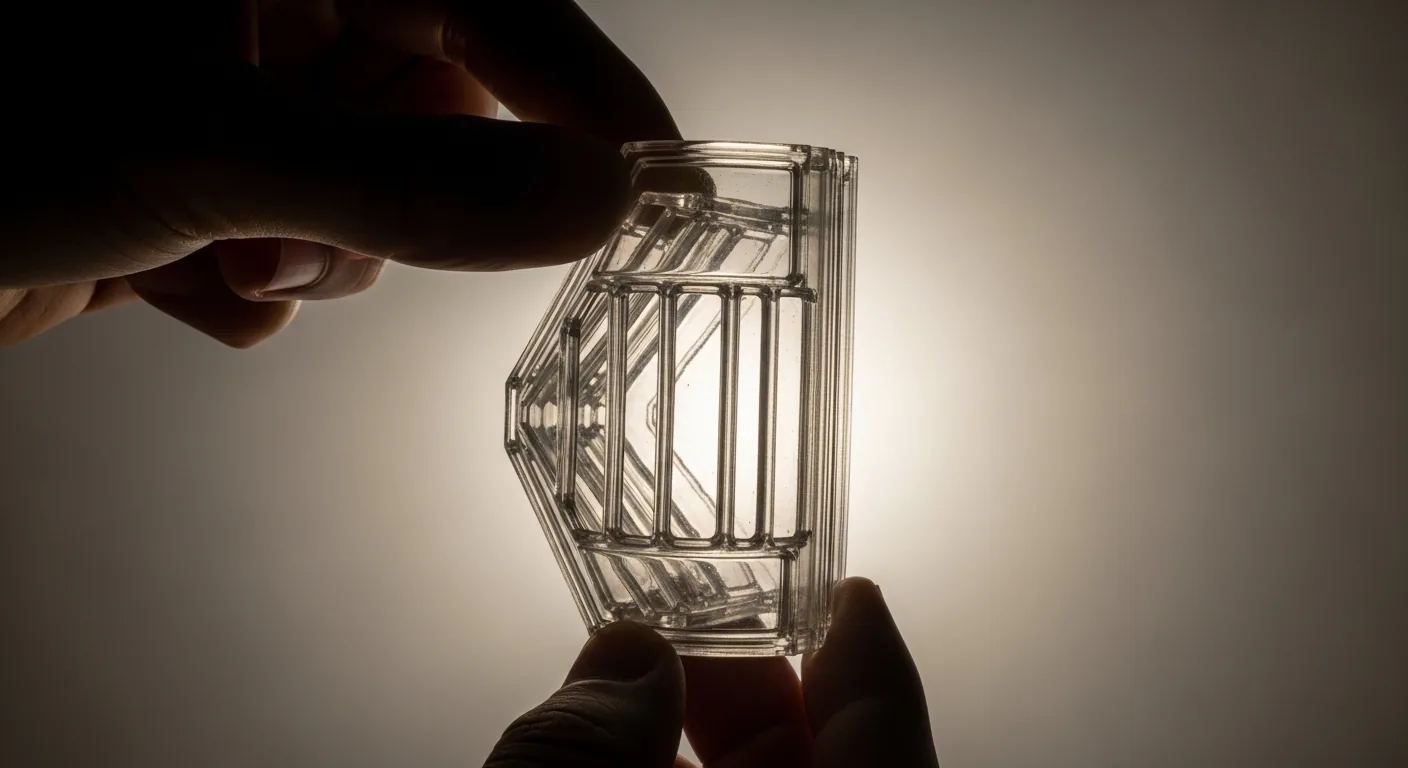
A translucent PETG 3D-printed part held up to soft light showing its light transmission
From brief to dispatch

Our process · How a PETG order moves through our workshop.

01

Brief

File or sketch in. Tell us colour, finish, water / food-adjacent or structural use.

02

Quote

Reviewed inside 24 hours · per-unit cost + colour confirmation.

03

DFM check

Wall thickness, overhang, support strategy, ductility-vs-load fit flagged before print.

04

Dry & print

Filament dried at 65°C for 6 hours (mandatory for PETG) · calibrated machine · stock or custom-RAL colour matched.

05

Finish

Sand to spec · 2K spray paint if needed · food-safe epoxy overcoat where requested.

06

Dispatch

Tracked UK courier, tracking number sent the moment it leaves.

Typical lead times · PETG
1-off prototype
3 to 5 working days
Quote inside 24h · drying adds ~6h, still faster than engineering composites
Batch of 10
5 to 7 working days
Multi-part bed packing for cost-efficient batch runs
Batch of 100
8 to 12 working days
Splits across multiple printers · QC sampled per print run · drying cycles parallelised
Rush turnaround
48 to 72h, on request
PETG drying time is the floor · realistic for small parts when filament is already conditioned · ask before quoting

Lead times start when CAD is signed off and colour is confirmed · CAD round-trips on rev requests can extend the clock. Custom RAL colour matching can add 1-2 days for filament procurement. Food-safe epoxy overcoat adds 24h for cure.

Case study
Hydroponic fittingWater-contact batch
Horticulture · water-contact

Hydroponic fitting batch run, PETG.

Production batch of water-contact irrigation fittings printed in standard PETG · stock-colour translucent grade, cosmetic-quality glossy finish out of process. PET-backbone hydrolytic stability proven in cold-to-warm water service. Indoor / outdoor commercial-grade use case · the part profile PETG was designed for.

Material: PETG · translucent finish Finish: Glossy as-printed Read the full case study →
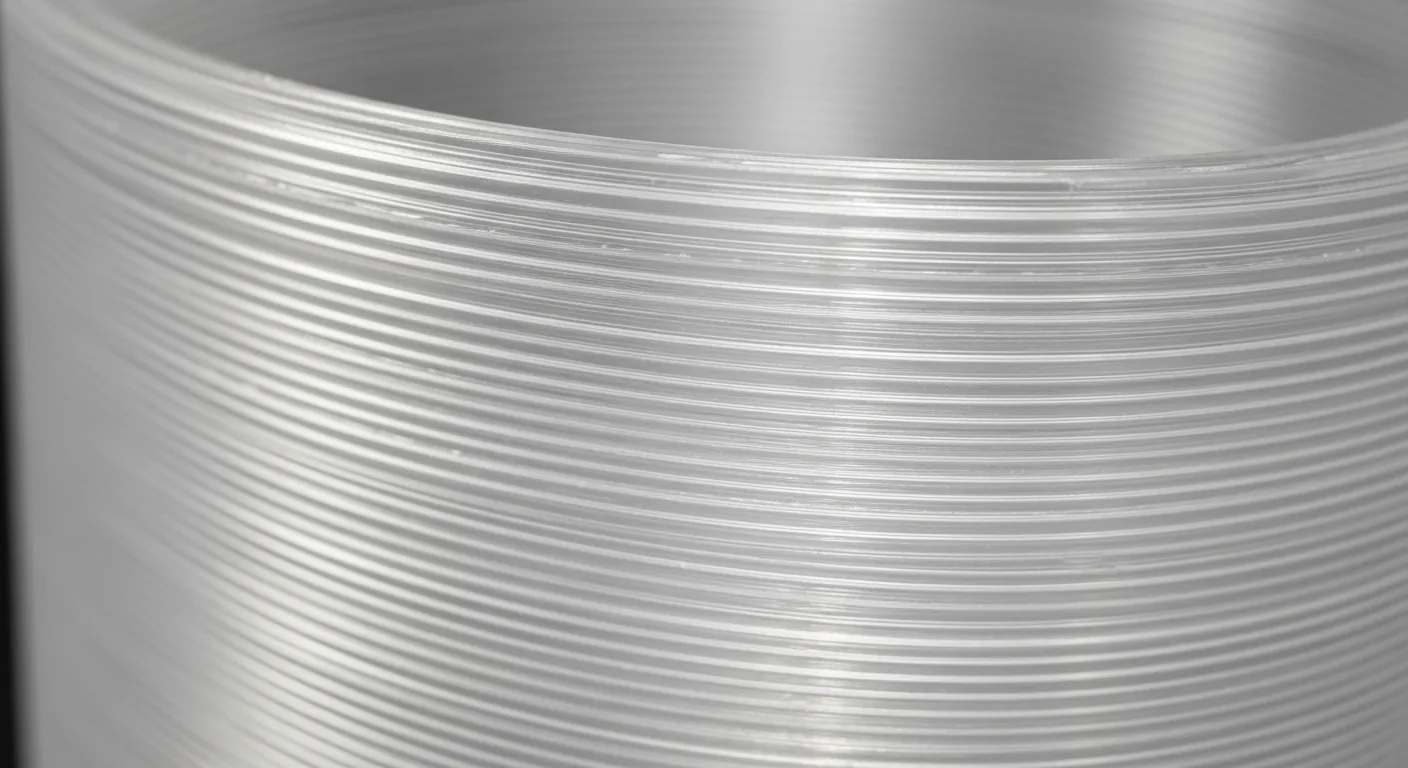
Extreme macro of the side wall of a translucent PETG 3D-printed part showing crisp regular horizontal layer lines with a glossy sheen
Material science · why it behaves the way it does

What PETG actually is · and why that matters for your part.

Definition

PETG is polyethylene terephthalate, glycol-modified · an amorphous copolyester where a fraction of the ethylene glycol monomer is replaced with cyclohexanedimethanol (CHDM). The base PET polymer is the same chemistry used in plastic water bottles, food packaging, and polyester fibre; the CHDM modification breaks the crystal symmetry and lets PETG print on FDM without the warping problems of crystalline PET. Tensile strength 50.8 MPa XY (ISO 527), HDT 78°C at 0.45 MPa (ISO 75), Young's modulus 2117 MPa, elongation at break 8.4% (more ductile than PLA's 6.3%). Density 1.25 g/cm³. The base polymer is FDA 21 CFR 177.1630 compliant for food contact in moulded/extruded form · the printed grade is not certified, but the chemistry makes certification straightforward.

"PETG is the material I reach for when the brief includes water, food-adjacent service, or mild outdoor exposure · or when the customer dropped a PLA prototype and watched it snap. It's the ductile commodity that does most of what people think PLA does, plus a meaningful jump in heat tolerance (78°C vs 60°C HDT) and the PET-backbone water story. The two catches are mandatory pre-print drying (PETG is hygroscopic · we condition every spool at 65°C for 6 hours) and the moderate UV ceiling. For multi-year outdoor we still recommend ASA."

· 3D Printing Express engineering team · UK workshop

Three questions worth answering before specifying PETG · where the polymer comes from, why it's hygroscopic, and where the 75°C HDT cliff really matters.

PET-bottle heritage

Same chemistry as a water bottle · with CHDM added so it prints

Base PET is the most-produced thermoplastic on Earth · food bottles, packaging, polyester fibre. Glycol modification (CHDM replaces some ethylene glycol) breaks the crystal symmetry, prevents crystallisation, and makes PET 3D-printable on FDM without the warping of crystalline PET.

Moisture behaviour

Hygroscopic · 0.54% equilibrium, drying mandatory

PETG absorbs water from humid air, saturating at ~0.54% per the manufacturer TDS. Wet PETG prints stringy, milky, brittle. The fix is straightforward · pre-print drying at 65°C for 6 hours (manufacturer setting). We do this on every spool before the bed.

Glass transition

Below 81°C · rigid · above · rubbery

Below Tg, polymer chains are frozen in the amorphous network. Above Tg, chains gain mobility · stiffness collapses and any residual stress relaxes. HDT 75°C at 1.8 MPa is the practical load-bearing ceiling. PLA Tg 61°C, ABS Tg 101°C (TDS V5.4).

What is PETG, chemically?

PETG is polyethylene terephthalate, glycol-modified · an amorphous copolyester. The base PET chemistry is the same polymer used in plastic water bottles, polyester clothing, and most food packaging. The modification: a fraction of the ethylene glycol monomer in the backbone is replaced with cyclohexanedimethanol (CHDM). That substitution breaks the crystal symmetry of the backbone and prevents the polymer from crystallising.

The chemical formula shifts from PET's -[O-CH₂-CH₂-O-CO-C₆H₄-CO]-n to PETG, where some of the -CH₂-CH₂- ethylene-glycol units are replaced with the larger -CH₂-C₆H₁₀-CH₂- CHDM rings. The result is a glass-clear, amorphous thermoplastic that prints beautifully on FDM without the warping problems of crystalline PET. This matters for three reasons: amorphous structure means no crystallisation shrinkage on cooling (large flat parts stay flat); PET backbone heritage gives PETG real chemical and moisture resistance; and the food-contact compliance of base PET (FDA 21 CFR 177.1630) carries through the chemistry for certified food-grade variants.

Why is PETG hygroscopic, and what does that mean for printing?

PETG absorbs moisture from humid air · equilibrium water absorption is 0.54% per the manufacturer TDS, reached over days to weeks in 60% RH workshop conditions. The hydroxyl groups introduced by the glycol modification are mildly polar, which is why PETG holds onto water more than purely non-polar polymers like polyethylene.

Wet PETG prints badly. Water in the filament flashes to steam at the nozzle (which sits well above water's boiling point), producing visible stringing, milky surface finish, and reduced layer adhesion. The brittleness of wet-printed PETG parts is the most common reason for "PETG broke at the layer line" complaints. The fix is straightforward · pre-print drying at 65°C for 6 hours (per the manufacturer's recommended setting) and storing the spool in a sealed dry-box with desiccant. We run every PETG spool through a filament drier before the bed; a maker skipping this step gets noticeably worse parts.

Why does PETG fail above 70°C?

PETG's glass transition temperature (Tg) sits at 81°C (DSC, 10°C/min). Below Tg the polymer chains are locked in the amorphous network and the part holds its shape. Above Tg the chains gain mobility · stiffness collapses, the part softens, and any residual stress from printing relaxes into creep. Heat deflection temperature (HDT) at 0.45 MPa load is 78°C, dropping to 75°C at 1.8 MPa load. Vicat softening at 84°C. For sustained service the practical ceiling is ~70°C · a PETG part in a car dashboard in summer, near an engine, or pressed against a radiator will creep and deform.

Steam autoclave at 121°C is well above HDT · parts deform. For sterilisation, ethylene oxide or IPA wipe-down work for PETG; dry-heat sterilisation below 70°C also works. For repeated steam autoclave service specify PEEK or PPSU. For sustained warm-service parts (engine bay, exhaust-adjacent, oven-adjacent) choose ABS or ASA (HDT 100°C class) or PA12-CF (HDT 130°C+ class).

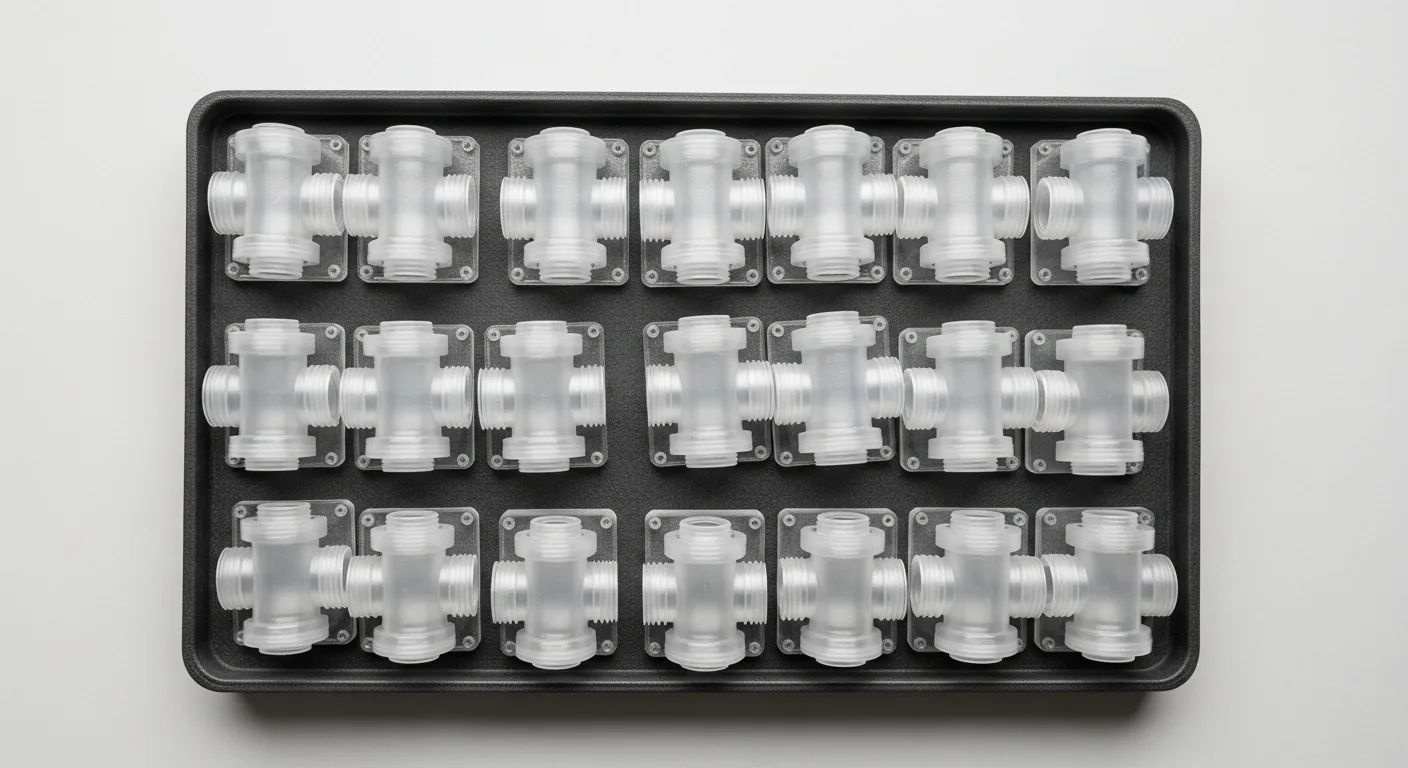
A neat tray of identical small translucent PETG 3D-printed water fittings
Full material spec · ISO-referenced

PETG material properties · every number an engineer needs, in one table.

Values measured to the ISO standards cited in the right-hand column, on the manufacturer's own injection-moulded test specimens · directly comparable to other engineering thermoplastics.

PropertyXY · print planeZ · build axisUnitStandard
Mechanical
Tensile strength50.842.8MPaISO 527
Young's modulus21171899MPaISO 527
Elongation at break8.43.3%ISO 527
Flexural strength (XY)69.6MPaISO 178
Flexural modulus (XY)1899MPaISO 178
Charpy impact (notched, XY)2.6kJ/m²ISO 179
Thermal
Heat deflection (HDT @ 0.45 MPa)78°CISO 75
Heat deflection (HDT @ 1.8 MPa)75°CISO 75
Glass transition temperature (Tg)81°CDSC, 10°C/min
Vicat softening temperature84°CISO 306
Physical
Density1.25g/cm³ @ 23°CISO 1183
Equilibrium water absorption0.54%manufacturer test
Melt index10.8g/10min240°C, 2.16kg
Light transmission90%GB/T 2410
Tensile anisotropy ratio1.19×XY/Zderived from ISO 527
Chemical resistance · manufacturer-rated
Weak acidsGood·manufacturer TDS
Strong acidsPoor·manufacturer TDS
Weak alkalisFair·manufacturer TDS
Strong alkalisPoor·manufacturer TDS
Oils and greaseGood·manufacturer TDS
Cosmetic / supply
Stock colour range20+ colours (incl. translucent + clear grades)·workshop stock
Custom RAL matchYes (1-2 day procurement)·on request
Finish grades availableGlossy as-printed, sanded, painted, translucent·workshop stock
Food-contact base polymerPET base · FDA 21 CFR 177.1630 compliant (printed grade NOT certified)·FDA regulation
Values from manufacturer-published ISO test specimens · directly comparable to other commodity thermoplastics Request full TDS by email →
Design for additive manufacturing

How to design a part that prints right in PETG.

Orientation

Mild anisotropy · favour XY load paths but less critical than engineering composites

PETG's anisotropy is mild (1.19× XY/Z · 50.8/42.8 MPa per TDS V5.4) · actually slightly less anisotropic than PLA (1.29×). For visual prototypes orient for cosmetic finish (best surface upward). For load-bearing PETG parts, still favour XY-direction load paths.

Wall thickness

Thicker walls survive impact · PETG's ductility helps but doesn't replace mass

PETG's higher elongation (8.4%) means thin walls handle impact better than PLA's, but layer-line geometry still dominates. The values shown follow the Hubs / Protolabs Network FDM minimums (0.8 mm supported, 2.0 mm minimum feature) · we DFM-check the wall thickness against your part's load case at quote stage.

Overhang behaviour

PETG bridges well · good hot-state stickiness lets long bridges hold

45° is the slicer-default support threshold across every major FDM tool · PETG's slower cooling and stickier hot state typically holds long bridges (5 mm+ at print temperature) better than PLA. Exact threshold depends on cooling, geometry, and surface-finish tolerance · we DFM-check overhangs at quote stage and recommend orientation.

Tolerance

Mid-range FDM tolerance · less precise than PLA, more predictable than ABS

PETG's amorphous structure means no crystallisation shrinkage on cooling (good) but the lower stiffness means slightly more deflection during finishing (modest). Exact tolerance depends on part size, geometry, and calibration · we confirm achievable tolerance against your CAD at quote stage.

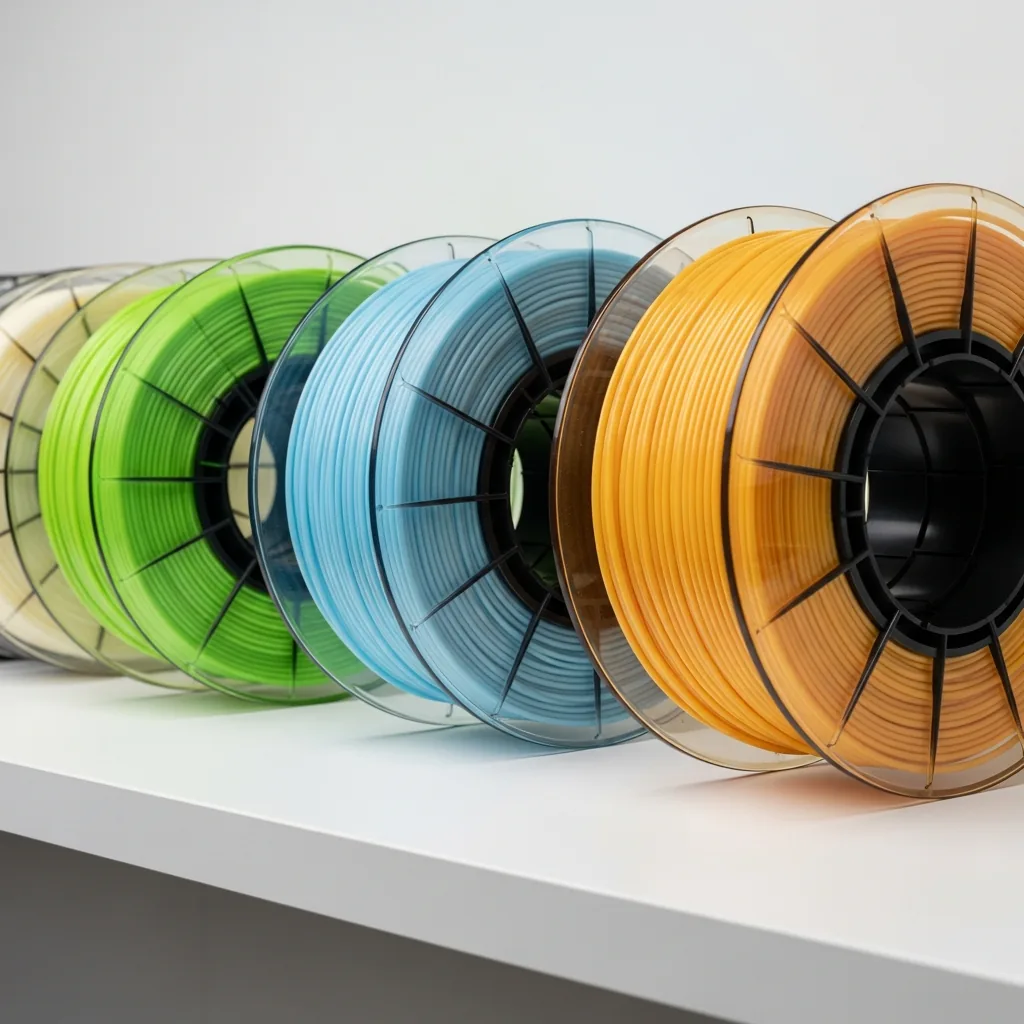
A stack of PETG filament spools in translucent colours on a shelf
Post-processing

Four routes to a finished surface.

Sanding · 240 → 400 → 800

Removes layer lines · matte finish

Removes 0.1-0.3 mm per surface · pre-paint prep or stand-alone hand-feel polish.

Pre-print drying · mandatory

Dry every spool at 65°C for 6 hours · skip this and the part suffers

Wet PETG (the spool has been in humid air more than ~3 days) prints stringy, milky, and brittle. Pre-print drying is per the manufacturer's recommended setting · we run this on every spool before the bed.

2K spray paint · RAL match

Glass-smooth · any colour from any RAL chart

PETG takes paint with adhesion-promoting primer (PETG resists direct paint adhesion more than PLA). Adds 0.05-0.15 mm per surface · sand to 800 grit, primer + topcoat · paint also acts as a UV barrier for outdoor service.

Food-safe epoxy overcoat

Seals layer porosity for water / food-adjacent service

The real food-contact risk on FDM PETG isn't the polymer · it's bacteria in micro-gaps between layers. A food-safe epoxy overcoat (we use NSF-certified two-part) bridges the layer-line porosity and gives a continuous food-adjacent surface. Adds 0.05-0.1 mm per surface and 24 hours cure.

Why 3DPE for PETG

Four reasons engineers and product brands send us their PETG briefs.

ISO

ISO-referenced spec on every part

Every value on this page traces to an ISO test method · the manufacturer's V5.4 EN TDS, cross-checked against the PDF in-session. We don't quote derived numbers without naming the standard.

UK

Printed in the UK · spools always dried

No offshore subcontracting. Files, prints, and couriers all stay in the UK · and we dry every PETG spool at 65°C for 6 hours before the bed, per the manufacturer's recommended setting.

FIT

Material-fit check on every brief

Send three things: where the part lives (water, food-adjacent, outdoor, indoor), what it does (cosmetic / functional / load-bearing), and colour / finish. our team come back inside 24 hours · if PLA, ABS, ASA, or another material fits better, we say so.

JC
FB

Two engineers, named

our team review every brief before quote. No ticket queue, no account managers.

According to the PolyLite PETG TDS, PETG delivers tensile XY 50.8 ± 0.9 MPa per ISO 527 with HDT 78 °C @ 0.45 MPa and Tg 81 °C · fully amorphous, no crystalline melt.

FAQ

FAQ · Fourteen questions worth getting in writing before specifying PETG.

How do you print PETG?

We print PETG at 230–260°C nozzle and 70–80°C bed, open frame with light part cooling, on a standard brass nozzle. PETG must be dried at 65°C for 6h before printing or you get bubbling and weak layers. The main print challenge is stringing and ooze, so we tune retraction, travel speed and temperature per part rather than running one generic profile. Bed adhesion is strong, so a release agent or textured plate is used to avoid tearing the sheet on removal.

Do you recycle PETG print waste?

Yes. We run a closed loop in our own workshop. Failed prints, purge, and support waste are collected, reground, and reprocessed here instead of going to landfill. That is standard on every PETG job, no surcharge.

Is PETG stronger than PLA?

Tensile strength XY is effectively a tie · 50.8 MPa PETG vs 52.3 MPa PLA (per TDS V5.4 for both). PLA wins on stiffness (Young's modulus 3427 vs 2117 MPa · 62% stiffer). The real PETG advantage is ductility · elongation at break 8.4% vs PLA's 6.3% (33% more strain before failure). PETG bends and yields under impact where PLA snaps clean. Notched Charpy is similar (2.6 vs 3.3 kJ/m²). For raw impact toughness ABS still wins (18.0 kJ/m² Charpy notched · 7× higher than PETG).

Is PETG food-safe?

The base PET polymer is FDA 21 CFR 177.1630 compliant for food contact in moulded and extruded form. Standard standard PETG is NOT certified for food contact · the certification applies to specific food-grade PETG variants, not to commodity FDM filaments. For a food-contact application 3DPE specifies a certified food-grade PETG variant and recommends a food-safe epoxy overcoat to seal FDM layer porosity (the real risk · bacteria can harbour in micro-gaps between print layers even when the polymer itself is food-safe). The honest answer: PETG is the right chemistry, but printed parts need certification + sealing for true food-contact service.

Is PETG waterproof?

Genuinely yes for cold-to-warm water service. PETG has good hydrolytic stability and the base PET backbone is the same chemistry used in plastic water bottles. Suitable for hydroponic fittings, splash enclosures, water-tank brackets, and vases. Long-term sustained service above 60°C in hot water starts to degrade the polymer; for repeatable hot-water service specify PP or PEEK. Note: PETG itself absorbs moisture from humid air (0.54% equilibrium per TDS) · this affects print quality, not the waterproof-ness of a finished, dried part.

Is PETG UV-resistant?

Moderate UV resistance · better than PLA, slightly better than ABS, not as good as ASA. The PET aromatic ring absorbs UV more stably than the aliphatic PLA backbone, which is why PET water bottles survive outdoor warehousing. For 6 to 12 months UK outdoor service uncoated PETG holds up reasonably (colour fade and surface micro-cracking begin around year 2). For multi-year outdoor service specify ASA or UV-stabilised PC. We use the phrase "moderate UV resistance" not "UV resistant".

Is PETG chemical-resistant? · TDS compatibility table

Per the manufacturer TDS · GOOD against weak acids and oils/grease, POOR against strong acids and strong alkalis, FAIR against weak alkalis. Also dissolves partially in acetone and other ketones. For sustained chemical-service parts use PA12 or PP. Match your specific exposure below.

Chemical / familyResistanceNotes
Weak acids (acetic, citric, dilute organic)GoodManufacturer TDS rating · short-term storage
Strong acids (sulphuric, HCl, nitric)PoorManufacturer TDS rating · polymer chain breakdown
Weak alkalis (dilute soap, mild bleach)FairManufacturer TDS rating · short-term only
Strong alkalis (caustic soda, ammonia)PoorManufacturer TDS rating · ester bond hydrolysis
Oils and greaseGoodManufacturer TDS rating · sustained contact OK
Cold water, sea water (cold)ExcellentPET-backbone hydrolytic stability · proven in bottles
Hot water (sustained > 60°C)LimitedApproaches HDT · hydrolysis accelerates over months
Steam autoclave (121°C)FailsAbove HDT · parts deform · choose PEEK / PPSU
Detergents, soap (mild)GoodDishwasher-style detergents · short-cycle only (heat above 60°C is the limit)
Alcohols (IPA, ethanol, methanol) wipeGoodSurface cleaning, no soak
Acetone, MEK (ketones)PoorPartial dissolution · industrial degreaser, nail polish remover
Toluene, xylene (aromatic hydrocarbons)PoorDegrades over time
Petrol, diesel (brief contact)LimitedBrief OK · sustained attacks the polymer
Chlorinated solvents (DCM, chloroform)PoorStrong solvents · industrial use only, workshop hazards
Swimming pool chemistry (chlorine, bromine)LimitedShort-term OK · sustained immersion attacks the polymer
UV exposure (UK outdoor)Limited6-12 months uncoated · multi-year requires overcoat or ASA
Outdoor weathering (sheltered)GoodRain-tight under cover, hydroponic outdoor, garden irrigation
Food contact (base PET chemistry)ExcellentFDA 21 CFR 177.1630 compliant base · printed grade needs certification + sealing for true food-contact

First five rows are direct manufacturer TDS ratings. Remaining rows reflect industry-typical PETG behaviour and 3DPE workshop experience · brief contact is always more forgiving than sustained exposure. For sustained chemical service beyond water and oils, switch material to ABS, PA12, or PP depending on the exposure.

Does PETG warp when printing?

Much less than ABS, slightly more than PLA. PETG is amorphous · no crystallisation shrinkage on cooling. Bed adhesion on PC, textured PEI, or buildtak is generally good. Large flat PETG parts stay flat. The biggest print issue is wet filament producing stringing and brittle layer adhesion, not warping · this is why we dry every spool at 65°C for 6 hours before printing per the manufacturer's recommended drying setting.

Why does PETG print badly when the filament is wet?

PETG is hygroscopic · equilibrium water absorption is 0.54% (per TDS) and the filament approaches saturation over days to weeks in humid UK workshop air. Water in the filament flashes to steam at the nozzle, producing visible stringing, milky surface, and reduced layer adhesion. Pre-print drying at 65°C for 6 hours (manufacturer setting) is mandatory for production work. A DIY maker skipping this step produces noticeably worse parts; we run every spool through a drier before the bed.

PETG vs ABS · which one for my part?

Different tools. PETG wins on: ease of print (no chamber needed, low VOC), water and food-adjacent service, moderate UV. ABS wins on: heat (HDT 98°C vs PETG 75°C), impact (Charpy 18.0 vs 2.6 kJ/m² · 7× tougher), acetone-smoothability for finishing, lower density (1.04 vs 1.25 g/cm³ · 17% lighter parts). If the part sees impact loads or sustained heat above 60°C, choose ABS. If it sees water, mild outdoor, or food-adjacent service, choose PETG.

Can PETG be solvent-bonded?

Not with common solvents. PETG resists most chemistry that would bond it (acetone partially dissolves but doesn't cleanly fuse like it does for ABS). Use 2-part epoxy for structural bonds · cyanoacrylate works but bonds are weaker than on PLA or ABS. Ultrasonic welding works well. For multi-part assemblies, mechanical fasteners with heat-set inserts (245°C iron temp) are the most reliable joint.

Can PETG be autoclaved at 121°C?

No. Steam autoclave at 121°C is above PETG's HDT (75°C at 1.8 MPa) · parts deform. Dry-heat sterilisation below 70°C, ethylene oxide, and IPA wipe-down all work for PETG. For repeated steam-autoclave service (medical, dental, lab equipment) specify PEEK or PPSU.

What temperature does PETG actually fail at?

Tg sits at 81°C · above this PETG softens. HDT is 78°C at 0.45 MPa and 75°C at 1.8 MPa (per TDS). Vicat softening at 84°C. A PETG part in sustained service above 70°C will creep and slowly deform. PETG handles 60°C hot water short-term, won't survive an engine bay, and is the wrong material for anything near a radiator or in direct summer sun on a hot surface. For warm-service parts choose ABS or ASA (HDT 100°C class).

How much does PETG cost vs other materials?

Filament cost is roughly £25-40/kg for stock-colour PETG · slightly above PLA (£20-35/kg), below ABS (£30-45/kg), well below PA12-CF (£90-130/kg). The total quote depends on print time + post-processing more than filament cost · for a typical bracket or enclosure, material is 10-20% of the unit cost. Send the brief and we'll quote the actual job.
Glossary

Engineering terms used on this page.

PETG (polyethylene terephthalate, glycol-modified)
An amorphous copolyester where a fraction of the ethylene glycol monomer in PET's backbone is replaced with cyclohexanedimethanol (CHDM). The result: same PET chemistry as plastic water bottles, modified so it prints on FDM without warping. The commodity workhorse for water-contact, food-adjacent, and moderate-temperature parts.
CHDM (cyclohexanedimethanol)
The bulky cycloaliphatic diol that replaces a fraction of ethylene glycol in the PET backbone to produce PETG. The larger ring structure breaks the crystal symmetry of PET, preventing crystallisation and making the polymer amorphous and FDM-printable.
Amorphous polymer
A polymer with no long-range crystalline order · chains arranged randomly in the solid state. PETG is amorphous, unlike crystalline PET. Amorphous polymers print without crystallisation shrinkage but soften gradually through Tg rather than melting sharply at Tm.
Hygroscopic
A material that absorbs water from humid air. PETG's equilibrium water absorption is 0.54% (per TDS). Hygroscopic filaments require pre-print drying · for PETG, 65°C for 6 hours per the manufacturer's recommendation.
FDA 21 CFR 177.1630
US Code of Federal Regulations section specifying food-contact compliance for polyethylene terephthalate (PET) base polymer. Applies to moulded and extruded PET food-contact items. The standard PETG used here has the right base chemistry but is NOT certified as food-grade; certified food-grade PETG variants exist for that use case.
Anisotropy
The dependence of a material's properties on direction. PETG's anisotropy ratio is mild (1.19× XY/Z, derived from TDS values) · slightly less anisotropic than PLA (1.29×) and much less than fibre-reinforced engineering composites.
Glass transition temperature (Tg)
The temperature at which an amorphous polymer transitions from glassy/rigid to rubbery/soft. PETG's Tg is 81°C (DSC, 10°C/min) · the practical service-temperature ceiling. Above Tg, parts soften and lose stiffness.
Heat deflection temperature (HDT)
The temperature at which a loaded specimen deflects a standard amount under a defined load (ISO 75). HDT @ 0.45 MPa is the lower-load value (78°C for PETG); HDT @ 1.8 MPa is the structural ceiling (75°C for PETG).
Vicat softening temperature
The temperature at which a standard needle penetrates a test specimen under defined load (ISO 306). PETG's Vicat is 84°C · a related but distinct ceiling from HDT.
Charpy impact strength
Energy a notched specimen absorbs in a swinging-pendulum impact test (ISO 179). PETG's notched value of 2.6 ± 0.2 kJ/m² is similar to PLA (3.3) · the real difference is yield, not raw impact. ABS at 18.0 kJ/m² is 7× higher.
FDM (Fused Deposition Modelling)
Filament-extrusion 3D printing. Distinct from SLS/MJF (powder-bed) and SLA (resin). PETG is FDM-only territory · powder-bed PET is a different process with different design rules.
Heat-set insert
A brass insert with knurled exterior that is melted into a pre-printed hole using a soldering iron. For PETG, iron temperature is approximately 245°C (printing temperature plus 10-20°C, per CNC Kitchen). Minimum 2 mm of material around and below the insert (Markforged).
PETG · GLYCOL-MODIFIED PET · UK PRINTED

Got a brief that calls for PETG? Tell us colour, finish, and where the part lives.

You'll hear back from our team within 24 hours · with material-fit check, colour confirmation, drying/lead-time confirmation, and food-safe overcoat recommendation if relevant.

Send your brief Browse other materials Email for full spec