Heat-resistant 3D printing · materials by service temperature, printed in the UK.

Nine heat-resistant grades from 110°C HDT to 252°C HDT. Pick by service temperature, load profile, and chemistry envelope · we print each grade in-house with the calibrated nozzle + anneal cycle. 5-day standard lead time.

Reviewed by the 3D Printing Express engineering team.

Heat resistant 3D printing service · UK · materials by HDT band · quoted in 6 hours.

Quick pick · by service temperature
  • 250°C+ HDT · PEEK-adjacent. PPS-CF (252°C HDT, stiffness-critical) · PPS-GF (236-249°C HDT dual anneal, dielectric). For aerospace cabin parts, chemical-plant fixtures, EV battery, semiconductor tooling. Both V-0 flame-rated.
  • 150-200°C HDT · engineering nylon + polyester composites. PA6-GF (191°C HDT, glass-reinforced PA6) · PA612-CF (175°C HDT, long-chain nylon-CF) · PA612-ESD (157°C HDT, ESD-safe). Under-hood automotive, engine-bay brackets, soldering jigs.
  • 130-150°C HDT · workhorse engineering composites. PA12-CF (131°C HDT, impact-tough) · PET-CF (147°C HDT, stiff annealed) · PET-GF (133°C HDT, isotropic). Industrial brackets, fixtures, mounts that see moderate heat.
  • 110-130°C HDT · cosmetic + housing. PC-ABS (112°C HDT, impact + heat) · PC (~110°C HDT, transparent + tough). For warm-service enclosures, dashboard parts, indoor light fixtures.

What clients say about our UK 3D printing service on Google

4.9 based on 36 Google reviews
Read all 36 on Google →
Jonny Higgs
· 2 months ago · via Google

"James handled the 3D printing for a functional heat resistant component we needed in batch production. He helped dial in the prototype first with their design service, then produced the final batch with really consistent results. Super fast 3D print turnaround and great quality across all the 3D printed parts. Will 100% be coming back."

Matt Shutler
· 8 months ago · via Google

"We needed a sit-in F1-car for an exhibition to showcase our new racing game. 3D Printing Express took our CAD, optimised it for strength and weight as we had no idea how it all worked! Turned out beautifully. They colour matched the finish and was looking like the real deal. On show day the cockpit ran non-stop, adults and kids jumped in. Multiple visitors asked who built it."

Kayleigh Adams
· 7 months ago · via Google

"We ordered a batch of 100 PA-12 parts from 3D Printing Express and could not be happier. Every part arrived consistent, dimensionally accurate, and ready for use straight from the box. The PA-12 gave us the strength and stability we needed for functional testing, with minimal post-processing required. Delivery was on time, communication was excellent, and their QC clearly made a difference."

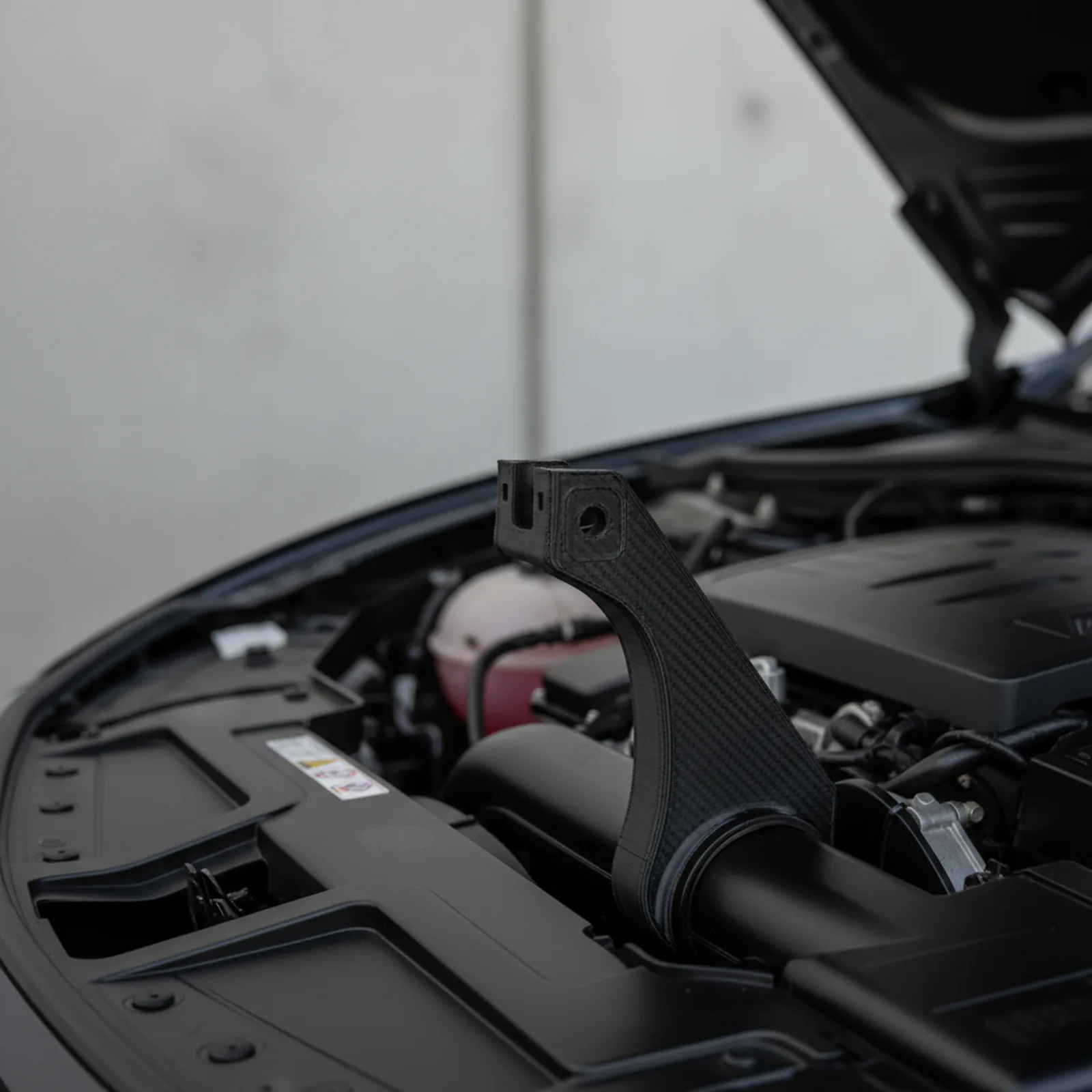
Heat-resistant 3D-printed under-bonnet bracket
The 9 grades, ranked by HDT

Match the service temperature to the grade.

HDT bands from cosmetic-heat (PC) up to PEEK-adjacent (PPS). All values per ISO 75 from the manufacturer TDS · cross-checked against the PDF.

According to the Polymaker PPS-CF10 TDS, the material reaches 252.5°C HDT @ 0.45 MPa per ISO 75 after the standard 125-130°C / 10-16h anneal · the highest HDT in our heat-resistant range. According to the Polymaker PA6-GF TDS, PA6-GF reaches 191°C HDT @ 0.45 MPa, the cost-effective glass-reinforced nylon for engine-bay-temperature service.

GradeHDT @ 0.45 MPaHDT @ 1.8 MPaTgContinuous service ceilingBest for
PPS-CF252.5°C133°C97.7°C~200°CAerospace, chemical-plant, V-0 flame
PPS-GF (230°C anneal)248.9°C219.6°C95.0°C~200°CEV battery, dielectric high-temp, V-0 flame
PPS-GF (130°C anneal)236.3°C125.8°C95.0°C~180°CStandard anneal · dielectric + V-0
PA6-GF191°C~157°C70.4°C~120°CInjection-mould-replacement, tough-when-wet
PA612-CF175°C125.4°C~50-60°C~110°COutdoor/UV-tolerant CF nylon
PA612-ESD157°C125.4°C41.8°C~90°CESD-safe soldering jigs, electronics handling
PET-CF (annealed)147.5°C~105°C79.3°C~100°CStiff CF composite, dimensional fixtures
PET-GF (annealed)133.7°C97°C59.5°C~90°CLow-anisotropy GF composite, moisture-stable
PA12-CF131°C~80°C~50°C~90°CImpact-tough nylon-CF, balanced engineering
PC-ABS111.7°C106.4°C109°C~95°CImpact + heat enclosures, dashboards
PC~110°C~108°C~145°C~95°CTransparent housings, light fixtures

Star (★) marks the band winner. HDT figures are post-anneal where applicable (PPS, PET family). Continuous service ceiling is typically 20-50°C below HDT for sustained-load service · send the brief with service duration and load profile for a tighter recommendation.

Which heat-resistant grade for which job

The decision tree, by service requirement.

Q1. What's the maximum continuous service temperature?
Above 180°C → PPS-CF or PPS-GF. Only family in our range with the thermal envelope. Above 220°C continuous → step to PEEK (we don't stock; can refer).
120-180°C → PA6-GF, PA612-CF, or PA612-ESD. PA family engineering composites.
90-120°C → PA12-CF, PET-CF, PET-GF, PC-ABS, PC.
Below 90°C → commodity grades (ABS, ASA, PETG) cover this range at lower cost.
Q2. Does the part need flame rating (UL94 V-0)?
Yes → PPS-CF (structural) or PPS-GF (dielectric). Both V-0 at 1.5mm. See flame-retardant guide.
No (HB acceptable) → the wider HDT range opens · PA-GF and PA-CF cover most heat-only requirements at lower cost.
Q3. Does the part need electrical isolation (dielectric)?
Yes → PPS-GF (6.05 kV/mm dielectric strength), or PET-GF for room-temp dielectric. CF composites are conductive at fibre boundaries · NOT specified for electrical isolation.
No → CF composites (PPS-CF, PA12-CF, etc.) deliver higher stiffness at the same HDT band.
Q4. Does the part see impact load or vibration?
Yes → PA12-CF (Charpy notched 9.9 kJ/m² · highest in the heat-tolerant range) or PC-ABS (~25 kJ/m² · PC-backbone toughness). PPS family is brittle in impact.
No (static load) → any heat-tolerant grade in the matching HDT band.
Q5. Does the part see humidity in service?
Yes (humid workshop, outdoor, marine) → PPS-CF or PPS-GF (0.11-0.225% water · lowest in our range). PA-CF nylons absorb 1.5-3.3% water and lose ~50% tensile when wet.
No (climate-controlled indoor) → PA-CF nylons fine.
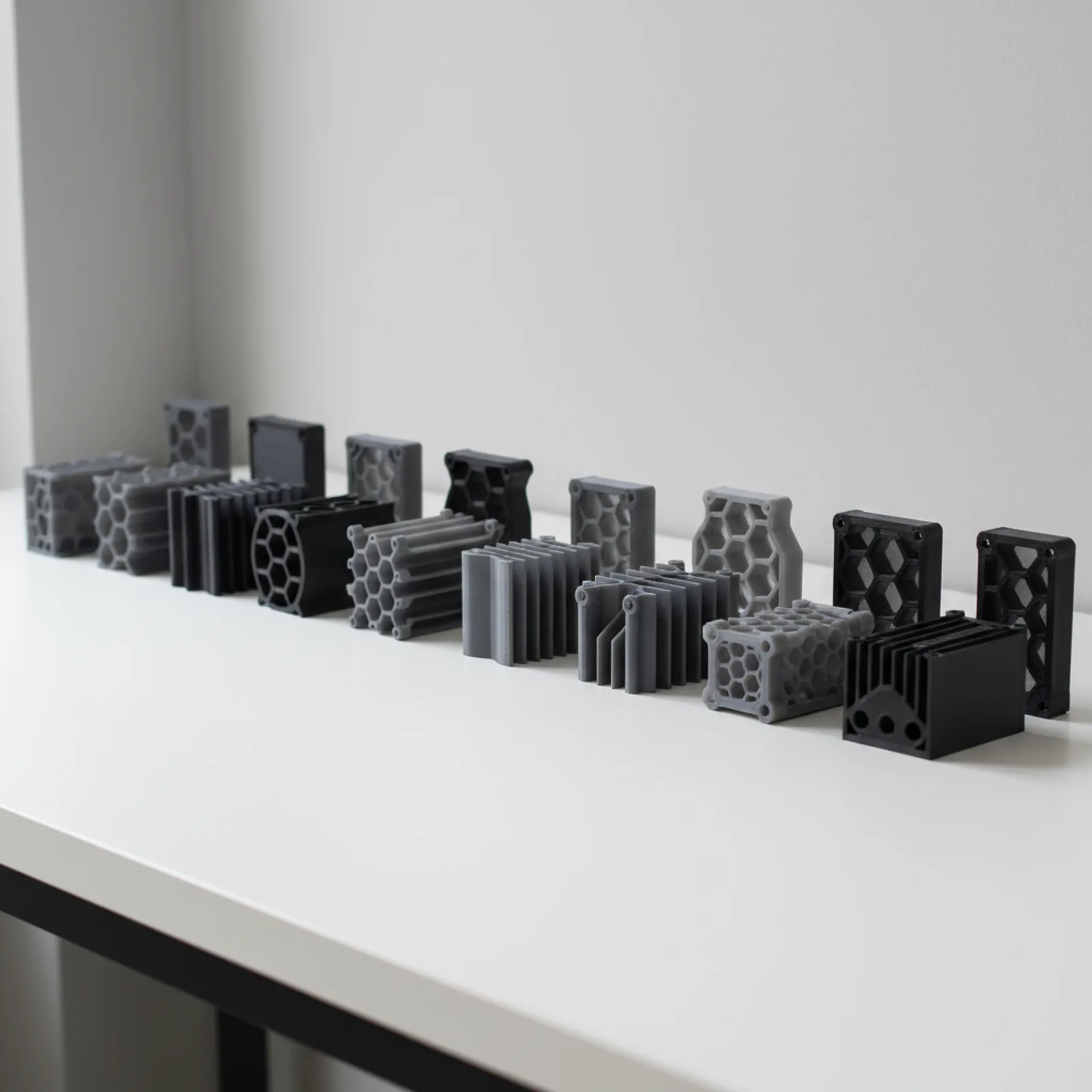
Range of heat-resistant 3D-printed grades
Applications by industry

Where each heat-resistant grade earns its place.

Automotive under-hood + engine-bay
PA6-GF for cost-effective glass-reinforced nylon at 120-150°C. PPS-CF for exhaust-adjacent + chemical proximity above 150°C. PA612-CF for UV-exposed under-hood parts (manufacturer-published UV claim).
EV battery + motor controller hardware
PPS-GF · the V-0 + dielectric + 236-249°C HDT wedge for battery module brackets, contactor housings, motor controller enclosures.
Aerospace cabin + non-flight-critical brackets
PPS-CF for structural · 252°C HDT, V-0, broad chemistry resistance. PPS-GF for fluid-handling near electrics. PEEK is the step-up for flight-critical (we don't stock; can refer).
Chemical-plant + petrochem tooling
PPS-CF · 252°C HDT + broad chemistry resistance (acids, bases, hydrocarbons, ketones, hot water and steam to 200°C). Industrial PPS family is OEM-specified for chemical-plant piping.
Soldering jigs + electronics-reflow fixtures
PA612-ESD · 157°C HDT + ESD-dissipative at 300°C calibrated nozzle (10^5-10^6 Ω/sq). The high-temperature ESD-safe nylon for soldering wave-front and reflow-near service.
Industrial fixtures + jigs (climate-controlled)
PA12-CF for balanced engineering at moderate heat (90-120°C). PA6-GF for injection-mould replacement with humidity tolerance.
Indoor warm-service enclosures + housings
PC-ABS (112°C HDT, impact-tough) for drop-tested enclosures. PC (~110°C HDT) for transparent housings + light fixtures.
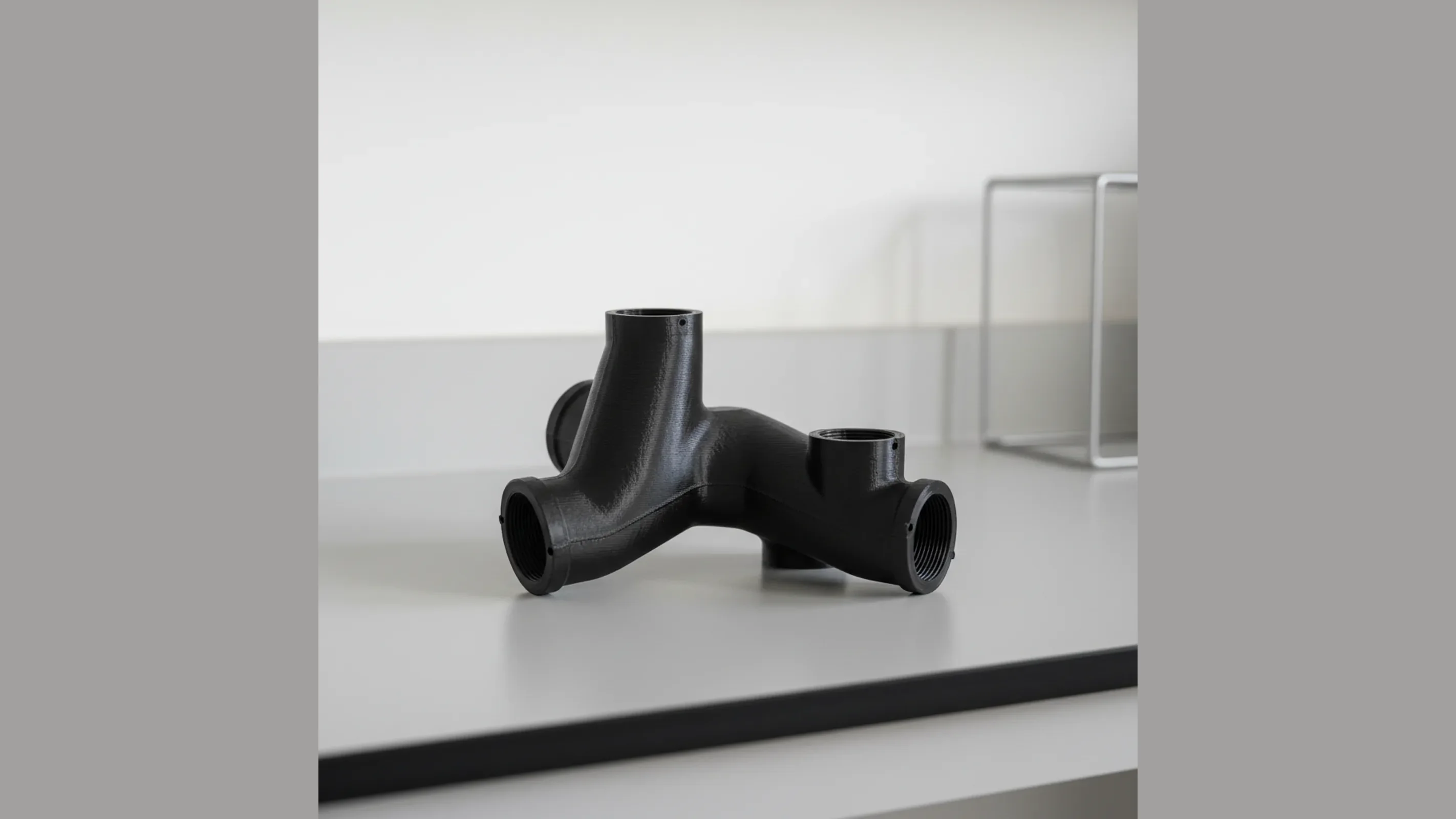
High-temperature 3D-printed manifold
The process · brief to heat-rated part

Our process · 5 working days standard · 2-3 days rush.

Each step calibrated for the target HDT · anneal cycle where applicable, dimensional QA against CAD.

01

Brief

Send CAD or sketch + max service temp + service duration + load profile + flame/ESD requirements. We confirm grade choice within 24 hours.

02

Quote

Fixed price + lead time + grade choice + anneal cycle plan. No design fees on standard quotes.

03

Print

Hardened-steel nozzle for CF/GF composites, standard for PC family. Production-grade FDM with calibrated chamber + bed temperatures.

04

Anneal & QA

PPS grades: 125-130°C / 10-16h (or 230°C for high-HDT PPS-GF). PA family: 100°C / 16h. PET family: 120°C / 10h. Dimensional check vs CAD post-anneal.

05

Despatch

Sent next-day courier from the UK. Documentation pack on request · material TDS, anneal record, dimensional report.

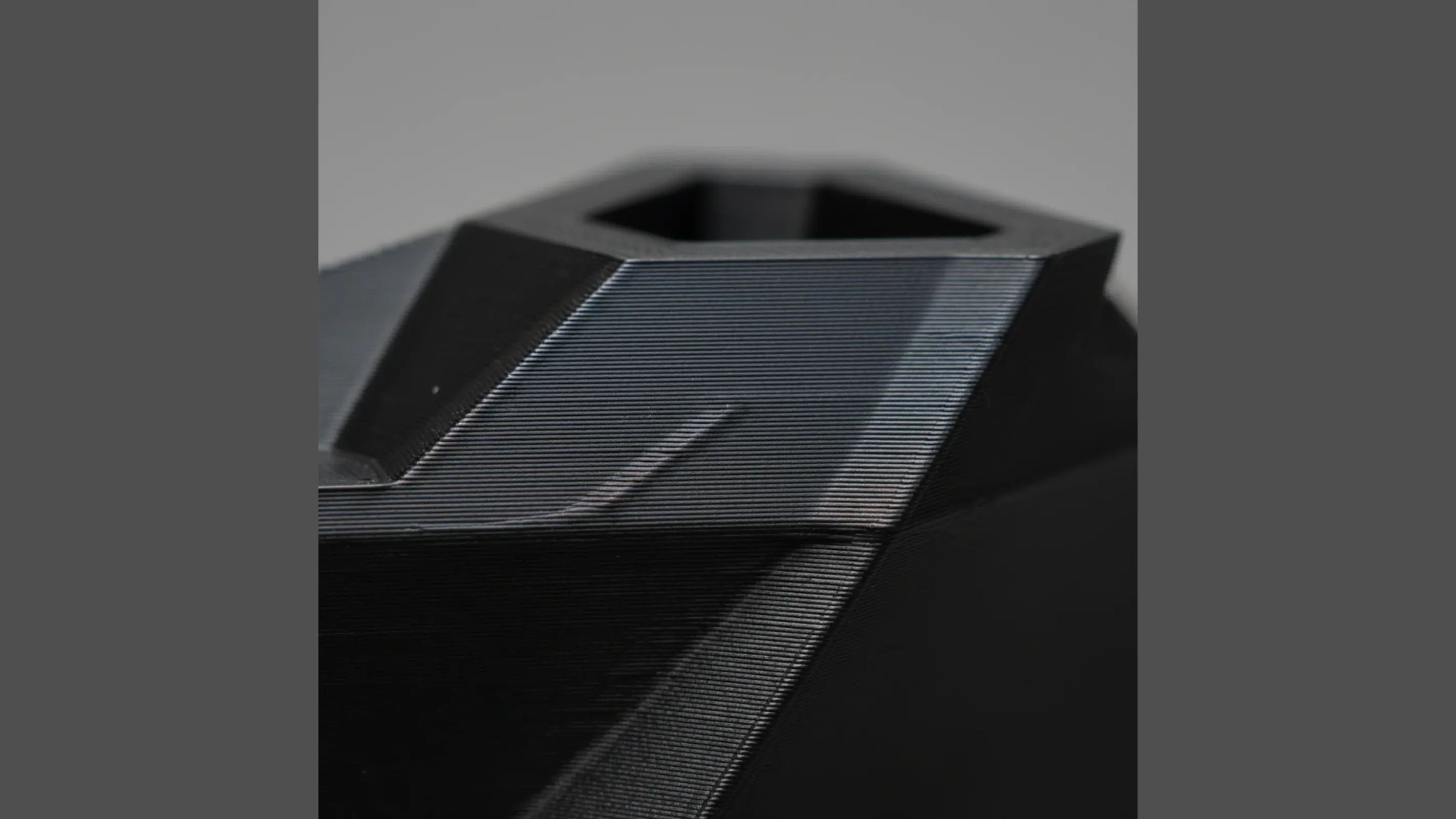
Macro of a heat-resistant 3D-printed surface
Common questions on heat-resistant 3D printing

FAQ · HDT, Tg, service temp · what the spec actually tells you.

What's the difference between HDT @ 0.45 MPa and HDT @ 1.8 MPa?

HDT @ 0.45 MPa is the lower-load value · the temperature at which a lightly-loaded specimen deflects a standard amount per ISO 75. Think of it as the cosmetic/light-service ceiling. HDT @ 1.8 MPa is the higher-load value · the structural-load ceiling. For continuous structural service, plan to stay below the 1.8 MPa HDT. For short-term thermal excursions or lightly-loaded parts, the 0.45 MPa HDT figure applies.

What does Tg vs HDT actually tell me?

Tg (glass transition temperature) is the point where amorphous polymer chains transition from glassy/rigid to rubbery/soft. HDT (heat deflection temperature) is the point where a loaded specimen has deflected a standard amount. For amorphous polymers (PETG, PC, ABS), Tg ≈ HDT. For semi-crystalline polymers (PPS, PET, PA), HDT can be significantly higher than Tg because the crystalline regions continue to carry load above Tg until the crystallites melt at Tm.

Which grade for a 150°C engine-bay bracket?

PA6-GF (HDT 191°C @ 0.45 MPa) for cost-effective glass-reinforced nylon at moderate engine-bay temperatures. PET-CF (HDT 147°C annealed) at edge-of-envelope. For sustained service above 130°C, step up to PPS-CF or PPS-GF (HDT 236-252°C) · PA-CF nylons start to creep above 130°C continuous.

Can I anneal a PLA or PETG part to raise HDT?

PLA · yes, modestly. Annealing semi-crystalline PLA at 80-110°C raises crystallinity and HDT from ~55°C to ~110°C, but parts shrink ~3% and become more brittle. PETG · no. PETG is amorphous · annealing doesn't raise HDT meaningfully. For heat above the 80°C PETG ceiling, step to PET-CF / PET-GF (semi-crystalline polyester, annealable) or to the PPS family.

What about PEEK? Why isn't it in your range?

PEEK is the next step up from PPS · HDT ~160-180°C, continuous service to 250°C. We don't currently stock PEEK because the £400-600/kg filament cost + £30k+ chamber-heated printer requirement doesn't fit our small-batch service model. For sustained service above 220°C, PEEK is the right material · we can refer you to a PEEK-specialist provider. For service below 220°C, our PPS-CF (252°C HDT) covers the same envelope at a fraction of the cost.

What about service temperature limits below the HDT?

HDT is the deflection-under-load test point. Continuous-service temperature (the long-term operational ceiling) is typically 20-50°C below HDT for most polymers. For PPS-CF (252°C HDT), continuous service is ~200°C. For PA12-CF (131°C HDT), continuous service is ~90°C. For PETG (75°C HDT), continuous service is ~60°C. Send the brief with service duration and we'll spec the right margin.

Does annealing always raise HDT?

Only for semi-crystalline polymers. Amorphous polymers (PETG, PC, ABS) have no crystallisation to lock in, so annealing them doesn't raise HDT meaningfully · just relieves residual print stress. Semi-crystalline polymers (PPS, PET-CF, PET-GF, PLA, PA family) can be annealed to raise crystallinity and HDT. PPS is mostly crystalline as-printed · its anneal is stress relief, not phase change. PET-CF/PET-GF need a true phase-change anneal to reach published HDT.

Glossary

Terms used in heat-resistance specification.

HDT (Heat Deflection Temperature)
The temperature at which a loaded specimen deflects a standard amount under a defined load (ISO 75). Two load levels typically reported: 0.45 MPa (cosmetic/light service) and 1.8 MPa (structural). For continuous service, stay below the 1.8 MPa value.
Tg (Glass Transition Temperature)
The temperature at which an amorphous polymer transitions from glassy/rigid to rubbery/soft. For amorphous polymers, Tg ≈ HDT. For semi-crystalline polymers, HDT can be significantly higher because crystalline regions carry load above Tg.
Tm (Melting Temperature)
The temperature at which crystalline regions of a semi-crystalline polymer melt to liquid. The hard upper bound for service. PPS Tm ≈ 280°C, PET Tm ≈ 240°C, PA12 Tm ≈ 180°C.
Vicat softening temperature
The temperature at which a standard needle penetrates a specimen under defined load (ISO 306). Related to but distinct from HDT. Useful for cross-comparing materials of different crystallinity.
Continuous service temperature
The long-term operational ceiling, typically 20-50°C below HDT. The number you actually use for design. Depends on load profile, duty cycle, and creep tolerance.
Annealing
Controlled post-print heat treatment that either raises crystallinity (phase change in PET, PLA, PA family) or relieves residual print stress (PPS · already crystalline as-printed). Anneal cycle varies by material · see individual material pages.
Decomposition temperature
The TGA-measured temperature at which the polymer begins thermal breakdown (typically the 5% mass-loss point). Above this, the polymer is destroyed, not softened. PPS-CF decomposition: 502.7°C · the highest in our range.
HEAT-RESISTANT 3D PRINTING UK · 110-252°C HDT · 5-DAY LEAD TIME

Got a high-temperature part to print? Tell us the service temperature, load, and chemical environment.

You'll hear back from our team within 24 hours · with grade recommendation, anneal cycle plan, and lead-time confirmation.

Send your brief Browse all materials Email an engineer