3D Printing vs Injection Moulding When Each One Actually Wins
Page sections
Details
3D printing beats injection moulding whenever you haven't yet justified a mould tool — while the run is small or the design is still changing — because there's no four-to-five-figure tooling to pay back and a design change costs a re-slice, not a re-cut tool. Moulding wins once volumes are high and the design is frozen. The honest rule: print to launch and validate, mould to scale.
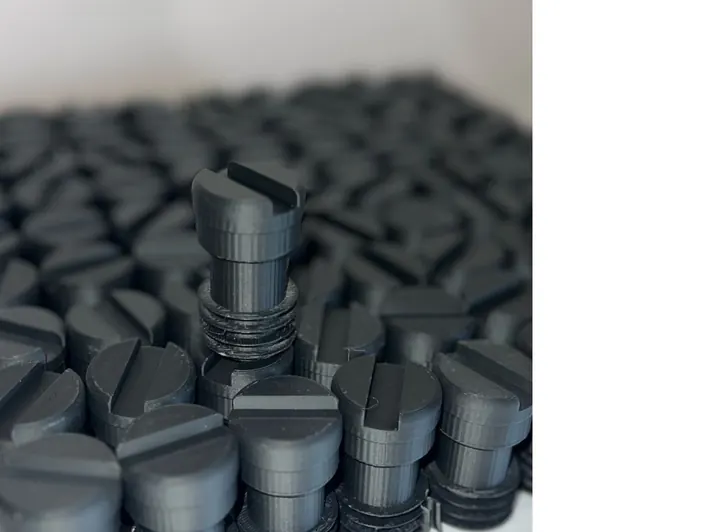
3D printing vs injection moulding isn't a fight — it's a sequence. Print first, mould later, switch when the volume justifies the tool.
They solve the same problem at different stages. 3D printing is the low-volume manufacturing route with zero tooling — ideal while you launch, validate and iterate. Injection moulding is the high-volume route, brilliant once the design is frozen and the numbers are big enough to repay a tool. This page lays out the honest trade-offs — tooling cost, per-unit cost, lead time, minimum order, the cost of a design change — so you can see exactly where the crossover sits and where 3D Printing Express fits: the step before tooling. Still deciding how to make the part at all? See which 3D printing process to use — FDM vs SLA vs SLS.

The honest answer to "3D printing or injection moulding?"
Most comparisons online treat this as a winner-takes-all contest. It isn't. The two processes are good at opposite ends of the same journey. 3D printing has no tooling, a £50 minimum order and a design change costs almost nothing — so it owns the early stages, where you're still finding out whether the part is right. Injection moulding has a high upfront tool cost and a long lead time, but a very low per-part price once it's running — so it owns the late stages, where the design is locked and you need thousands.
Our honest position, as an FDM 3D printing service: we are deliberately not trying to replace moulding at scale. We're the route that gets you to the point where commissioning a tool is a confident, evidence-based decision instead of an expensive guess — and we'll tell you plainly when your volumes have crossed the line and moulding is the better buy.
The decision: when 3D printing wins, and when to switch to moulding
Three questions decide it — volume, design stability and time-to-first-part. Here's how an engineer reads them.
- 1
Volume — the unit crossover
This is the big one. A mould tool is a four-to-five-figure cost spent before the first usable part exists, so its economics depend entirely on spreading that cost across a big run. Until the run is large enough to pay that tool back — geometry depending — 3D printing is usually cheaper because you pay only for the parts. Above that, the tooling cost spreads thin enough that moulding's low per-part price pulls ahead. If you're not sure where your part lands, that's exactly the call our engineers make for you.
3D printing wins · low volume, no tooling to repay, pay-per-part - 2
Design stability — is it still moving?
While a design is still changing, moulding is the wrong tool at any volume. Changing a moulded part means modifying or re-cutting steel — slow and expensive — and a big change can mean a whole new tool. A printed change costs a new file and a re-slice. So even if you'll eventually need ten thousand parts, the smart sequence is to print through the iteration phase, lock the design with real parts in hand, then cut a tool you won't have to modify.
3D printing wins · iterate in days at the price of the parts - 3
Time to first part — speed to market
Moulding carries weeks of tooling lead time before a single part exists. 3D printing skips that entirely — an engineer reviews your file and you can have real parts in working days. If you're racing to a launch, a trade show, a funding milestone or a customer trial, printing gets validated parts into the world while a tool would still be on the bench. Once the tool exists, moulding churns out thousands fast — but only after that wait.
3D printing wins · real parts in working days, no tooling wait - 4
When moulding wins — and we'll say so
Injection moulding is the right answer for genuinely high-volume, design-frozen plastic parts where per-unit cost and consistent moulded finish at scale matter most. That's a real and important job — it's just a different one from ours. When your run gets big enough and your design is locked, the moulding maths wins, and we'd rather tell you that than keep printing past the crossover.
Moulding wins · high volume, frozen design, lowest per-part cost at scale
3D printing vs injection moulding — the honest comparison
Relative, not invented. We don't quote mould tooling, so the figures below are framed by direction and order of magnitude — true of FDM and plastic injection moulding generally, not a price list.
| Factor | FDM 3D printing | Injection moulding |
|---|---|---|
| Tooling / upfront cost | £0 — no tool. You pay only for parts. | Four-to-five-figure mould tool, spent before the first usable part. |
| Per-unit cost | Flat-ish; falls modestly with batch size as setup is shared. | Very low once the tool exists — the main reason to mould at volume. |
| Lead time to first part | Working days — engineer-reviewed quote in 2 hours. | Weeks of tooling before any part exists; fast per-part after. |
| Minimum order | None — one part is a normal order. | Practical minimum in the hundreds-to-thousands to amortise the tool. |
| Cost of a design change | A new file and a re-slice — iterate in days. | Modify or re-cut steel; a big change can mean a new tool. |
| Strength behaviour | Anisotropic — engineered around with orientation, walls and material (PA12-CF can replace metal in suitable brackets). | Near-isotropic — similar strength in every direction by default. |
| Material & finish | Polymaker / Fiberon range, PLA up to carbon-fibre nylons; finishing itemised. | Wide thermoplastic range; smooth moulded surface straight off the press. |
| Best for | Prototypes, iterations, pilot runs, low-volume production, spares, bridge volumes. | High-volume, design-frozen production parts. |
The honest summary: tooling cost and design-change cost are where 3D printing crushes moulding early; per-unit cost at scale is where moulding crushes printing late. The art is knowing where you are on that curve — see what drives a 3D printing quote for the cost detail on our side.
3D printing is the step before tooling
The expensive mistake is committing to a mould tool too early — before the design is proven and the demand is real. 3D printing removes that risk. It lets you launch, get parts in front of customers, iterate on what you learn, and only graduate to moulding once the volume genuinely justifies the tool.
You arrive at the moulding decision with proven parts, real demand and a frozen design — not a guess.
Launch & validate
Get real, functional parts into customers' hands in working days — no tooling wait. Our product development service takes you from first mock-up through iteration.
Iterate without penalty
Every design change is a re-slice, not a re-cut tool. Lock the design with real parts in hand, so the tool you eventually cut is one you won't need to modify.
Bridge to volume
Run pilot batches and bridge volumes with small-batch production — even while a tool is being made — then switch to moulding once the crossover is behind you.
Send an STL or STEP file and tell us what the part has to do, and an engineer will tell you honestly whether you should be printing or thinking about a tool. If you only have a sketch, our CAD design service builds the model first. We print in-house in Poole, Dorset — local to Bournemouth and the south coast, a tracked parcel away from everywhere else.
Watch one part travel from print to tool — and see exactly where the switch makes sense.
Take a realistic part — a handheld enclosure for a new product. Here's the sensible sequence, and the point where moulding finally earns its tool.
Print first, mould when it's justified
- Stage 1 — prototype. A handful of printed units to prove the shape and fit. No tooling, parts in days, change the file as often as you like. Moulding here would be pure waste.
- Stage 2 — pilot run. 50 to a few hundred printed units for a field trial or first customers. Still no tooling commitment; you're learning what the design really needs while you sell.
- Stage 3 — the crossover. Demand is proven, the design is frozen, and the volume is finally high enough that the tool pays back. This is where we say: cut the mould — and you do it on evidence, not a guess.
The lesson in one line: you don't choose between the two — you sequence them. Print until the tool is justified, then mould. We're the part of that sequence that de-risks the expensive bit.
Not sure if you should print or tool? Ask an engineer who'll tell you straight.
Send your part and we'll review it and return a fixed UK quote within 2 hours — and tell you honestly where you sit on the printing-vs-moulding curve. Rated 4.9★ across 48 Google reviews.