Rapid Prototyping Service, Parts in 5-7 Working Days
3D Printing Express runs an FDM rapid prototyping service from our Poole, UK production facility. Send an STL or STEP file and an engineer reviews it and returns a quote within 2 hours. Standard lead time is 5-7 working days, with a £50 minimum order, print one, test it, iterate.
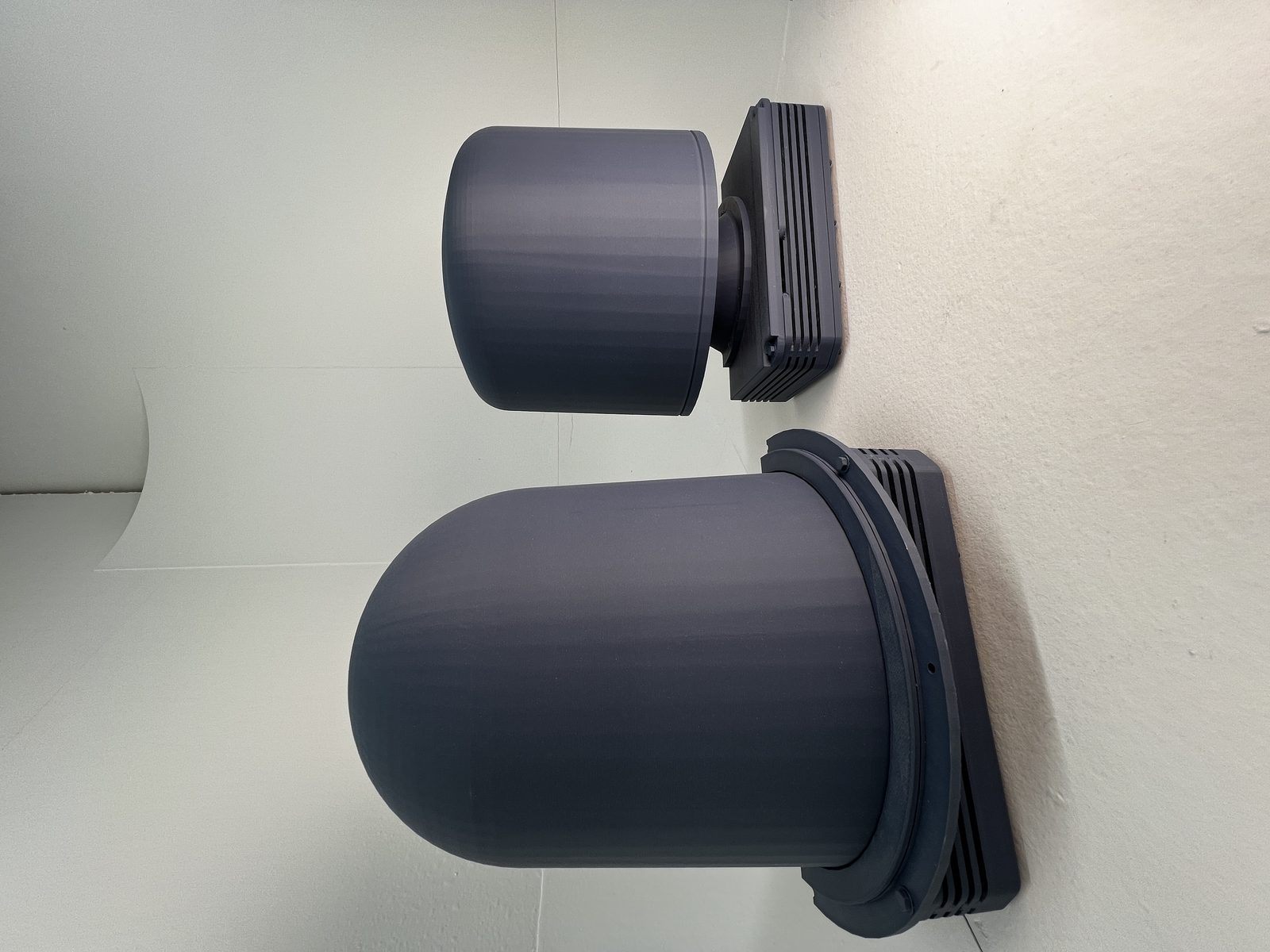
Rapid prototyping in the UK, functional FDM parts from STL or STEP, engineer-reviewed and dispatched in days from Poole.
A prototype 3D printing service for product developers, engineers and ops teams who need to iterate: plastic prototypes in engineering-grade materials, made in our Bournemouth and Poole workshop. Quote in 2 hours, parts in 5-7 working days as standard, a £50 minimum order. Print in the same engineering materials you'll ship in, then carry a proven revision straight into small-batch production.
What is rapid prototyping?
Rapid prototyping means making physical test parts directly from CAD data in days rather than weeks, so design problems get found before you commit to tooling. Each printed version costs a fraction of a mould revision. The faster the loop runs, the more versions you can afford to test, and the fewer surprises survive into production. (What drives the price of each one? See what 3D printing costs.)
It's a category, not one machine. FDM, SLA, SLS and CNC machining are all rapid prototyping technologies, and they answer different questions.
We run FDM (fused deposition modelling, printing engineering thermoplastics layer by layer) and in-house resin printing. FDM is the right choice when you need functional plastic parts fast and cheaply enough to iterate: enclosures, brackets, housings, mechanisms, jigs, anything with walls of 0.8 mm and up. It's the wrong choice for sub-0.5 mm cosmetic detail (that's SLA's territory) or machined-metal tolerances (that's CNC). For that level of detail we switch you to our in-house resin printing. If your part needs something else entirely, the engineer reviewing your file will say so in the quote, printing you something that can't answer your question helps nobody.
A prototype 3D printing service earns its keep one way: each loop teaches you something true about your design before that lesson gets expensive.
| Process | Best at | Typical turnaround | Honest watch-outs | When it's the right call |
|---|---|---|---|---|
| FDM (what we run) | Functional plastic parts in engineering thermoplastics; cheapest cost per iteration | Days, ours are 5-7 working days as standard | Layer lines; directional (Z) strength; tight, repeatable tolerances | Fit, function and load testing; prototyping in the production material |
| SLA (in-house resin) | Fine detail and smooth cosmetic surfaces; features below ~0.5 mm | Days | Standard resins trade toughness for detail; resin is rarely the production material | Visual models, cosmetic approvals, very fine features |
| CNC machining (not us) | Metal and tight tolerances; isotropic strength | Days to weeks | Highest cost per iteration; internal geometry limits | Machined-metal validation, tolerance-critical interfaces |
The iteration loop, why speed is the whole point
A mould tool is a bet. Cut steel on an unproven design and every flaw you didn't catch is now machined into something that takes weeks and serious money to change. That's the maths rapid prototyping exists to fix: find the flaws while a revision costs a part, not a tool. We lay the two paths side by side in 3D printing vs injection moulding.
So the whole value of the service lives in loop time. Ours runs like this:
- Quote in 2 hours. An engineer reviews your file and prices it the same day. The loop never stalls waiting for a number.
- Parts in 5-7 working days as standard. Test, measure, revise the CAD, resubmit.
- Fast turnaround prototypes when the loop is tight: Fast Track in 3-5 working days, Priority in 1-2 working days, Express as little as same day. Against the weeks of tooling lead time a mould commits you to, that's the difference between testing your design and gambling on it.
- Parallel variants. With a fleet of printers we can run several design candidates simultaneously. Print v2a, v2b and v2c in the same run, put all three on the bench together, and A/B them physically instead of arguing about them in a meeting.
Functional prototyping only works at this pace if review doesn't bottleneck it. Every file that comes in is checked by an engineer, wall thicknesses, overhangs, load paths, material fit, before anything prints. You get printability feedback with the quote, not a failed part three days later.
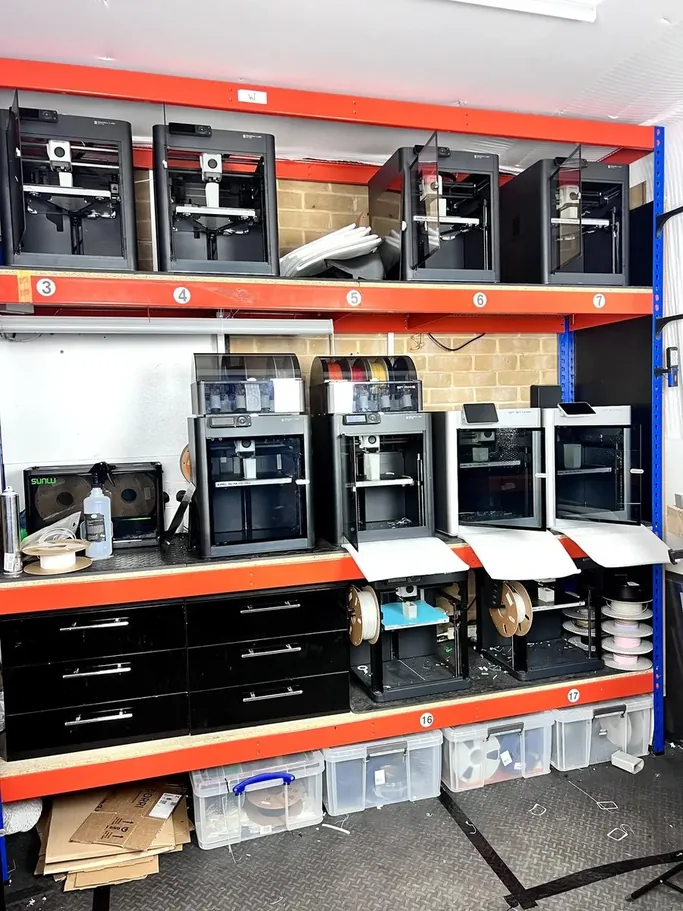 A fleet of printers running in parallel, several design candidates at once, on the bench by morning.
What your prototype can and can't tell you
No prototyping process is honest by default, so here's the FDM honesty up front. We'd rather you design around these from v1 than discover them at v3.
What an FDM prototype tells you reliably
- Fit and assembly. Do the parts go together, do clearances work, does the cable route?
- Form and ergonomics. In your hand, on the bench, in the housing it has to live in.
- Function under representative loadprovided the part is printed in the right orientation and a sensible material rung (see the ladder below).
- Whether the design survives contact with reality before tooling does.
What it can't tell you, design around these
- Strength is directional. Layer-bond (Z) strength is materially lower than in-plane (XY) strength. We orient the load path in-plane where geometry allows, but a part that only survives in one orientation is telling you something about the design.
- Tolerances are FDM tolerances. geometry-dependent, we confirm the tolerance achievable for your part. Good enough for most fit checks; not a substitute for a machined datum.
- Holes typically print slightly undersize. We compensate in CAD, or plan to ream or drill to final size.
- Surfaces show layer lines, and unsupported overhangs past roughly 50-60° need support material, which leaves witness marks. If the question you're testing is cosmetic finish, an FDM part won't answer it, say so in your brief and we'll tell you what will.
- Minimum reliable wall is 0.8 mm (two 0.4 mm perimeters). Thinner features may print, but you can't trust what they tell you.
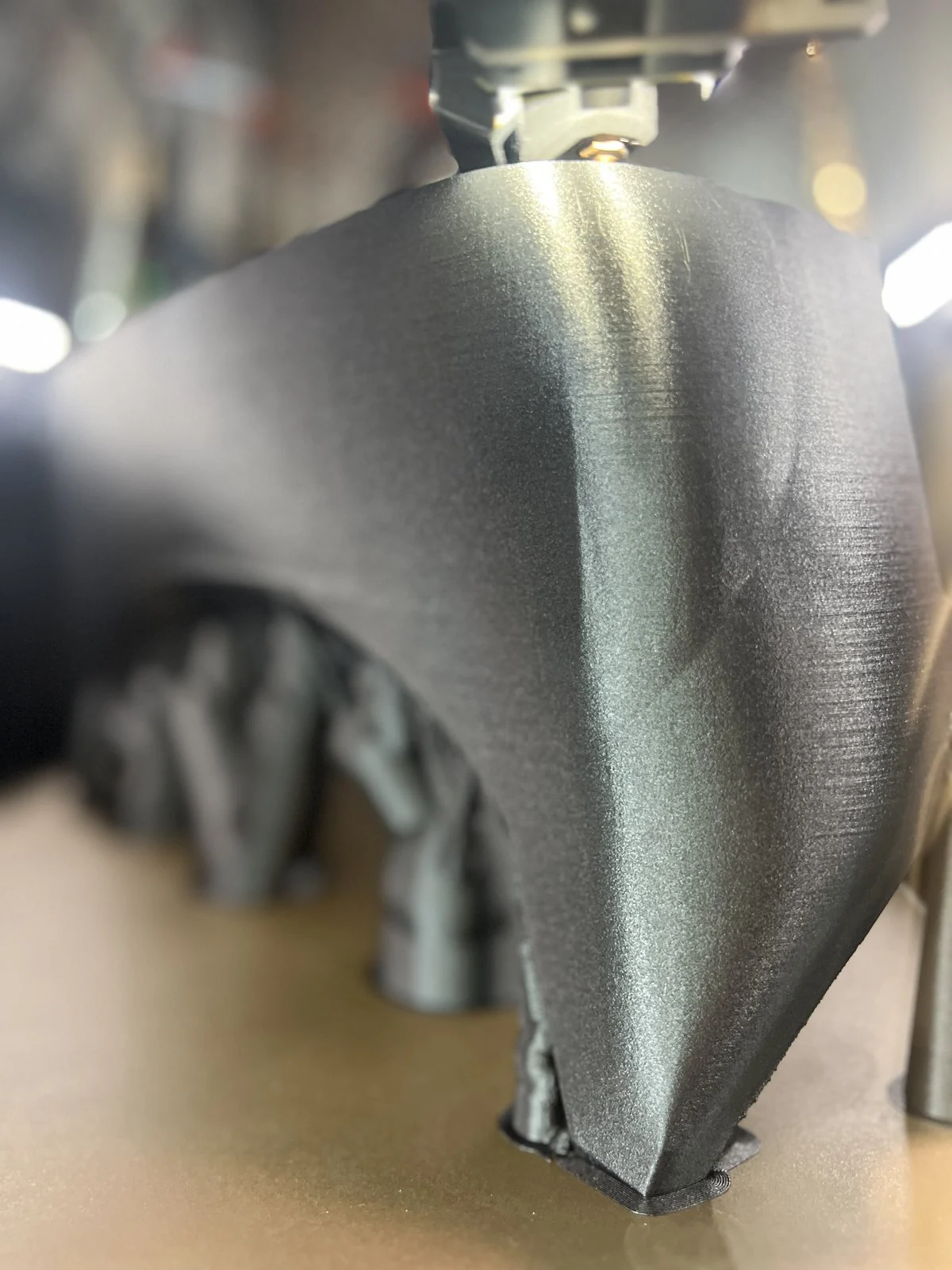
Flag what you're testing when you send the file, fit, stiffness, snap-fit life, thermal behaviour, and the engineer reviewing it will tell you whether an FDM part can genuinely answer that question.
Materials for prototyping, matched to the question you're asking
Plastic prototyping is easy to over-specify. Don't pay engineering-nylon prices to find out a shape is wrong, and don't trust a load test done in the cheapest material on the shelf. Match the material rung to the question:
| Stage | The question you're asking | Material | Why this rung |
|---|---|---|---|
| 1 · Form check | "Is the shape right?" | PLA / PLA Matte | Cheapest and fastest rung. Dimensionally accurate, ideal for desk-evaluation and fit-up. |
| 2 · Fit & assembly | "Do the parts go together?" | PETG | Tougher than PLA, slightly forgiving in assemblies, handles repeated fitting without snapping. |
| 3 · Function under load & heat | "Does it survive use?" | ABS / ASA | Higher heat resistance than rungs 1-2; ASA adds UV stability for outdoor parts. |
| 4 · End-use validation | "Will the production part work?" | PA12-CF / PA6-CF | The prototype is the production material, stiffness, chemical resistance and temperature behaviour you can act on. |
All four rungs print in Polymaker and Fiberon filaments, the same spools, profiles and machines we use for production work, so a rung-4 prototype isn't an approximation of the final part. It's the final part, one revision early.
That last point is worth being direct about, because it's where FDM beats the resin shops for functional work: an SLA prototype in a "tough" resin can pass a test that the injection-moulded or FDM production part later fails, because the resin was never the production material. Validate in the material you'll ship in. Full datasheets and honest limits for every filament are on the materials pages.
From prototype to production
Prototype manufacturing shouldn't dead-end at v3. When a revision passes its tests, the same file, material, machine profile and QC process carry straight into small-batch production10 to 1,000+ units, with no re-validation gap, because nothing about the process changed.
And here engineers always ask the moulding question, so here's the honest answer:
Until your run is big enough to pay back a mould tool, 3D printing is typically the cheaper route for the project, because there is no tooling cost to recover.
Run your own numbers: break-even quantity ≈ tooling quote ÷ per-part moulding saving. Above the break-even, moulding wins on unit cost, we'll tell you when you're there.
Two honest corollaries. First, the crossover moves with part size and material, big simple parts cross sooner, small complex parts later. Second, some geometries never cross at all, because no tool can release them from a cavity; for those, printing isn't the cheaper option, it's the only one.
Earlier than CAD? If the concept is still moving, sketches, a brief, no model yet, that's a different job from prototyping it, and our product development service covers the full journey from idea to manufacturable design. If the model just needs building, CAD design services will get you to an STL.
How it works
Getting a prototype made in the UK shouldn't need a procurement exercise. Three steps:
- 1
Send your file
STL or STEP through the quote form. STEP preferred if you have it. A sentence on what you're testing helps the review enormously. Sketch only? Start with CAD design.
- 2
Engineer review and quote, within 2 hours
A real engineer checks printability, flags risk (thin walls, overhangs, load direction), recommends the right material rung, and prices it. If FDM can't answer your question, we say so here.
- 3
Print and dispatch
Parts leave our Poole facility in 5-7 working days as standard, with free next-day UK delivery.
That review step is what to look for in any rapid prototyping company: who actually reads the file before it prints? Here, the answer is an engineer, every file, including the one-offs. We've shipped 11,183+ parts so far this year (as at October 2026) on exactly that process, full detail on how it works.
We print everything in-house in our own UK workshops, with our main workshop in Poole, local to Bournemouth and the rest of Dorset if you'd rather talk through a part in person, and a tracked parcel away from everywhere else. Most rapid prototyping services in the UK are remote to their customers anyway; what matters is the loop time, and ours is measured in days.
Ready to put your design on the bench?
Send your CAD and an engineer will review it and quote within 2 hours. A £50 minimum order, one part is a normal order here.