Low volume manufacturing you can put on your approved supplier list.
Low volume production for procurement teams: repeat runs from a UK workshop, with no tooling to fund. Supplier questionnaires completed, audits welcomed, material traceability and batch records kept, and already on multiple customers' approved lists.
49 Google reviewsThe quote form takes CAD, PDF and images. Word and Excel questionnaires go straight to hello@3dprintingexpress.co.uk.
Low volume plastic manufacturing in the UK, without tooling
Parts are built straight from your approved file in filament or resin, so there is no mould tool to design, pay for or wait on. That makes the economics work at tens and hundreds of units rather than tens of thousands. If you are prototyping rather than supplying, start at rapid prototyping. If you are a product team running your first batches rather than a buyer setting up supply, small-batch production is written for you.
What a UK 3D printing bureau should tell you before you add it as a supplier
Most suppliers make you find this out during the audit. Here it is before you spend any time on us, including the parts we do not make ourselves.
What we can put in front of your quality team
- A completed supplier questionnaire. Email it to hello@3dprintingexpress.co.uk and it comes back filled in, including the questions where the answer is no.
- A supplier audit, hosted. If your process needs someone to come and look at how parts are made and recorded, we will host that visit.
- Material traceability. We track the material a run was made from, so a batch can still be identified after it has left us.
- Batch records. Every production run is recorded, not just invoiced.
- Existing approvals. We are already on multiple customers' approved supplier lists, so onboarding is a process we have been through rather than one we are attempting for the first time.
What we do not do here, said plainly
- We do not print metal in-house. Our workshops run filament and resin. Metal parts are placed with a partner we already work with, so a metal component in your assembly does not have to mean a second supplier on your approved list.
- We do not quote from a rate card. Part size, geometry, material and finish move a price far more than unit count does, so a per-unit table would be wrong for most parts the moment it was published. Every run is read by an engineer and quoted on its own terms, which is slower than an instant quote and more likely to be right.
- We do not run SLS nylon or multi jet fusion in-house. Those are powder processes and we run filament and resin. When a part genuinely needs powder, it goes to a partner rather than back to you to source.
The reason we put the limits next to the capabilities is simple. A supplier who hides one until the audit costs you the whole qualification cycle. Everything above is answerable in writing before you commit an hour to us.
Supplier questionnaires, audits and approved vendor lists
The questions a buyer actually has to answer internally before a new supplier can be raised, and where we stand on each one:
| What your process asks for | Our answer | What that means in practice |
|---|---|---|
| A completed supplier questionnaire | Yes | Emailed back completed, with honest answers rather than blanks on the awkward rows. |
| Willingness to be audited | Yes | We will host a visit from your quality team and show how parts are made, tracked and recorded. |
| Material traceability on a batch | Yes | The material a run was built from is tracked, so a batch stays identifiable after delivery. |
| Batch records for each run | Yes | Runs are recorded as production, not just as an invoice line. |
| Evidence of existing approvals | Yes | We are on multiple customers' approved supplier lists already. |
| Ongoing monthly supply | Yes | Standing monthly volumes are a normal shape of work here, not an exception we squeeze in. |
| Invoicing on account | Yes | Monthly invoicing on account rather than paying per run. |
| A published rate card or price list | No | Part size, geometry, material and finish move a price far more than unit count does, so every run is read by an engineer and quoted on its own terms rather than priced off a table. |
| Metal parts | Via partner | Not made in-house. Metal work is placed with a partner we already use, so you can order it through us rather than adding a supplier to your list. |
Questionnaires are usually Word or Excel documents, so email them to hello@3dprintingexpress.co.uk rather than using the quote form, which takes CAD, PDF and images. If your questionnaire asks something not covered above, send it anyway. An honest no on a form is worth more to both sides than a maybe that unravels at the audit.
The commercial terms, in writing
Buyers ask these questions on every first call and almost no supplier answers them on a web page. Ours are here so you can take them to your finance team before you speak to us.
We keep your approved file and reprint on demand
Once a part is signed off, the approved file stays with us as a digital inventory. Reordering is a message rather than a fresh setup, and you are not holding stock of something we can make again on request.
Monthly invoicing on account
Repeat customers are invoiced monthly on account rather than paying job by job, so a standing arrangement does not mean a payment run every time a batch ships.
No tooling to fund, ever
There is no mould to pay for before the first part exists, and no tool sitting in a rack depreciating if the design changes. A revision costs a new file, not a new tool.
An engineer reads every enquiry
Quotes are not generated by an instant-price bot that has never looked at your geometry. A real engineer reads the file, and tells you when printing is the wrong answer for your part.
Can you actually hold a monthly quantity?
It is the question a buyer needs answered before anything else, and the honest answer is yes. We take on standing monthly production volumes routinely, not as a favour squeezed between one-off jobs. Recurring supply is a normal shape of work here.
Production runs across several machines rather than queueing behind one printer, which is why a standing monthly quantity is normal work here rather than something we fit in.
Tell us the part, the monthly quantity and when you need the first delivery. If the schedule you want is one we cannot hold, we will say so at the enquiry rather than discover it in month three.
The best manufacturing process for 500 plastic parts
At a few hundred units the right process is genuinely arguable, and the deciding factor is not usually cost. It is how settled the design is and how fast the quantity will grow. Here is how we work it out with you, including the rows where we are not the answer:
| Route | Tooling needed first | Cost of a design change | Where it wins |
|---|---|---|---|
| 3D printing, filament and resin (ours) | None | A new file | Tens to hundreds of units, designs that may still change, parts needed before a tool could be cut, and geometry a mould cannot release. |
| Vacuum casting (not ours) | A silicone tool, made from a master | A new master and a new tool | Runs where you want a moulded surface finish and the quantity outgrows printing but does not justify steel. |
| Injection moulding (not ours) | A hard tool, cut before part one | Modifying or recutting the tool | Frozen designs at high and rising volume, where the tool cost spreads thin enough to win on unit price. |
| SLS nylon and multi jet fusion (via partner) | None | A new file | Powder processes the large UK bureaus run. Strong nylon parts with no support marks, and their per-unit cost falls hard at high quantity. Not run in-house. We place powder work with a partner, so you can still order it through us. |
| Metal parts and CNC machining (metal via partner) | None, but setup and fixturing per part | A new programme | Metal parts, tight tolerances and material properties printing cannot reach. Metal work is placed with a partner we already use. |
Two things decide most of these arguments. The first is tooling cost: moulding carries one and printing carries none, which is why printing wins before a tool is paid off and loses after it. The second is the unit price break. A moulded part's cost per unit keeps falling as quantity climbs, because the tooling cost spreads thinner every time. A printed part's flattens out instead, because every single unit still takes machine time. Quantity does move our rate, and we would rather show you where it stops moving than pretend printing scales the way moulding does.
Two of those rows are not made in this building, but they are still available through us. Metal and powder work goes to partners we already use, so consolidating your parts with one supplier does not mean giving up the ones we do not make in-house. You deal with us either way, and we tell you plainly which parts are made here and which are made by a partner.
The short version: if your 500 is on its way to tens of thousands with a design that will not move, you are heading for a mould tool and we will tell you that rather than take the run. If your 500 is genuinely 500, or the drawing might still change, there is no case for funding a tool.
What "identical" has to mean on a repeat order
A production supplier is not judged on the first batch. It is judged on whether batch nine matches batch one, months later, after nobody involved remembers the settings.
That is what the retained file is for. The approved geometry, material and setup are kept as a record rather than rebuilt from memory each time you reorder, so a later run starts from the same proven state rather than from someone's best recollection of it.
The batch records sit alongside it. If a question comes back from your own customer about a delivery from six months ago, that run is identifiable rather than lost.

How a repeat supply arrangement starts here
Four steps from an enquiry to a standing monthly quantity:
- 1
Send the part and the quantity
A file or a drawing, the monthly quantity you need and when the first delivery has to land, through the quote form. If you have a supplier questionnaire, email it to hello@3dprintingexpress.co.uk at the same time. No CAD yet? That is CAD design, and it is a step we can do rather than a reason to turn you away.
- 2
An engineer reads it and quotes
A real engineer reviews the geometry, tells you what it will cost to make and flags anything that will cause trouble at volume. If printing is the wrong process for your part, this is where we say so.
- 3
You approve a real part, not a render
A sample comes off the same setup the production run will use, so what you sign off is what repeats. Once it is approved, that file and setup become the record we build from.
- 4
The standing quantity runs
Batches run to the agreed monthly quantity, recorded as they go, invoiced monthly on account. Reordering or changing the quantity is a message, because the approved file is already here.
Everything we print is designed, printed and finished in-house in our own UK workshops, with our main workshop in Poole, local to Bournemouth and the rest of Dorset if you want to walk a part in or bring your quality team to look at the workshop, and a tracked parcel from anywhere else in the UK.
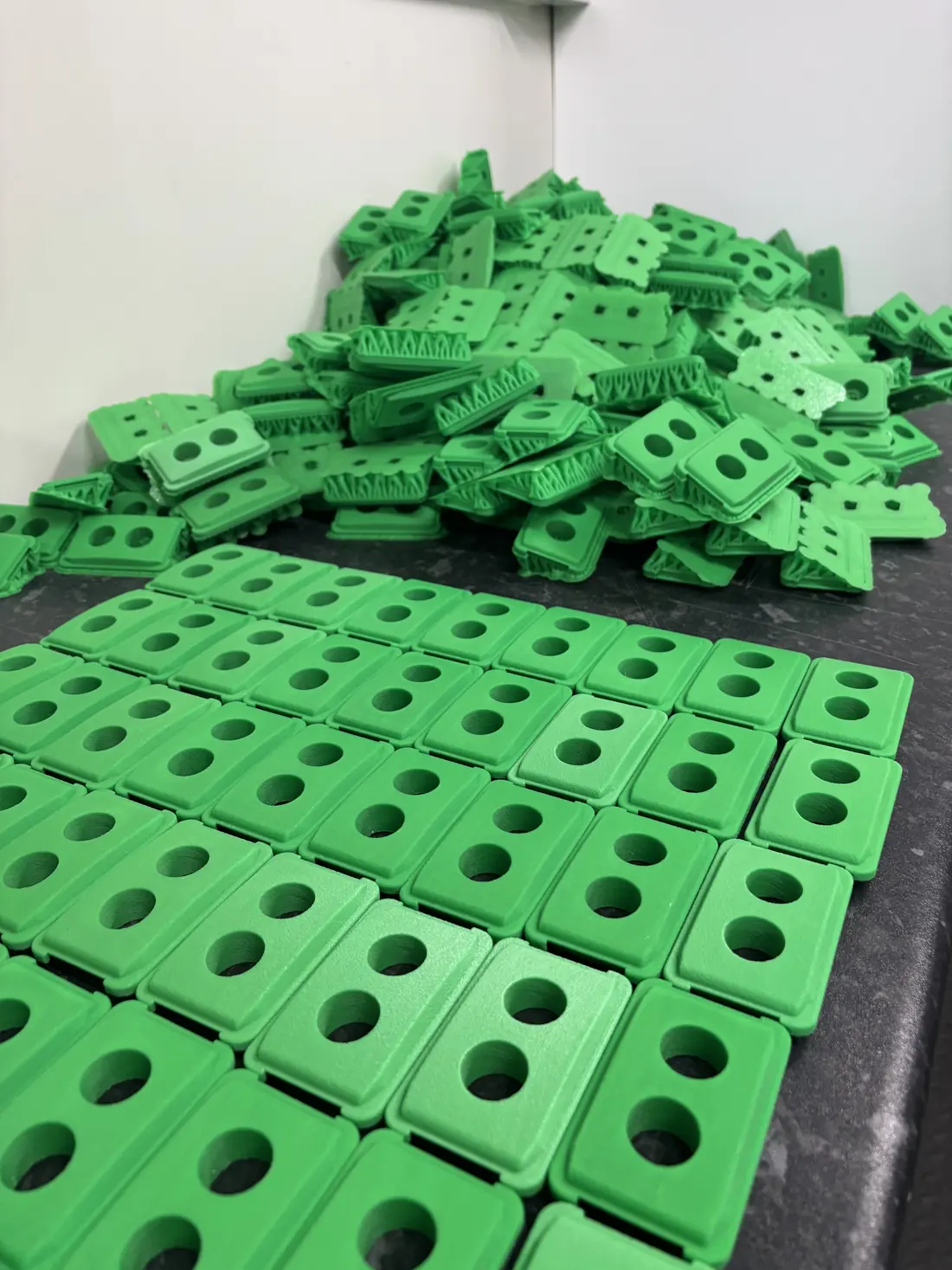
Volume work we have actually shipped
The parts in this photograph are a real production run out of this workshop, not a stock image of somebody else's factory. Runs like it are the everyday work here rather than the exception we wheel out for a website.
If you want the detail of how a commercial run is scoped and delivered, the Durable case study walks through one, and there are more on the case studies page. For the founder-facing version of this service, where the question is usually a first batch rather than a supply agreement, see small-batch production.
Material choice is part of the quote rather than an afterthought. The materials pages set out the engineering polymers we run, including glass and carbon filled grades where a part has to take load.
Setting up a supplier for repeat production?
Send the part and the monthly quantity through the quote form. If you have a supplier questionnaire, email it to hello@3dprintingexpress.co.uk, because it will be a Word or Excel file. An engineer will read both and come back with a real answer, including an honest no if this is not the right process for your part.