3D Printed Architectural Models — Planning, Presentation & Marketing
We 3D print architectural scale models in the UK for planning applications, client presentations and marketing suites — from massing studies to detailed 1:100 presentation models, including models with separable components such as lift-off roofs and removable floors. An engineer reviews your drawings or model file and returns a scale recommendation and quote within 2 hours from our Dorset studio.
Architectural models in the UK — massing, planning and presentation models 3D printed from your drawings, with separable components where you need them.
A 3D printing service for architects and property developers who need a physical model for planning, a pitch or a sales suite. Send a model file or 2D drawings, get a scale recommendation and quote in 2 hours, and have it couriered UK-wide. Need the model built first? Our CAD design service works from your drawings.
Architectural model 3D printing in the UK — the specifications at a glance
Architectural model 3D printing is the process of turning an architect's CAD model or 2D drawings into a physical scale model using additive manufacturing. We do this with FDM from our Poole studio for planning, presentation and marketing-suite models. The essentials:
- Scales we work at: 1:500 for site and massing studies, 1:200 for planning and context models, 1:100 for presentation and competition models, 1:50 for detail and section models.
- Files we accept: SKP, IFC, STEP, OBJ or 3D DWG ideally; 2D plans and elevations in PDF or DWG are fine — our CAD design service builds the 3D model first.
- Minimum reliable printed feature: about a 0.8 mm wall and a 0.6 mm free-standing pin, so we advise the scale that lets your detail read.
- Separable components: lift-off roofs, storey splits and removable building plugs, registered on dowels or magnets with about 0.2 to 0.3 mm clearance.
- Turnaround: an engineer-reviewed scale recommendation and quote within 2 hours; a lead-time band quoted with it, a £50 minimum order, couriered UK-wide including London.
Architectural models with separable components
This is the part most bureaus quietly skip, and it is the one architects ask for most: a model you can take apart. A lift-off roof to show the top floor. Storey-by-storey splits to reveal the section. Removable building plugs that drop into a fixed context base so a single masterplan model can show three different schemes on the same site.
The craft is in the registration. Separable parts only earn their keep if they seat cleanly and lift off without forcing, so we design the joins with roughly 0.2 to 0.3 mm clearance and locate them on dowels or hidden magnets. Chunky, handled, taken-apart-and-put-back-together parts are exactly where FDM beats brittle resin: a dropped resin roof shatters, a printed one survives the meeting.
Tell us at the quote stage which parts need to come apart and what each separated view has to show — we engineer the splits around that, not around what is easiest to print.
Model types by purpose
Different jobs need different models. We build to the purpose, not to a house style.
Planning & context models
Massing and site-context models for planning applications and committee presentations — the surrounding streetscape, the scheme in its setting, the heights and the shadows. Clean white volumes are what planners read fastest, so detail is deliberately restrained and the relationship to neighbours is what comes forward.
Presentation & competition models
Higher-detail models for client pitches and design competitions, typically 1:200 to 1:100, where facade rhythm, window reveals and entrance detail start to read. The finish does the persuading here, so this is where the paintable matte white surface and careful seam placement matter most.
Marketing suite & developer sales models
Models that live in a sales suite and get handled by the public for months. These are built tougher — a more durable material, robust separable parts and finishing that takes fingerprints and knocks. A sales model has a different job from a one-night competition model, and we build it for the life it will actually have.
Scale, detail and what is physically printable
Most of the questions architects ask come down to one thing: at my scale, what will actually read? Here are the honest FDM numbers, based on our production platform — no competitor publishes this, and it is the difference between a model that communicates and one that disappoints in the room.
| Scale | What reads well | Minimum representable detail | Typical use |
|---|---|---|---|
| 1:500 | Massing, footprints, site context, building heights | Whole volumes; individual windows do not read | Site and masterplan studies |
| 1:200 | Window openings, balconies, major facade features | A 0.8 mm printed wall represents about 160 mm real-world — fine for context | Planning and context models |
| 1:100 | Facade rhythm, reveals, entrances, storey detail | A typical 3 m storey prints at about 30 mm at 1:100 — tall enough that mullions read as relief | Presentation and competition models |
| 1:50 | Section detail, interior layout, individual components | Fine architectural detail; close to our finest reliable feature | Detail and section models |
The hard floor is the same whatever the scale: our minimum reliable printed feature is about a 0.8 mm wall (two 0.4 mm perimeters) and roughly a 0.6 mm free-standing pin. Balustrades, thin mullions and railings that fall below that at your chosen scale are better represented as etched relief, printed slightly oversize for legibility, or omitted — and we will tell you which, per model, rather than print something fragile that snaps in transit.
Large sites: build volume and tiling
A single building prints in one piece up to our printer build volume — a roughly 256 mm-class plate covers most individual buildings at planning and presentation scales. Bigger than that, and masterplans almost always are, the model tiles into base sections.
Tiling is a craft decision, not a compromise. We plan the joins to fall on natural lines — a road, a property boundary, the edge of a block — and register the sections on hidden dowels so the seams disappear and the model still travels safely and assembles on site. With more than multiple printers running in parallel we can print a large model's sections simultaneously rather than serially, which keeps the lead time sane on a big site.
For oversized display and exhibition models that go beyond a tabletop — a feature model for a launch event or a developer's marketing suite — our large-scale activations service handles the structural and transport side.
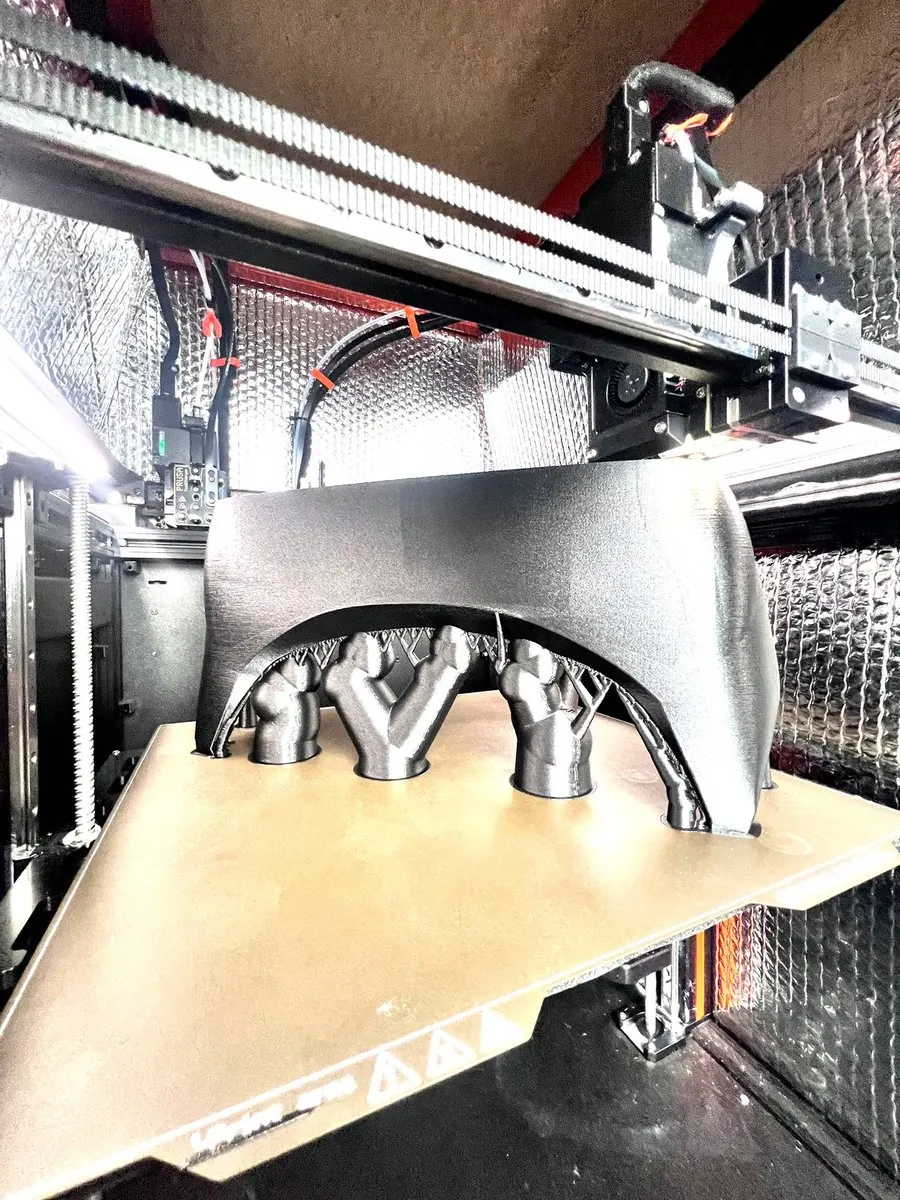 Large-format FDM in progress in our Poole workshop — single-piece capacity for most buildings, tiled base sections for full sites.
Materials and finishes
The default architectural finish is a clean matte white that photographs well and takes paint, so we reach for Polymaker PLA Matte in white for most planning, context and presentation models — the matte surface hides layer lines far better than a glossy filament and gives a model-maker's neutral finish straight off the printer.
For marketing-suite and developer sales models that get handled for months, we step up to PETG, which is tougher and more knock-resistant for separable parts that the public will pick up and put down. Every model prints in Polymaker and Fiberon filaments, the same spools we run for production work.
One honest limit: we print FDM, not SLS or SLA. For ultra-fine sub-0.5 mm filigree — delicate tracery at 1:500, hair-fine balustrades — an SLS or SLA bureau is the right tool, and we will say so rather than sell you a finish FDM cannot hold.
For everything from massing studies to handled 1:100 presentation models with separable components, FDM is the right tool, and it is usually the more affordable one.
What an architectural model costs
We are not going to invent a price for a model we have not seen, and we do not publish a rate card, because the honest answer is that four things drive the cost and they vary on every job (the same factors we break down in what 3D printing costs):
- Scale and footprint. A bigger model uses more material and more print time, and a sprawling site tiles into more base sections than a single building.
- Separable components. Lift-off roofs, storey splits and removable plugs add design and finishing work — worth it when the model has to perform, not worth paying for when it does not.
- Level of finishing. A raw matte-white print costs less than a hand-painted, fully detailed presentation piece.
- Deadline. A comfortable timeline costs less than a model that has to jump the queue for a submission date.
What we can say plainly: FDM 3D printing removes most of the labour-heavy hand-cutting that makes traditional model-making expensive, so for massing and planning models it is usually the cheaper route — and there is no tooling cost and a £50 minimum order. Send your drawings or model file and you will have a real scale recommendation and a real number back within 2 hours.
How architects work with us
Three steps, no procurement exercise:
- 1
Send your drawings or model file
A 3D model is ideal — SKP, IFC, STEP or OBJ — but plans and elevations in PDF or DWG are fine too. Use the quote form and tell us the scale and which parts need to be separable.
- 2
We advise scale & build approach — within 2 hours
An engineer recommends the scale that reads best for the model's purpose, flags any detail too fine to print at that scale, plans the separable splits and tiling, and quotes it. No 3D file? Our CAD service builds the model from your drawings first.
- 3
Print, finish & courier
We print and finish in-house in Poole and courier UK-wide, including London. Tiled models arrive ready to assemble on site.
We print everything in our own Poole workshop — local to Bournemouth and the rest of Dorset if you would rather walk a model through in person, and a tracked parcel away from London and everywhere else.
Got a planning, presentation or marketing model coming up?
Send your drawings or model file and an engineer will recommend the right scale and quote it within 2 hours. Tell us your deadline and we will tell you honestly whether we can hit it.