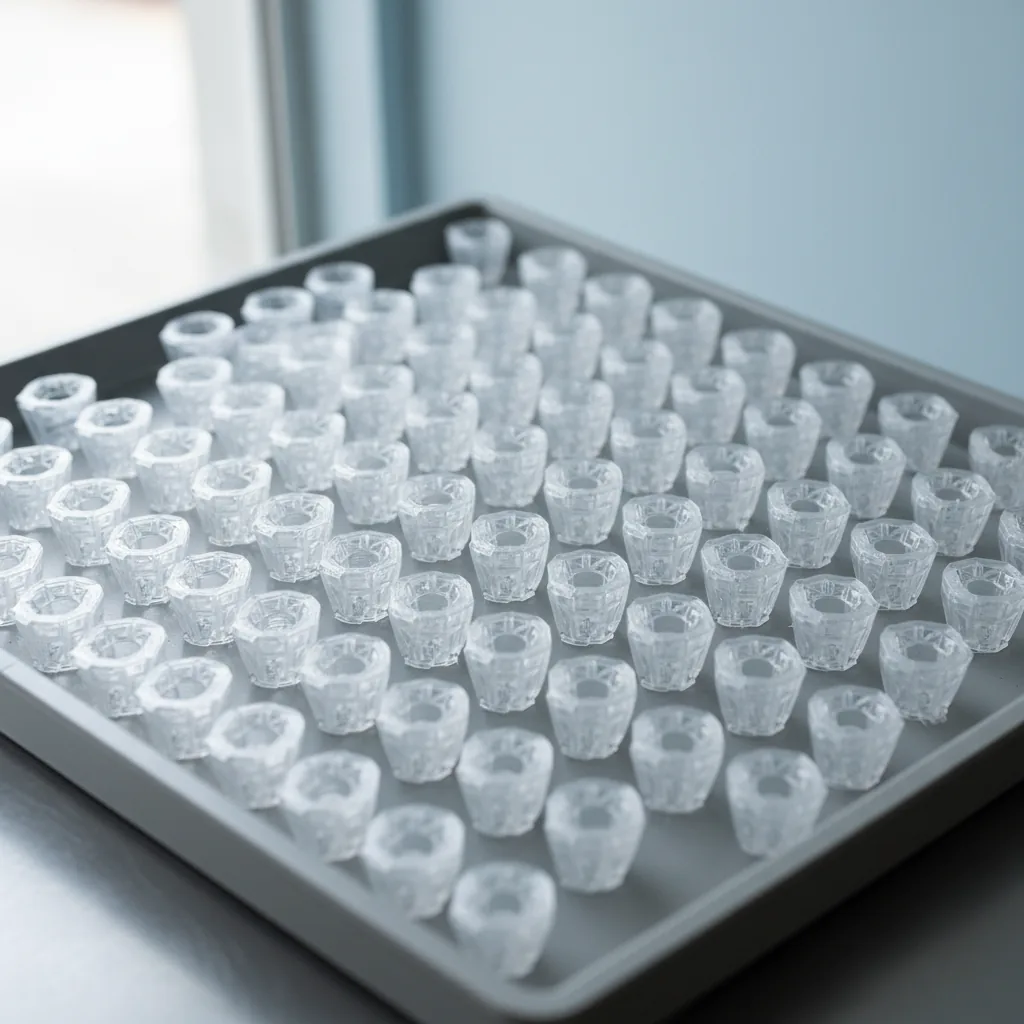
Do you recycle PETG+ print waste?
Yes. We run a closed loop in our own workshop. Failed prints, purge, and support waste are collected, reground, and reprocessed here instead of going to landfill. That is standard on every PETG+ job, no surcharge.
PETG+ vs plain PETG · what's the actual difference?
PETG+ is a toughened PETG/PCTG blend. The headline difference is ~4.5× the notched Charpy impact (11.6 vs 2.6 kJ/m²). Datasheet tensile (37.9 MPa) and modulus (1684 MPa) read below plain PETG (50.8 / 2117), but real-world durability is the premium-grade advantage · we treat PETG+ as the tougher functional choice. Same chemistry family, same drying protocol (65°C / 6h), same printing window · no heated chamber. Pick PETG+ when impact survival matters (drop-tested parts, snap-fit cycling, vibrating fixtures); pick plain PETG for cosmetic or cost-led work.
Is PETG food-safe?
The base PET polymer is FDA 21 CFR 177.1630 compliant for food contact in moulded and extruded form. Standard PETG is NOT certified for food contact · the certification applies to specific food-grade PETG variants, not to commodity FDM filaments. For a food-contact application 3DPE specifies a certified food-grade PETG variant and recommends a food-safe epoxy overcoat to seal FDM layer porosity (the real risk · bacteria can harbour in micro-gaps between print layers even when the polymer itself is food-safe). The honest answer: PETG is the right chemistry, but printed parts need certification + sealing for true food-contact service.
Is PETG waterproof?
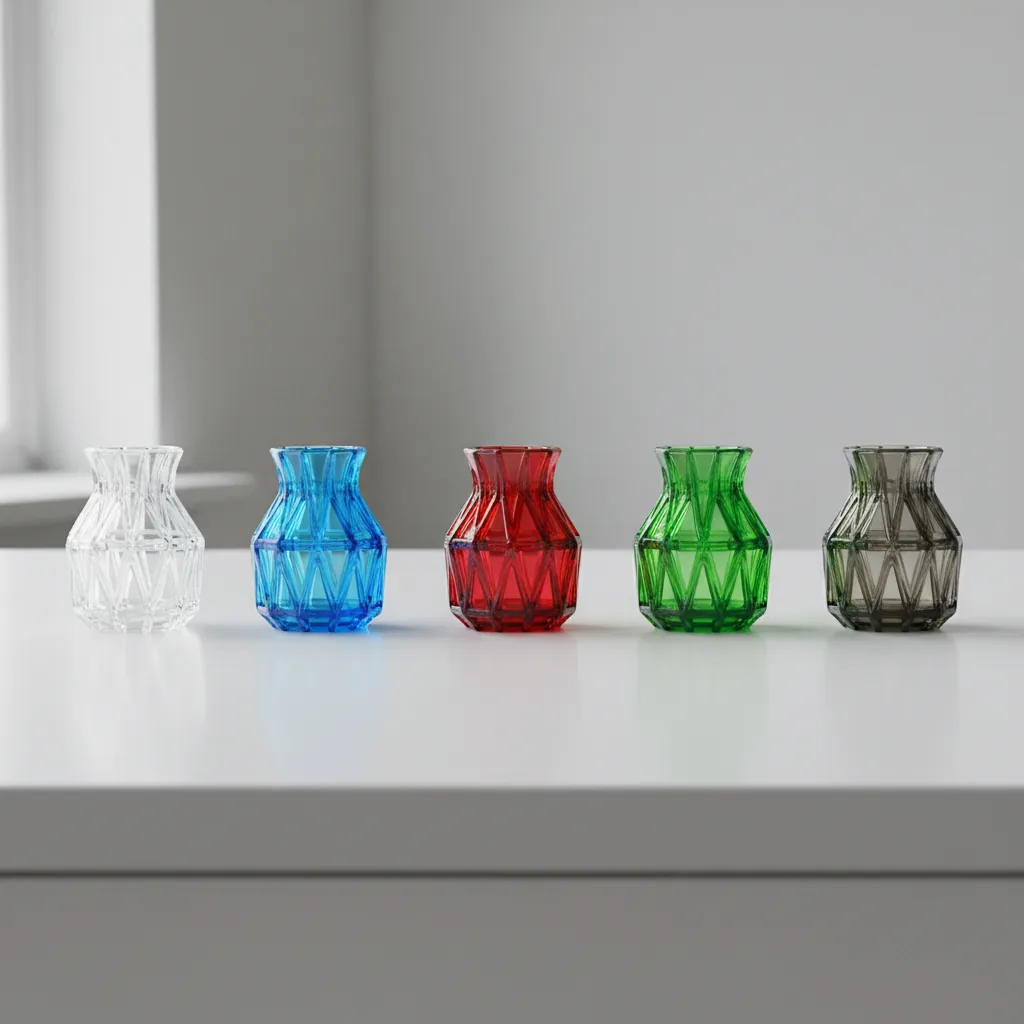
Genuinely yes for cold-to-warm water service. PETG has good hydrolytic stability and the base PET backbone is the same chemistry used in plastic water bottles. Suitable for hydroponic fittings, splash enclosures, water-tank brackets, and vases. Long-term sustained service above 60°C in hot water starts to degrade the polymer; for repeatable hot-water service specify PP or PEEK. Note: PETG itself absorbs moisture from humid air (0.54% equilibrium per TDS) · this affects print quality, not the waterproof-ness of a finished, dried part.
Is PETG UV-resistant?
Moderate UV resistance · better than PLA, slightly better than ABS, not as good as ASA. The PET aromatic ring absorbs UV more stably than the aliphatic PLA backbone, which is why PET water bottles survive outdoor warehousing. For 6 to 12 months UK outdoor service uncoated PETG holds up reasonably (colour fade and surface micro-cracking begin around year 2). For multi-year outdoor service specify ASA or UV-stabilised PC. We use the phrase "moderate UV resistance" not "UV resistant".
Is PETG chemical-resistant? · TDS compatibility table
Per the manufacturer TDS · GOOD against weak acids and oils/grease, POOR against strong acids and strong alkalis, FAIR against weak alkalis. Also dissolves partially in acetone and other ketones. For sustained chemical-service parts use PA12 or PP. Match your specific exposure below.
| Chemical / family | Resistance | Notes |
|---|
| Weak acids (acetic, citric, dilute organic) | Good | Manufacturer TDS rating · short-term storage |
| Strong acids (sulphuric, HCl, nitric) | Poor | Manufacturer TDS rating · polymer chain breakdown |
| Weak alkalis (dilute soap, mild bleach) | Fair | Manufacturer TDS rating · short-term only |
| Strong alkalis (caustic soda, ammonia) | Poor | Manufacturer TDS rating · ester bond hydrolysis |
| Oils and grease | Good | Manufacturer TDS rating · sustained contact OK |
| Cold water, sea water (cold) | Excellent | PET-backbone hydrolytic stability · proven in bottles |
| Hot water (sustained > 60°C) | Limited | Approaches HDT · hydrolysis accelerates over months |
| Steam autoclave (121°C) | Fails | Above HDT · parts deform · choose PEEK / PPSU |
| Detergents, soap (mild) | Good | Dishwasher-style detergents · short-cycle only (heat above 60°C is the limit) |
| Alcohols (IPA, ethanol, methanol) wipe | Good | Surface cleaning, no soak |
| Acetone, MEK (ketones) | Poor | Partial dissolution · industrial degreaser, nail polish remover |
| Toluene, xylene (aromatic hydrocarbons) | Poor | Degrades over time |
| Petrol, diesel (brief contact) | Limited | Brief OK · sustained attacks the polymer |
| Chlorinated solvents (DCM, chloroform) | Poor | Strong solvents · industrial use only, workshop hazards |
| Swimming pool chemistry (chlorine, bromine) | Limited | Short-term OK · sustained immersion attacks the polymer |
| UV exposure (UK outdoor) | Limited | 6-12 months uncoated · multi-year requires overcoat or ASA |
| Outdoor weathering (sheltered) | Good | Rain-tight under cover, hydroponic outdoor, garden irrigation |
| Food contact (base PET chemistry) | Excellent | FDA 21 CFR 177.1630 compliant base · printed grade needs certification + sealing for true food-contact |
First five rows are direct manufacturer TDS ratings. Remaining rows reflect industry-typical PETG behaviour and 3DPE workshop experience · brief contact is always more forgiving than sustained exposure. For sustained chemical service beyond water and oils, switch material to ABS, PA12, or PP depending on the exposure.
Does PETG warp when printing?
Much less than ABS, slightly more than PLA. PETG is amorphous · no crystallisation shrinkage on cooling. Bed adhesion on PC, textured PEI, or buildtak is generally good. Large flat PETG parts stay flat. The biggest print issue is wet filament producing stringing and brittle layer adhesion, not warping · this is why we dry every spool at 65°C for 6 hours before printing per the manufacturer's recommended drying setting.
Why does PETG print badly when the filament is wet?
PETG is hygroscopic · equilibrium water absorption is 0.54% (per TDS) and the filament approaches saturation over days to weeks in humid UK workshop air. Water in the filament flashes to steam at the nozzle, producing visible stringing, milky surface, and reduced layer adhesion. Pre-print drying at 65°C for 6 hours (manufacturer setting) is mandatory for production work. A DIY maker skipping this step produces noticeably worse parts; we run every spool through a drier before the bed.
PETG vs ABS · which one for my part?
Different tools. PETG wins on: ease of print (no chamber needed, low VOC), water and food-adjacent service, moderate UV. ABS wins on: heat (HDT 98°C vs PETG 75°C), impact (Charpy 18.0 vs 2.6 kJ/m² · 7× tougher), acetone-smoothability for finishing, lower density (1.04 vs 1.25 g/cm³ · 17% lighter parts). If the part sees impact loads or sustained heat above 60°C, choose ABS. If it sees water, mild outdoor, or food-adjacent service, choose PETG.
Can PETG be solvent-bonded?
Not with common solvents. PETG resists most chemistry that would bond it (acetone partially dissolves but doesn't cleanly fuse like it does for ABS). Use 2-part epoxy for structural bonds · cyanoacrylate works but bonds are weaker than on PLA or ABS. Ultrasonic welding works well. For multi-part assemblies, mechanical fasteners with heat-set inserts (245°C iron temp) are the most reliable joint.
Can PETG be autoclaved at 121°C?
No. Steam autoclave at 121°C is above PETG's HDT (72°C at 1.8 MPa) · parts deform. Dry-heat sterilisation below 70°C, ethylene oxide, and IPA wipe-down all work for PETG. For repeated steam-autoclave service (medical, dental, lab equipment) specify PEEK or PPSU.
What temperature does PETG actually fail at?
Tg sits at 79°C · above this PETG softens. HDT is 76°C at 0.45 MPa and 72°C at 1.8 MPa (per TDS). Vicat softening at 82°C. A PETG part in sustained service above 70°C will creep and slowly deform. PETG handles 60°C hot water short-term, won't survive an engine bay, and is the wrong material for anything near a radiator or in direct summer sun on a hot surface. For warm-service parts choose ABS or ASA (HDT 100°C class).
How much does PETG+ cost vs plain PETG?
Filament cost is roughly £30-45/kg for stock-colour PETG+ · a 15-20% premium over plain PETG (£25-40/kg) for the toughened PCTG blend. Print conditions and print time are the same as plain PETG · the extra cost is specialty-blend pricing. Worth it when impact survival is the design requirement, not for parts that never see impact. Send the brief and we'll quote PETG+ vs plain PETG side-by-side.