Nylon 3D Printing ServiceChoose the Right Polyamide
3D Printing Express runs a UK nylon 3D printing service: carbon- and glass-filled PA6, PA12 and PA612 grades for functional prototypes and end-use parts, printed in-house at our two UK workshops. Our team matches the polyamide to your load, heat and moisture case, engineer-reviewed quote within 2 working hours.
Last updated: June 2026 · Reviewed by the 3D Printing Express engineering team.
This page covers FDM nylon, filled engineering filaments printed on industrial FDM machines. If you're comparing against SLS or MJF powder-bed PA12, the honest comparison is further down the page.
What clients say about our UK 3D printing service on Google
"We ordered a batch of 100 PA-12 parts from 3D Printing Express and could not be happier. Every part arrived consistent, dimensionally accurate, and ready for use straight from the box. The PA-12 gave us the strength and stability we needed for functional testing, with minimal post-processing required. Delivery was on time, communication was excellent, and their QC clearly made a difference."
JH
Jonny Higgs
★★★★★ · 2 months ago · via Google
"James handled the 3D printing for a functional heat resistant component we needed in batch production. He helped dial in the prototype first with their design service, then produced the final batch with really consistent results. Super fast 3D print turnaround and great quality across all the 3D printed parts. Will 100% be coming back."
MS
Matt Shutler
★★★★★ · 8 months ago · via Google
"We needed a sit-in F1-car for an exhibition to showcase our new racing game. 3D Printing Express took our CAD, optimised it for strength and weight as we had no idea how it all worked! Turned out beautifully. They colour matched the finish and was looking like the real deal. On show day the cockpit ran non-stop, adults and kids jumped in. Multiple visitors asked who built it."
Which nylon?
PA6 vs PA12 vs PA612 in plain English.
Every difference between the nylons comes from one structural fact: how many carbon atoms sit between the amide groups in the polymer chain. PA6 has six, PA12 has twelve, and PA612 alternates segments of both. More amide groups means more hydrogen bonding, stiffer, stronger, more heat-tolerant. It also means more sites for water to attack, because amide groups are what absorb moisture. That single trade-off is the whole nylon decision.
Base polymer
Character
Where it wins
The trade
Our grades
PA6 (nylon 6)
The strength and heat champion
Highest stiffness, strength and heat deflection of the family
Thirstiest, ~3.3% equilibrium water absorption; loses roughly half its dry strength when saturated
Fillers trade toughness for stiffness, sometimes the right answer is no filler
All values from the Polymaker Fiberon technical data sheet for the grade we stock, moulded-specimen values, dry unless stated. Full ISO-referenced tables live on each grade page.
Not sure which row is yours? That's the normal case. Send the part with peak load, service temperature and where it lives (indoors, engine bay, outdoors), our team comes back with a grade, an orientation and a price or price range within 2 working hours.
Every nylon we stock carries a filler, and it's worth being precise about what the filler does and doesn't do.
Chopped carbon fibre raises stiffness and creep resistance, a 10% loading takes plain PA12 from roughly 1,500 MPa modulus to 3,311 MPa, and 20% in PA6 reaches 8,636 MPa. It also makes nylon dramatically easier to print accurately: the fibres restrain shrinkage as the print cools, so carbon-filled grades hold flat geometry that unfilled nylons visibly warp out of. The cost is abrasion (we run hardened-steel nozzles on every filled print, included in the quote) and some ductility, filled grades break at 2-4% elongation where plain PA12 stretches to roughly 20%.
Chopped glass fibre buys stiffness for less money and is kinder to toughness. Our PA6-GF is the interesting case: its tensile strength is near-isotropic, 90.1 MPa in the print plane, 90.7 MPa across the layers, and its notched impact resistance actually rises when the part absorbs moisture, because water plasticises the PA6 matrix.
What no filler does: multiply strength across the layer lines. Chopped fibres align with the print head's direction of travel as the bead is laid down, so they reinforce the print plane, and barely bridge between layers. Z-direction strength still depends on polymer-to-polymer layer bonding, which is why anisotropy grows with filler performance: 1.48× on PA12-CF, 2.14× on PA6-CF, 3.92× on PA612-ESD. This isn't a defect, it's a design input. We DFM-check every nylon part before quoting and orient the load path in the strong plane, and if a load genuinely has to cross the layers, we'll tell you and point you at PA6-GF or a different process.
Our nylon range
Five filled engineering grades, all Polymaker Fiberon.
All printed in-house from dried stock. Each card links to the full grade page, ISO-referenced spec table, design rules, honest limits, chemical-compatibility data.
ESD-safe fixtures and electronics-handling tooling that also see heat
We stock filled grades deliberately, they cover the stiffness, heat and ESD cases engineering briefs actually ask for, and they print flatter. If your job genuinely needs unfilled PA12, living hinges, snap-fits, cold-impact service, we print it on request and will say so at quote stage rather than force a filler on the wrong part.
Bold marks the best column per row. Saturated-retention figures compare the TDS wet values (48h immersion at 60°C) against dry. PA612-ESD's surface resistivity is nozzle-temperature dependent, we calibrate at 300°C for the dissipative band on every ESD job.
Stiffness, measured. Young's modulus (XY, dry, ISO 527) across our nylon range: PA6-CF 8,636 MPa · PA6-GF 5,357 MPa · PA612-CF 5,137 MPa · PA612-ESD 4,294 MPa · PA12-CF 3,311 MPa. Source: Polymaker Fiberon technical data sheets for the stocked grades, moulded-specimen values; FDM parts are direction-dependent, which is why we orient the load path before we print.
Carbon-filled grades sit in two families at once, PA-CF is also the backbone of our carbon fibre 3D printing range, where it lines up against PET-CF, PPS-CF and the other reinforced polymers.
FDM nylon vs SLS / MJF PA12
The honest comparison.
We print FDM in-house. We don't run SLS or MJF ourselves, but we can place those jobs with a UK partner on your behalf, so read this knowing where we stand. Both deserve a place: same polymer family, different machines, genuinely different parts.
FDM filled nylon (what we print)
SLS / MJF PA12 (powder-bed)
Process
Filament extrusion, layer by layer
Laser- or agent-sintered powder bed
Tensile strength XY
77-115 MPa (CF/GF grades)
~48 MPa (unfilled PA12)
Stiffness (Young's modulus)
3,311-8,636 MPa
~1,700 MPa
Anisotropy
1.48-3.92×, orientation matters
~1.1×, near-isotropic
Elongation at break
2-4% (filled grades)
~20%, ductile
HDT @ 0.45 MPa
131-215°C by grade
~163°C
Surface finish
Layer lines, sand or paint for smooth
Uniform matte powder-grain
Internal channels, lattices
Limited, support material needed
Excellent, the powder is the support
Cost, 1-off and small batch
Lower
Higher (machine + powder economics)
Cost, batch of 100+
Comparable
Often lower (efficient bed packing)
Typical turnaround
5-7 working days standard
Longer for one-offs elsewhere
Choose FDM filled nylon when stiffness is the driver (no sintered unfilled PA12 approaches a CF grade), when you need one part or twenty rather than five hundred, when the part is large, or when the deadline is this week. Choose MJF or SLS when the geometry is intricate and internal, when strength must be the same in every direction, or for batches of 50+ where packing density wins. FDM and SLS figures from the Fiberon TDS and the process comparison published on our PA12-CF page.
If powder-bed is the right answer for your part, we'll tell you at quote stage, we'd rather route you correctly once than print you the wrong process.
Real-world nylon
Moisture, drying, and why datasheets mislead.
Every number on this page comes from a technical data sheet, and every TDS number was measured on an injection-moulded specimen in a conditioned lab. Three things change between that lab and your part, and a nylon supplier who doesn't talk about them is hiding the interesting bit.
FDM parts are directional. A moulded test bar has fibres and polymer distributed evenly; an FDM part has layers. Strength along the print plane approaches the datasheet; strength across the layers can be a third to a half lower on filled nylons. We treat the TDS as the ceiling, not the promise, and orient your load path in the strong plane at the DFM check.
Nylon's properties move with moisture, in service, not just on the spool. A saturated PA6-CF part keeps about 47% of its dry tensile strength; a saturated PA612-CF part keeps about 90%. Same family, opposite behaviour. Oddly, toughness can go the other way, PA6-GF's notched impact nearly triples when wet because absorbed water plasticises the matrix. This is why "which nylon?" is really "which environment?"and it's the first question we ask about your part.
Wet filament prints bad parts. Nylon starts absorbing air moisture within hours of leaving a sealed bag. Print it wet and the water boils at the nozzle: a rough, foamed surface, micro-voided extrusion, and visibly weaker layer bonds. Our standard practice on every nylon job, included, no surcharge: spools dried at 100°C for 10 hours per the manufacturer spec immediately before printing, sealed dry storage between jobs, enclosed chambers on the warp-prone grades, hardened-steel nozzles on every filled filament, and a 100°C/16h anneal where the spec calls for it.
What we've printed in nylon
The engineering end of 11,183 parts shipped this year (as at October 2026).
11,183 parts have shipped from our workshops this year (as at October 2026) across all materials; the nylons carry the engineering end of that work. A few that are already public:
A flame-retardant PCB enclosure for Telesoft
Printed in PA12-CF10 to a UL94 V-0 flame-retardant spec and delivered for a London demo, an electronics housing that had to look right and certify right. Read the case study →
A production HVAC vent-louvre run
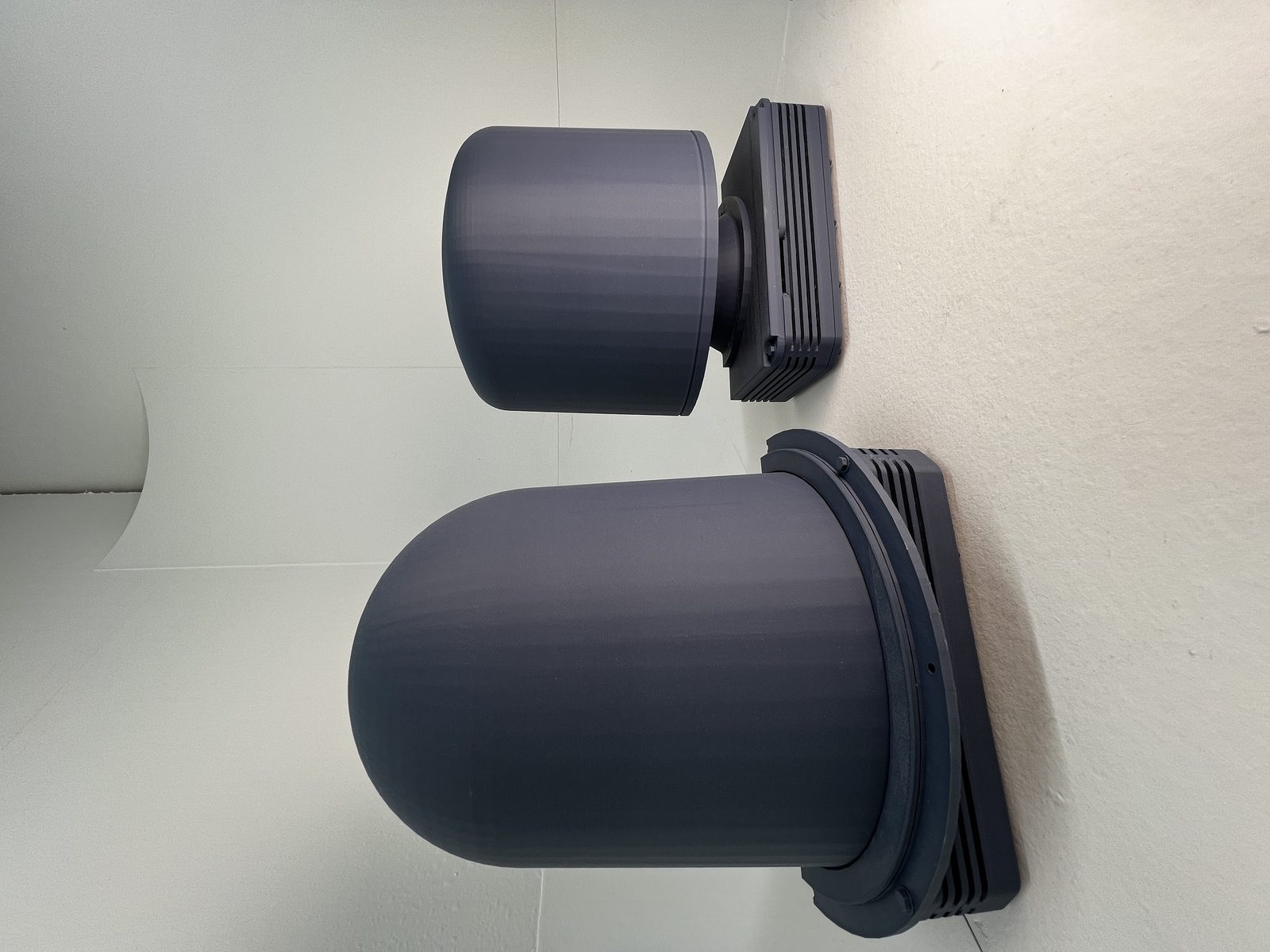
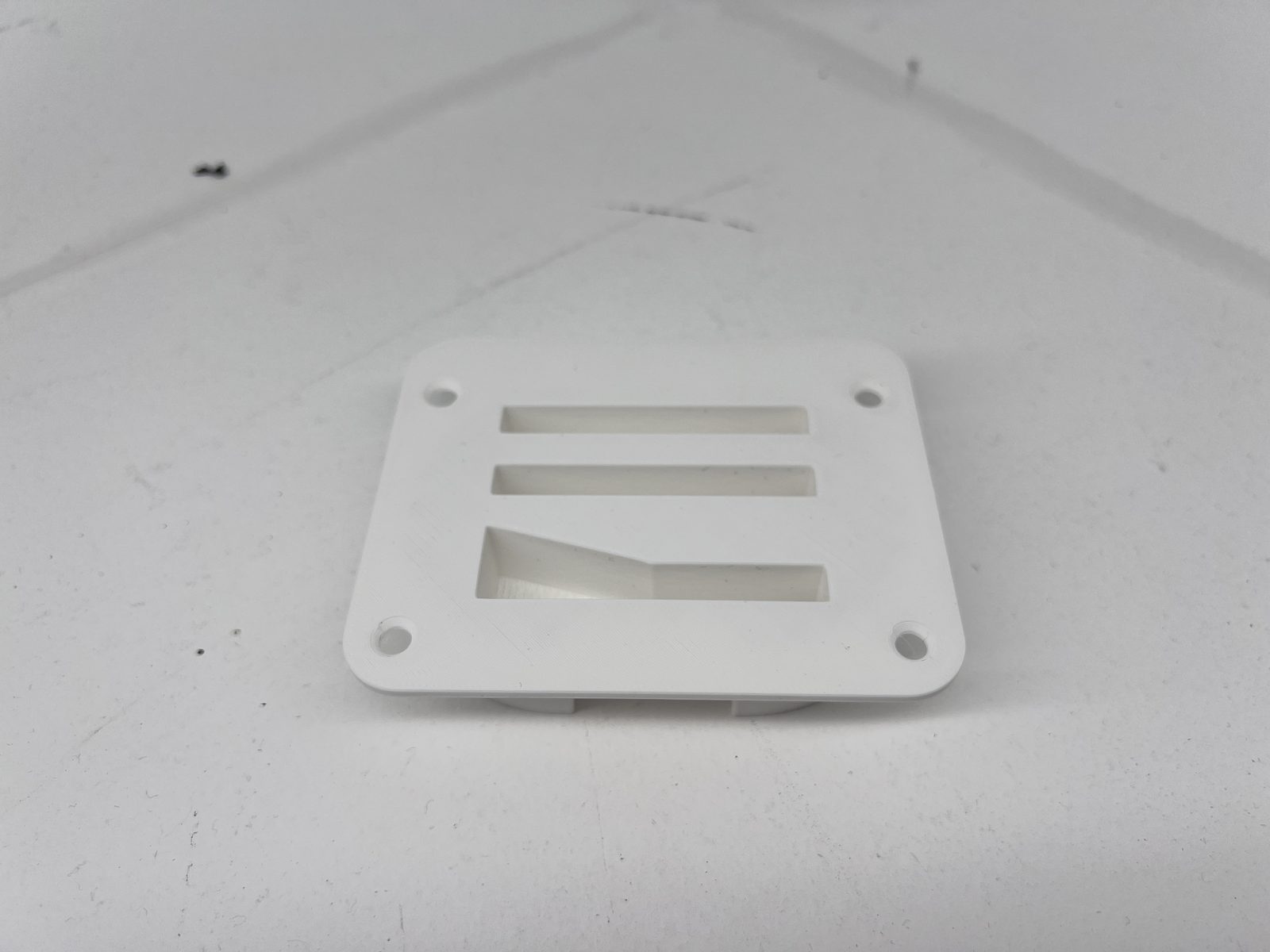
Printed in PA12-CF for an industrial client after earlier PA6-GF prints warped on the second installation cycle, the low-moisture PA12 chemistry held the louvre geometry through factory-floor temperature swings. The part that taught the client the PA6-vs-PA12 lesson this page is built on.
Discontinued gearbox housings, reprinted
Moulded PA6-GF housings that went out of production, re-engineered and printed in PA6-GF25 as direct injection-moulding replacements, 191°C HDT covered the gearbox heat-soak envelope, with no tooling bill and no MOQ.
A 100-unit batch of PA12 functional-test parts
QC'd on the first, midpoint and last unit; the client's public Google review reports every part arrived "consistent, dimensionally accurate, and ready for use straight from the box."
Rated 4.9★ from 50 Google reviews.
Nylon 3D printing FAQs
The questions engineers actually ask.
Is nylon good for 3D printing?
Yes, for functional parts it's one of the best FDM material families there is: strong, wear-resistant and chemically tolerant where PLA and PETG fall short. It makes two genuine demands. It must be printed dry, because nylon absorbs moisture from the air and wet filament prints rough and weak. And like every FDM print it's weaker across the layer lines than along them. A service that controls drying and orientation removes both problems before they reach your part.
What's the difference between PA6 and PA12 for 3D printing?
PA6 is the stronger, stiffer, more heat-tolerant polymer, our PA6-CF reaches 115.3 MPa tensile and 215°C HDT on dry moulded-specimen values. PA12 absorbs roughly half as much moisture (~1.5% vs ~3.3% at equilibrium), so it holds its dimensions and strength in humid service, where saturated PA6 loses about half its dry strength. PA612 is the copolymer between the two. Rule of thumb: PA6 for dry strength and heat, PA12 for dimensional stability, PA612 when the part needs strength and weather at once.
Is carbon-filled nylon stronger than glass-filled?
Along the print direction, usually, our PA6-CF prints at 115.3 MPa tensile XY against 90.1 MPa for PA6-GF, and carbon adds more stiffness per gram. But glass-filled PA6-GF is near-isotropic: 90.7 MPa across the layers, where PA6-CF drops to 54 MPa. It's also tougher once it's absorbed moisture, and it costs less. If the load crosses the layer lines or budget matters, glass wins. If in-plane stiffness rules the part, carbon wins.
Do you print unfilled nylon?
Our stocked range is the five filled grades on this page, carbon, glass and CNT-filled, because they cover the stiffness, heat and ESD cases engineering briefs usually need, and they print flatter than unfilled nylon. Unfilled PA12 is available on request for the jobs where ductility or impact genuinely beats stiffness: living hinges, snap-fits, cold-impact service. If that's your part, we'll say so at quote stage rather than sell you the wrong filler.
FDM or MJF/SLS nylon, which should I choose?
We print FDM, so weigh this knowing that. Choose FDM filled nylon for stiffness, carbon-filled grades reach 3,300-8,600 MPa modulus where sintered unfilled PA12 sits near 1,700, and for one-offs, small batches, larger single parts and fast turnaround. Choose MJF or SLS PA12, which we don't run in-house but can place with a UK partner on your behalf, for intricate internal geometry, near-isotropic strength and batches of 50+ where bed packing drives unit cost down. Send the load case and geometry: if powder-bed is the right answer, we'll tell you.
Why does nylon need drying before printing?
Nylon starts absorbing moisture from the air within hours of leaving a sealed bag. Printed wet, that water boils at the nozzle: the surface comes out rough and foamy, the extruded bead is full of micro-voids, and the layers bond weakly, the part is visibly and mechanically worse. We dry every nylon spool at 100°C for 10 hours per the manufacturer spec immediately before printing and run from sealed dry storage. Standard practice on every nylon job, no surcharge.
Which nylon is best for outdoor use?
PA612-CF is the one nylon in our range with a real outdoor story: the manufacturer publishes a 92% tensile-strength-retention claim after 1,000 hours of UV exposure (a product-page figure, not an ISO test), and it keeps about 90% of its strength when moisture-saturated. Honest family caveat: nylons in general yellow and embrittle under years of direct sun. For permanently outdoor cosmetic parts we'll usually point you at ASA or a 2K-topcoated print instead.
NYLON 3D PRINTING UK · PA6, PA12 & PA612 · 2-HOUR QUOTES
Got a part that should be nylon, or might be?
Send the file, a sketch or a photo with peak load, service temperature and where the part lives. Our team replies with a grade recommendation, orientation and a price or price range, engineer-reviewed, within 2 working hours.